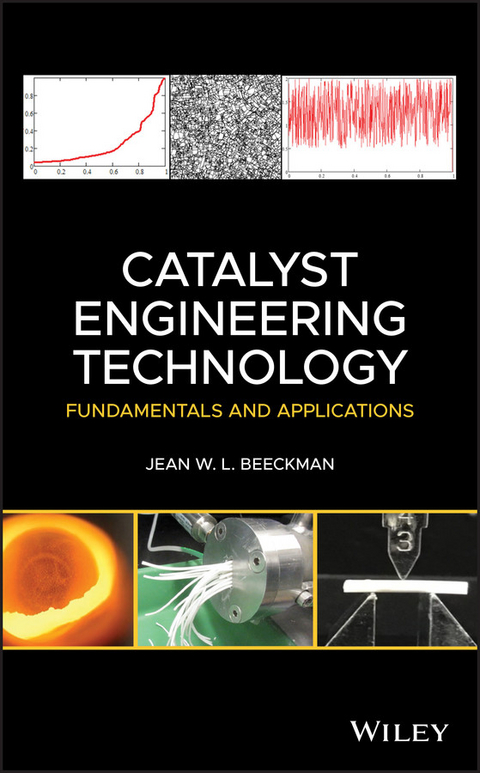
Catalyst Engineering Technology (eBook)
304 Seiten
John Wiley & Sons (Verlag)
978-1-119-63501-7 (ISBN)
JEAN W. L. BEECKMAN obtained his chemical engineering degree in 1975 and later his doctorate in 1979 at the Rijksuniversiteit Gent, Belgium. Since 2001, the author has been with ExxonMobil in Annandale, NJ. His entire career has been in the area of catalyst development, catalyst manufacturing and mathematical modeling. Jean has over 35 patents and over 25 peer reviewed technical publications.
About the Author ix
Acknowledgments xi
Foreword xiii
1 Catalyst Preparation Techniques and Equipment 1
1.1 Introduction 1
1.2 Forming of Catalysts 4
1.3 Impregnation and Drying 12
1.4 Rotary Calcination 13
1.5 From the Laboratory to a Commercial Plant 29
Nomenclature 29
References 30
2 Extrusion Technology 35
2.1 Background 35
2.2 Rheology 36
2.3 Extrusion 47
Nomenclature 57
References 59
3 The Aspect Ratio of an Extruded Catalyst: An In-depth Study 61
3.1 General 61
3.2 Introduction to Catalyst Strength and Catalyst Breakage 63
3.3 Mechanical Strength of Catalysts 67
3.4 Experimental Measurement of Mechanical Strength 76
3.5 Breakage by Collision 88
3.6 Breakage by Stress in a Fixed Bed 129
3.7 Breakage in Contiguous Equipment 145
3.8 Statistical Methods Applied to Manufacturing Materials 158
Nomenclature 159
Greek Symbols 161
Subscripts 162
References 162
4 Steady-state Diffusion and First-order Reaction in Catalyst Networks 165
4.1 Introduction 165
4.2 Classic Continuum Approach 169
4.3 The Network Approach 171
Nomenclature 270
Greek Symbols 270
References 271
Appendix 4.1 Diffusion in a simple network 272
Appendix 4.2 Property of the semi-inverse 272
Appendix 4.3 Diffusion and reaction in a simple network 273
Appendix 4.4 Matrix properties for diffusion and reaction in a simple network 274
Appendix 4.5 Perturbation in a simple network 274
Appendix 4.6 A random variable 275
Appendix 4.7 Diffusion along a string of nodes 275
Appendix 4.8 Diffusion in a rectangular strip with an equal number of nodes 276
Appendix 4.9 Diffusion in a rectangular strip with an unequal number of nodes 277
Appendix 4.10 Diffusion and first-order reaction in a very deep network of 500 layers deep and five nodes per layer 279
Appendix 4.11 Diffusion and first-order reaction 280
Index 281
| Erscheint lt. Verlag | 28.7.2020 |
|---|---|
| Sprache | englisch |
| Themenwelt | Naturwissenschaften ► Chemie ► Technische Chemie |
| Technik ► Maschinenbau | |
| Schlagworte | catalysis • Catalysis & Chemical Reaction Engineering • chemical engineering • Chemie • Chemische Verfahrenstechnik • Chemistry • Festkörpermechanik • Katalyse • Katalyse u. Chemische Reaktionstechnik • Maschinenbau • mechanical engineering • solid mechanics |
| ISBN-10 | 1-119-63501-2 / 1119635012 |
| ISBN-13 | 978-1-119-63501-7 / 9781119635017 |
| Informationen gemäß Produktsicherheitsverordnung (GPSR) | |
| Haben Sie eine Frage zum Produkt? |
 EPUB (Adobe DRM)
Kopierschutz: Adobe-DRM
Adobe-DRM ist ein Kopierschutz, der das eBook vor Mißbrauch schützen soll. Dabei wird das eBook bereits beim Download auf Ihre persönliche Adobe-ID autorisiert. Lesen können Sie das eBook dann nur auf den Geräten, welche ebenfalls auf Ihre Adobe-ID registriert sind.
Details zum Adobe-DRM
Dateiformat: EPUB (Electronic Publication)
EPUB ist ein offener Standard für eBooks und eignet sich besonders zur Darstellung von Belletristik und Sachbüchern. Der Fließtext wird dynamisch an die Display- und Schriftgröße angepasst. Auch für mobile Lesegeräte ist EPUB daher gut geeignet.
Systemvoraussetzungen:
PC/Mac: Mit einem PC oder Mac können Sie dieses eBook lesen. Sie benötigen eine
eReader: Dieses eBook kann mit (fast) allen eBook-Readern gelesen werden. Mit dem amazon-Kindle ist es aber nicht kompatibel.
Smartphone/Tablet: Egal ob Apple oder Android, dieses eBook können Sie lesen. Sie benötigen eine
Geräteliste und zusätzliche Hinweise
Buying eBooks from abroad
For tax law reasons we can sell eBooks just within Germany and Switzerland. Regrettably we cannot fulfill eBook-orders from other countries.
aus dem Bereich