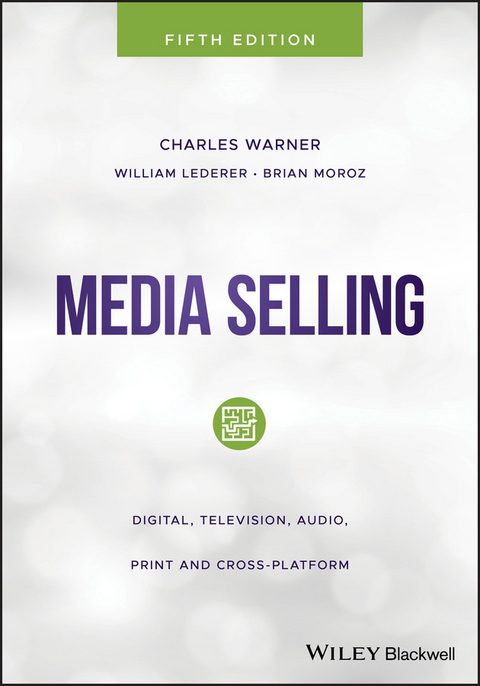
Media Selling (eBook)
John Wiley & Sons (Verlag)
978-1-119-47741-9 (ISBN)
The must-have resource for media selling in today's technology-driven environment
The revised and updated fifth edition of Media Selling is an essential guide to our technology-driven, programmatic, micro-targeted, mobile, multi-channel media ecosystem. Today, digital advertising has surpassed television as the number-one ad investment platform, and Google and Facebook dominate the digital advertising marketplace. The authors highlight the new sales processes and approaches that will give media salespeople a leg up on the competition in our post-Internet media era.
The book explores the automated programmatic buying and selling of digital ad inventory that is disrupting both media buyers and media salespeople. In addition to information on disruptive technologies in media sales, the book explores sales ethics, communication theory and listening, emotional intelligence, creating value, the principles of persuasion, sales stage management guides, and sample in-person, phone, and email sales scripts. Media Selling offers media sellers a customer-first and problem-solving sales approach. The updated fifth edition:
- Contains insight from digital experts into how 82.5% of digital ad inventory is bought and sold programmatically
- Reveals how to conduct research on Google Analytics
- Identifies how media salespeople can offer cross-platform and multi-channel solutions to prospects' advertising and marketing challenge
- Includes insights into selling and distribution of podcasts
- Includes links to downloadable case studies, presentations, and planners on the Media Selling website
- Includes an extensive Glossary of Digital Advertising terms
Written for students in communications, radio-TV, and mass communication, Media Selling is the classic work in the field. The updated edition provides an indispensable tool for learning, training, and mastering sales techniques for digital media.
CHARLES WARNER teaches in the graduate Media Management Program in the School of Media Studies at The New School, New York. He is also the Goldenson Chair Emeritus at the University of Missouri School of Journalism.
WILLIAM LEDERER is Chairman and CEO of iSOCRATES, a global leader in programmatic media planning and execution. In addition to leading global consulting and managed services teams, he teaches in the graduate Media Management Program at The New School, New York.
BRIAN MOROZ is head of one of Google's global strategy units, and previously served in Google's Agency Sales group.
CHARLES WARNER teaches in the graduate Media Management Program in the School of Media Studies at The New School, New York. He is also the Goldenson Chair Emeritus at the University of Missouri School of Journalism. WILLIAM LEDERER is Chairman and CEO of iSOCRATES, a global leader in programmatic media planning and execution. In addition to leading global consulting and managed services teams, he teaches in the graduate Media Management Program at The New School, New York. BRIAN MOROZ is head of one of Google's global strategy units, and previously served in Google's Agency Sales group.
About the Authors ix
Acknowledgments xi
Preface xiii
1 The Marketing/Media Ecology 1
Charles Warner
2 Selling in the Digital Era 15
Charles Warner
3 Sales Ethics and Transparency 47
Charles Warner
4 The AESKOPP Approach, Attitude, and Goal Setting 61
Charles Warner
5 Emotional Intelligence 81
Charles Warner
6 Effective Communication, Effective Listening, and Understanding People 91
Charles Warner
7 Influence and Creating Value 111
Charles Warner
8 The New Buying and Selling Process 139
Charles Warner
9 Prospecting and Qualifying 155
Charles Warner
10 Researching Insights and Solutions 187
Brian Moroz
11 Educating 207
Charles Warner
12 Proposing 235
Charles Warner
13 Negotiating and Closing 245
Charles Warner
14 Customer Success 293
Charles Warner
15 Marketing 305
Charles Warner
16 Advertising 327
Charles Warner
17 Programmatic Marketing and Advertising 353
William A. Lederer
18 Measuring Advertising 375
William A. Lederer
19 Selling Digital and Cross-Platform Advertising 391
Charles Warner
20 Google and Search 415
Brian Moroz
21 Facebook and Social Media 425
Charles Warner
22 Television 457
Charles Warner
23 Print and Out of Home 475
Charles Warner
24 Audio 495
Charles Warner
25 Time Management 513
Charles Warner
Appendix: Digital Advertising Glossary 523
Index 535
1
The Marketing/Media Ecology
Charles Warner
- What Is Marketing?
- The Internet and Ad Words: Disrupting Marketing and Advertising
- Customers Versus Consumers
- What Is Advertising?
- The Media
- Hypocrites Not Allowed
Anyone taking a moment to ponder the $2 trillion marketing and advertising sector of the economy “can’t avoid the inescapable truth that capitalism could not exist without marketing,” Ken Auletta writes in Frenemies: The Epic Disruption of the Ad Business (and Everything Else).1 The marketing process is vital to the vigor of the American economy, and the media are integral elements in that marketing process and, thus, to the economy’s health and stability. Consumer demand is what drives the economy, and it is marketing that fuels demand. Advertising is a major component of marketing, and it is through the media that consumers and businesses receive advertising messages about products and services. Also, “in the United States each dollar spent in advertising alone spawned nineteen dollars in sales and supported sixty‐seven jobs across many industries…”2
Furthermore, advertising keeps a brand healthy and growing in a highly competitive marketplace. In a March 4, 2019 issue of Ad Age an article titled “The end of austerity” detailed how “The stunning tumble of Kraft Heinz has caused pain for investors … after Kraft Heinz took a $15.4 billion write‐down of its assets.”3 The article goes on to report how Kraft Heinz owner, Brazilian investment firm 3G, went into a cost‐cutting mode and used a zero‐based budgeting process to cut advertising investments drastically. After the Kraft Heinz huge write‐down on assets, a JP Morgan analyst said, “Investors for years have asked if 3G’s extreme belt‐tightening model ultimately would result in brand equity erosion.”4 So not only is advertising a major element in the fuel that drives consumer demand, lack of sufficient advertising investment can stunt a brand’s growth.
If any one of the three elements (marketing, advertising, and the media) is not healthy, the other two cannot thrive. This chapter will examine the ecosystem‐like interdependent relationships among marketing, advertising, and the media and how the Internet disrupted that ecosystem.
What Is Marketing?
In his influential book, The Practice of Management, Peter Drucker, “the Father of Modern Management,” presented and answered a series of simple, straightforward questions. He asked, “What is a business?” The most common answer, “An organization to make a profit,” is not only false, but it is also irrelevant to Drucker. “There is only one valid definition of business purpose: to create a customer,” Drucker wrote.
Drucker pointed out that businesses create markets for products and services: “There may have been no want at all until business action created it – by advertising, by salesmanship, or by inventing something new. In every case it is a business action that creates a customer.” Furthermore, he said, “What a business thinks it produces is not of first importance – especially not to the future of the business and to its success.” “What the customer thinks he is buying, what he considers ‘value,’ is decisive – it determines what a business is, what it produces and whether it will prosper.” Finally, Drucker said, “Because it is its purpose to create a customer, any business enterprise has two – and only these two – basic functions: marketing and innovation.”5
Notice that Drucker did not mention production, suppliers, or distribution, but only customers. That is what marketing is – a customer‐focused business approach.
A production‐focused business first produces goods and then tries to sell them. In the book Marketing 3.0: From Products to Customers to Human Spirit, Philip Kotler and his two co‐authors refer to a product‐focused approach as Marketing 1.0.6 A customer‐focused business approach produces goods or services that it knows will sell based on market research and data that reveal customers’ aspirations, wants, needs, tastes, and preferences. In Marketing 4.0: Moving from Traditional to Digital, Kotler, who is often referred to as “the father of modern marketing,” and his co‐authors refer to a customer‐focused approach as Marketing 2.0.7 In Chapter 15: Marketing and Chapter 16: Advertising, you will learn more about how marketing has further changed from Marketing 1.0 (product focused), to Marketing 2.0 (customer focused), to Marketing 3.0 (human centricity), and to Marketing 4.0 (customer collaboration), but for now, we will concentrate on customer‐focused Marketing 2.0.
Another leading theorist, former Harvard Business School Professor Theodore Levitt, wrote an article in 1960 titled “Marketing myopia” that is perhaps the most influential single article on marketing ever published. Levitt claims that the railroads went out of business “not because the need [for passenger and freight transportation] was filled by others … but because it was not filled by the railroads themselves. They let others take customers away from them because they assumed themselves to be in the railroad business rather than in the transportation business.”8 In other words, the railroads failed because they did not know how to create and keep customers; they were not marketing‐oriented. Where would makers of buggy whips be today if they had decided they were in the vehicle acceleration business or in the transportation accessory business instead of being in the buggy whip business?
As a result of the customer‐focused, marketing approach espoused by Drucker, Levitt and other leading management and marketing theorists, in the 1960s, 1970s, and 1980s many companies asked themselves the question, “What business are we in?” and subsequently changed their direction to focus more on marketing and customers rather than on products. After the Internet became widely adopted by consumers in the late 1990s, entrepreneurs such as Larry Page and Sergey Brin (Google), Mark Zuckerberg (Facebook), and Jeff Bezos (Amazon) asked “What business do our customers want us to be in?”. Existing businesses that survived after the Internet disruption had a heightened sensitivity to customers and changed the old‐fashioned outlook of, “Let’s produce this product because we’ve discovered how to make it.” The Internet opened the door to a new digital age in human history, and from a business perspective, successful businesses and entrepreneurs in the digital age put the preferences, wants, and needs of customers and consumers first as these customer‐first businesses shot past traditional companies in market value.
In today’s digital‐age economy consumers rule because the availability of information on the web has switched the information asymmetry that existed in favor of marketers prior to the Internet to be in favor of consumers in the post‐Internet, digital era. Before the Internet and search, someone who wanted to buy a car had to depend on car dealers and their salespeople to provide information about a car’s features, benefits, condition, and price. The information asymmetry favored the salesperson.
Today, consumers can search for the information about the make, model, features, benefits, condition, and price of a car on the Internet and can be armed with thorough information before walking into a dealership, often with more information than a dealer salesperson has. Therefore the information asymmetry has switched to the consumer in the digital era. Any company that does not recognize that customers now rule and put them on a pedestal, wow them, and delight them with an excellent experience will disappear from the business landscape.9
The Internet and Ad Words: Disrupting Marketing and Advertising
The Internet completely disrupted marketing. It switched the focus of marketing from mass marketing in the mass media to marketing to one individual at a time in customized, personalized, and fragmented media. In addition, the Internet allowed marketers to appeal to a narrow market of just one person out at the end of the long tail; to sell less of more, as Chris Anderson writes in The Long Tail.10
Not only did the Internet allow marketing to be more precise and more highly targeted, it also allowed consumers to discover a new product or service, to get more information about the product in the moment, without going to a retail store or dealership, and, probably most important, it allowed consumers to purchase a product online without going to a retail checkout counter. Thus, elements in the old value chain were upended; distribution costs and transaction costs were reduced to virtually zero – an enormous disruption.
Figure 1.1 The value chain
Let’s look at the steps in the value chain that companies had to go through in order to be successful:
The top step in each box (in gray, no parentheses) is the original one...
| Erscheint lt. Verlag | 17.7.2020 |
|---|---|
| Sprache | englisch |
| Themenwelt | Sozialwissenschaften ► Kommunikation / Medien ► Allgemeines / Lexika |
| Sozialwissenschaften ► Kommunikation / Medien ► Medienwissenschaft | |
| Sozialwissenschaften ► Politik / Verwaltung | |
| Technik ► Elektrotechnik / Energietechnik | |
| Wirtschaft ► Betriebswirtschaft / Management ► Marketing / Vertrieb | |
| Schlagworte | Advertising • Business & Management • Communication & Media Studies • Journalismus • Kommunikation u. Medienforschung • <p>Selling media • media analytics</p> • media selling ethics • Media Studies • Medien • Medienforschung • negotiating media buys • researching media buys • selling audio media • selling digital advertising • selling digital media • selling media cross-platform • selling print media • selling television media • Werbung • Wirtschaft u. Management |
| ISBN-10 | 1-119-47741-7 / 1119477417 |
| ISBN-13 | 978-1-119-47741-9 / 9781119477419 |
| Informationen gemäß Produktsicherheitsverordnung (GPSR) | |
| Haben Sie eine Frage zum Produkt? |
 EPUB (Adobe DRM)
Kopierschutz: Adobe-DRM
Adobe-DRM ist ein Kopierschutz, der das eBook vor Mißbrauch schützen soll. Dabei wird das eBook bereits beim Download auf Ihre persönliche Adobe-ID autorisiert. Lesen können Sie das eBook dann nur auf den Geräten, welche ebenfalls auf Ihre Adobe-ID registriert sind.
Details zum Adobe-DRM
Dateiformat: EPUB (Electronic Publication)
EPUB ist ein offener Standard für eBooks und eignet sich besonders zur Darstellung von Belletristik und Sachbüchern. Der Fließtext wird dynamisch an die Display- und Schriftgröße angepasst. Auch für mobile Lesegeräte ist EPUB daher gut geeignet.
Systemvoraussetzungen:
PC/Mac: Mit einem PC oder Mac können Sie dieses eBook lesen. Sie benötigen eine
eReader: Dieses eBook kann mit (fast) allen eBook-Readern gelesen werden. Mit dem amazon-Kindle ist es aber nicht kompatibel.
Smartphone/Tablet: Egal ob Apple oder Android, dieses eBook können Sie lesen. Sie benötigen eine
Geräteliste und zusätzliche Hinweise
Buying eBooks from abroad
For tax law reasons we can sell eBooks just within Germany and Switzerland. Regrettably we cannot fulfill eBook-orders from other countries.
aus dem Bereich