John Houbolt (eBook)
374 Seiten
Purdue University Press (Verlag)
978-1-55753-948-9 (ISBN)
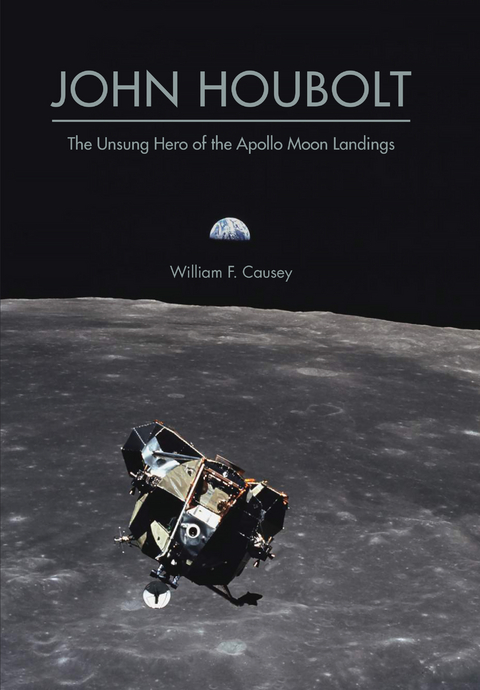
In May 1961, President Kennedy announced that the United States would attempt to land a man on the moon and return him safely to the earth before the end of that decade. Yet NASA did not have a specific plan for how to accomplish that goal. Over the next fourteen months, NASA vigorously debated several options. At first the consensus was to send one big rocket with several astronauts to the moon, land and explore, and then take off and return the astronauts to earth in the same vehicle. Another idea involved launching several smaller Saturn V rockets into the earth orbit, where a lander would be assembled and fueled before sending the crew to the moon.
But it was a small group of engineers led by John C. Houbolt who came up with the plan that propelled human beings to the moon and back—not only safely, but faster, cheaper, and more reliably. Houbolt and his colleagues called it “lunar orbit rendezvous,” or “LOR.” At first the LOR idea was ignored, then it was criticized, and then finally dismissed by many senior NASA officials.
Nevertheless, the group, under Houbolt’s leadership, continued to press the LOR idea, arguing that it was the only way to get men to the moon and back by President Kennedy’s deadline. Houbolt persisted, risking his career in the face of overwhelming opposition. This is the story of how John Houbolt convinced NASA to adopt the plan that made history.
William F. Causey has followed the space program since 1961, when he watched in his elementary school gymnasium astronaut as Alan Shepard became the first American in space. Trained as a lawyer who started his legal career on Capitol Hill, Causey later worked at the United States Department of Justice, the American Red Cross, and the District of Columbia Office of the Attorney General. He taught for more than three decades at the Georgetown University Law Center. Causey also served on numerous historical, educational, and literary society boards, including the Board of Trustees of American University, the Board of Directors of the PEN/Faulkner Foundation, and the Historical Society of the District of Columbia Circuit. Now retired, Causey serves as a docent at the National Air and Space Museum, where he has met and talked with dozens of astronauts, engineers, and managers of America's space effort. Causey and his wife, Sally, reside in Washington, DC.
Contents
Abbreviations
Author’s Note
Prologue
PART I: Beginnings
CHAPTER 1: A Young Engineer
CHAPTER 2: Evolution of an Agency
CHAPTER 3: The Space Task Group
CHAPTER 4: Predicting the Future
PART II: Ideas
CHAPTER 5: From the Earth to the Moon
CHAPTER 6: More Committees, Groups, and Panels
CHAPTER 7: Parking Orbit
CHAPTER 8: Mode Discussions
CHAPTER 9: A National Commitment
PART III: Debate
CHAPTER 10: The “Admiral’s Page” and a Letter
CHAPTER 11: More Committees, New Issues
CHAPTER 12: “All That Nonsense”
CHAPTER 13: One Step Forward, Two Steps Back
CHAPTER 14: A New Way of Doing Things
CHAPTER 15: The Lunar Crasher
CHAPTER 16: A Letter From a Crank
CHAPTER 17: A Fifth Engine and a New Spacecraft
CHAPTER 18: Time for Serious Comparisons
CHAPTER 19: Almost There
CHAPTER 20: Charlie Frick’s Road Show
CHAPTER 21: Scratching Backs
PART IV: Decision
CHAPTER 22: A Surprise Announcement
CHAPTER 23: Not There Yet
CHAPTER 24: “An Act of Faith and Vision”
Epilogue
Acknowledgments
Notes
Bibliography
Index
| Erscheint lt. Verlag | 15.3.2020 |
|---|---|
| Reihe/Serie | Purdue Studies in Aeronautics and Astronautics | Purdue Studies in Aeronautics and Astronautics |
| Zusatzinfo | 29 b/w photographs, 2 b/w figures |
| Verlagsort | West Lafayette |
| Sprache | englisch |
| Themenwelt | Literatur ► Biografien / Erfahrungsberichte |
| Literatur ► Romane / Erzählungen | |
| Sachbuch/Ratgeber ► Geschichte / Politik ► 20. Jahrhundert bis 1945 | |
| Natur / Technik ► Fahrzeuge / Flugzeuge / Schiffe ► Luftfahrt / Raumfahrt | |
| Geschichte ► Allgemeine Geschichte ► Neuzeit (bis 1918) | |
| Geisteswissenschaften ► Geschichte ► Regional- / Ländergeschichte | |
| Naturwissenschaften ► Geowissenschaften ► Geografie / Kartografie | |
| Technik ► Fahrzeugbau / Schiffbau | |
| Technik ► Luft- / Raumfahrttechnik | |
| Schlagworte | Apollo 11 • direct ascent mode • earth orbit rendezvous • LOR • Lunar • lunar orbit rendezvous • Moon landing • Nasa • nova rocket • Saturn V • space flight • Space race • Space Travel |
| ISBN-10 | 1-55753-948-0 / 1557539480 |
| ISBN-13 | 978-1-55753-948-9 / 9781557539489 |
| Informationen gemäß Produktsicherheitsverordnung (GPSR) | |
| Haben Sie eine Frage zum Produkt? |
 EPUB (Adobe DRM)
Kopierschutz: Adobe-DRM
Adobe-DRM ist ein Kopierschutz, der das eBook vor Mißbrauch schützen soll. Dabei wird das eBook bereits beim Download auf Ihre persönliche Adobe-ID autorisiert. Lesen können Sie das eBook dann nur auf den Geräten, welche ebenfalls auf Ihre Adobe-ID registriert sind.
Details zum Adobe-DRM
Dateiformat: EPUB (Electronic Publication)
EPUB ist ein offener Standard für eBooks und eignet sich besonders zur Darstellung von Belletristik und Sachbüchern. Der Fließtext wird dynamisch an die Display- und Schriftgröße angepasst. Auch für mobile Lesegeräte ist EPUB daher gut geeignet.
Systemvoraussetzungen:
PC/Mac: Mit einem PC oder Mac können Sie dieses eBook lesen. Sie benötigen eine
eReader: Dieses eBook kann mit (fast) allen eBook-Readern gelesen werden. Mit dem amazon-Kindle ist es aber nicht kompatibel.
Smartphone/Tablet: Egal ob Apple oder Android, dieses eBook können Sie lesen. Sie benötigen eine
Geräteliste und zusätzliche Hinweise
Buying eBooks from abroad
For tax law reasons we can sell eBooks just within Germany and Switzerland. Regrettably we cannot fulfill eBook-orders from other countries.
aus dem Bereich