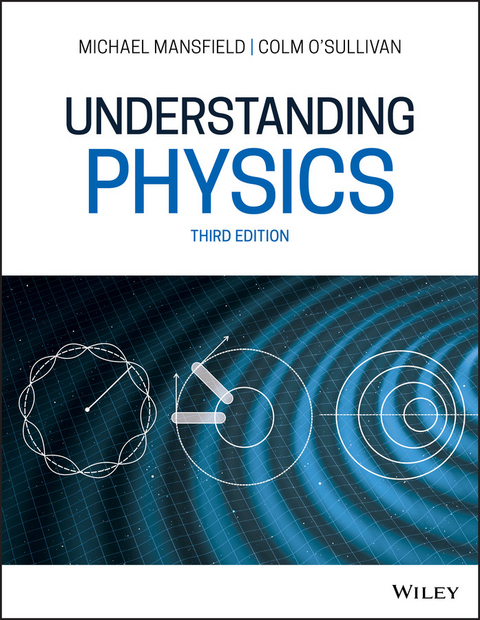
Understanding Physics (eBook)
John Wiley & Sons (Verlag)
978-1-119-51952-2 (ISBN)
An updated and thoroughly revised third edition of the foundational text offering an introduction to physics with a comprehensive interactive website
The revised and updated third edition of Understanding Physics presents a comprehensive introduction to college-level physics. Written with today's students in mind, this compact text covers the core material required within an introductory course in a clear and engaging way. The authors - noted experts on the topic - offer an understanding of the physical universe and present the mathematical tools used in physics.
The book covers all the material required in an introductory physics course. Each topic is introduced from first principles so that the text is suitable for students without a prior background in physics. At the same time the book is designed to enable students to proceed easily to subsequent courses in physics and may be used to support such courses. Relativity and quantum mechanics are introduced at an earlier stage than is usually found in introductory textbooks and are integrated with the more 'classical' material from which they have evolved.
Worked examples and links to problems, designed to be both illustrative and challenging, are included throughout. The links to over 600 problems and their solutions, as well as links to more advanced sections, interactive problems, simulations and videos may be made by typing in the URL's which are noted throughout the text or by scanning the micro QR codes given alongside the URL's, see: http://up.ucc.ie
This new edition of this essential text:
- Offers an introduction to the principles for each topic presented
- Presents a comprehensive yet concise introduction to physics covering a wide range of material
- Features a revised treatment of electromagnetism, specifically the more detailed treatment of electric and magnetic materials
- Puts emphasis on the relationship between microscopic and macroscopic perspectives
- Is structured as a foundation course for undergraduate students in physics, materials science and engineering
- Has been rewritten to conform with the revised definitions of SI base units which came into force in May 2019
Written for first year physics students, the revised and updated third edition of Understanding Physics offers a foundation text and interactive website for undergraduate students in physics, materials science and engineering.
MICHAEL MANSFIELD, PHD, is Emeritus Professor in the Department of Physics, University College Cork, Ireland.
COLM O'SULLIVAN, PHD, is Emeritus Professor in the Physics Department, University College Cork, Ireland.
An updated and thoroughly revised third edition of the foundational text offering an introduction to physics with a comprehensive interactive website The revised and updated third edition of Understanding Physics presents a comprehensive introduction to college-level physics. Written with today's students in mind, this compact text covers the core material required within an introductory course in a clear and engaging way. The authors noted experts on the topic offer an understanding of the physical universe and present the mathematical tools used in physics. The book covers all the material required in an introductory physics course. Each topic is introduced from first principles so that the text is suitable for students without a prior background in physics. At the same time the book is designed to enable students to proceed easily to subsequent courses in physics and may be used to support such courses. Relativity and quantum mechanics are introduced at an earlier stage than is usually found in introductory textbooks and are integrated with the more 'classical' material from which they have evolved. Worked examples and links to problems, designed to be both illustrative and challenging, are included throughout. The links to over 600 problems and their solutions, as well as links to more advanced sections, interactive problems, simulations and videos may be made by typing in the URL s which are noted throughout the text or by scanning the micro QR codes given alongside the URL s, see: http://up.ucc.ieThis new edition of this essential text: Offers an introduction to the principles for each topic presented Presents a comprehensive yet concise introduction to physics covering a wide range of material Features a revised treatment of electromagnetism, specifically the more detailed treatment of electric and magnetic materials Puts emphasis on the relationship between microscopic and macroscopic perspectives Is structured as a foundation course for undergraduate students in physics, materials science and engineering Has been rewritten to conform with the revised definitions of SI base units which came into force in May 2019 Written for first year physics students, the revised and updated third edition of Understanding Physics offers a foundation text and interactive website for undergraduate students in physics, materials science and engineering.
MICHAEL MANSFIELD, PHD, is Emeritus Professor in the Department of Physics, University College Cork, Ireland. COLM O'SULLIVAN, PHD, is Emeritus Professor in the Physics Department, University College Cork, Ireland.
Preface to Third Edition
Goals and objectives
Understanding Physics is written primarily for students who are taking their first course in physics at university level. While it is anticipated that many readers will have some previous knowledge of physics or of general science, each topic is introduced from first principles so that the text is suitable for students without any prior background in physics. The book has been written to support most standard first year undergraduate university physics courses (and often beyond the first year) and can serve as an introductory text for both prospective physics majors and other students who will need to apply the principles and techniques of basic physics in subsequent courses. A principal aim of this book is to give the reader the foundation required to proceed smoothly to intermediate level courses in physics and engineering and to courses in the chemical, computer, materials, and earth sciences, all of which require a sound knowledge of basic physics.
Students with some previous knowledge of physics will find that they are already familiar with many of the topics covered in the early sections. These readers should note, however, that the treatment of these topics in Understanding Physics often differs from that given in school textbooks and is designed to lay the foundations for the treatment of new and more advanced topics. As authors, one of our aims is to integrate school physics more closely to that studied at university, encouraging students to appreciate the relevance of physics previously studied and to integrate it with the material encountered at university. For these reasons we hope that students with a previous knowledge of physics will take the opportunity to refresh and deepen their understanding of topics which they may regard as familiar.
Some knowledge of simple algebra, geometry, and trigonometry is assumed but differential and integral calculus, vector analysis, and other more advanced mathematical methods are introduced within the text as the need arises and are presented in the context of the physical problems which they are used to analyse. Historically, many mathematical techniques were developed specifically to address problems in physics and these can often be grasped more easily when applied to a relevant physical situation than when presented as an otherwise abstract mathematical concept. These mathematical asides are indicated throughout the text by a grey background and it is hoped that by studying these short sections, the reader will gain some insight into both the mathematical techniques involved and the physics to which the techniques are applied.
The mathematical asides, together with Appendix A (Mathematical Rules and Formulas), cannot, however, substitute for a formal course in mathematical methods, but rather they could be considered a mathematical ‘survival kit’ for the study of introductory physics. It is hoped that most readers will either have already taken or be studying an introductory mathematics course. In reality the total amount of mathematics required is neither large nor particularly demanding.
Approach
It is no longer credible to describe the discoveries and developments made during the early years of the twentieth century as ‘modern physics’. This is not to deny the radical and revolutionary nature of these developments but rather is a recognition that they have long since become a part of mainstream physics. Quantum mechanics, relativity, and our picture of matter at the subatomic level will surely form part of the ‘classical’ tradition of twenty‐first century physicists. On the other hand, the discoveries of the seventeenth, eighteenth, and nineteenth centuries have lost none of their importance. The majority of everyday experiences of the material world can be understood in a fully satisfactory manner in terms of classical physics. Indeed attempts to explain such phenomena in the language of twentieth century physics, while possible in principle, tend to be unnecessarily complicated and often confusing.
In Understanding Physics, ‘modern’ (twentieth century) topics are introduced at an earlier stage than is usually found in introductory textbooks and are integrated with the more ‘classical’ material from which they have evolved. Although many of the concepts which are basic to twentieth century physics are relatively easy to represent mathematically, they are not as intuitive as those of classical physics, particularly for students with an extensive previous acquaintance with ‘classical’ concepts. This book aims to encourage students to develop an intuition for relativistic and quantum concepts at as early a stage as is practicable. However, if instructors prefer to introduce relativity (Chapter 9) and quantum physics (Chapter 14) at a later stage, their introduction may be delayed until after Chapter 23.
Understanding Physics has been kept to a compact format in order to emphasise, in a fully rigorous manner, the essential unity of physics. At each stage new topics are carefully integrated with previous material. Throughout the text references are given to other sources where more detailed discussions of particular topics or applications may be found. In order to avoid breaking the flow and unity of the material within chapters, worked examples are placed at the end of each chapter. Indications are given throughout the text as to when a particular worked example might be studied.
The internationally agreed system of units (SI) is now adopted almost universally in science and engineering and is used uncompromisingly in this text. In addition, we have adhered rigorously to the recommendations of the International Union of Pure and Applied Physics (IUPAP) on symbols and nomenclature (Cohen and Giacomo, 1987). As noted below, this edition of Understanding Physics has been rewritten to conform with the revision of the SI which came into force in May 2019.
The text takes a reflective approach towards the scientific method at all stages – that is, while learning the fundamentals of physics the student should also become familiar with the scientific method. In keeping with the title of the text, emphasis is placed on understanding of and insight into the material presented. The book therefore seeks not merely to describe the discoveries and the models of physics but also, in the process, to familiarise readers with the skills and techniques which been have developed to analyse natural phenomena, skills and techniques which they can look forward to applying themselves. This book does not seek to reveal and explain all the mysteries of the physical universe but, instead, lays the foundations on which readers can build and (perhaps more importantly) encourages and equips readers to explore further.
Structure
Chapter 1 starts with a short overview of the way in which physics today describes the material universe, from the very smallest building blocks of matter up to large scale bulk materials. It is a remarkable fact that the same basic principles seem to apply over the full range of distance scales – from sub‐nuclear to inter‐galactic. The physical principles encountered in subsequent chapters are applied to systems on all of these scales, as the need arises. The basic ideas of calculus are introduced in Chapter 2 in the context of the description of motion in one dimension; readers with a good prior knowledge of this material may wish to skip this chapter, although such readers might find it profitable to use the chapter to refresh their memories.
Chapters 3 to 7 introduce the main themes of classical dynamics. This is followed by an introduction to relative motion (Chapter 8), which is an essential prerequisite to the study of the special theory of relativity (Chapter 9). Chapters 10 to 12, deal with the mechanical and thermal behaviour of matter. A sound knowledge of wave motion (Chapter 13), a very important part of physics in its own right, is essential for a proper understanding of quantum mechanics (Chapter 14). The seven subsequent chapters (15 to 21) cover the main aspects of classical electromagnetism and its application to wave and geometrical optics is covered in Chapters 22 and 23.
The final four chapters (24 to 27) – on atomic physics, on electrons in solids, on semiconductors and on nuclear and particle physics – are a little more specialised and detailed than the others. Depending on the subjects which the reader plans to pursue subsequently, significant amounts of all or some of these chapters might well be omitted.
Changes in the third edition
- This edition has been rewritten to conform with the revision of the SI which came into force in May 2019. In the revised system definitions are achieved by adopting fixed numerical values for certain fundamental constants of nature (see Appendix D for details).
- The electromagnetism chapters have been reorganised to emphasise the integration of the various topics into a view of physics as a unified whole. Particular emphasis is placed on the use of the concept of flux (and Gauss's law) as a basis for the analyses of gravitation, electricity and magnetism.
- More advanced sections, which were indicated by a blue background in previous editions may now be accessed through links to the Understanding Physics Website (described below). Problems are also accessed through the Website.
- Numerous detailed improvements have been made...
| Erscheint lt. Verlag | 23.6.2020 |
|---|---|
| Sprache | englisch |
| Themenwelt | Naturwissenschaften ► Physik / Astronomie ► Allgemeines / Lexika |
| Technik ► Elektrotechnik / Energietechnik | |
| Technik ► Maschinenbau | |
| Schlagworte | analysis of physics • Applications of Physics • data and physics • dynamics of physics • Electrical & Electronics Engineering • Elektrotechnik • Elektrotechnik u. Elektronik • Fundamentals of Physics • Guide to Understanding Physics • mathematical examples of physics • mathematical tools of physics • Nanophysics • Nanophysik • Nanotechnologie • nanotechnology • Physics • Physik • text on understanding physics |
| ISBN-10 | 1-119-51952-7 / 1119519527 |
| ISBN-13 | 978-1-119-51952-2 / 9781119519522 |
| Informationen gemäß Produktsicherheitsverordnung (GPSR) | |
| Haben Sie eine Frage zum Produkt? |
 EPUB (Adobe DRM)
Kopierschutz: Adobe-DRM
Adobe-DRM ist ein Kopierschutz, der das eBook vor Mißbrauch schützen soll. Dabei wird das eBook bereits beim Download auf Ihre persönliche Adobe-ID autorisiert. Lesen können Sie das eBook dann nur auf den Geräten, welche ebenfalls auf Ihre Adobe-ID registriert sind.
Details zum Adobe-DRM
Dateiformat: EPUB (Electronic Publication)
EPUB ist ein offener Standard für eBooks und eignet sich besonders zur Darstellung von Belletristik und Sachbüchern. Der Fließtext wird dynamisch an die Display- und Schriftgröße angepasst. Auch für mobile Lesegeräte ist EPUB daher gut geeignet.
Systemvoraussetzungen:
PC/Mac: Mit einem PC oder Mac können Sie dieses eBook lesen. Sie benötigen eine
eReader: Dieses eBook kann mit (fast) allen eBook-Readern gelesen werden. Mit dem amazon-Kindle ist es aber nicht kompatibel.
Smartphone/Tablet: Egal ob Apple oder Android, dieses eBook können Sie lesen. Sie benötigen eine
Geräteliste und zusätzliche Hinweise
Buying eBooks from abroad
For tax law reasons we can sell eBooks just within Germany and Switzerland. Regrettably we cannot fulfill eBook-orders from other countries.
aus dem Bereich