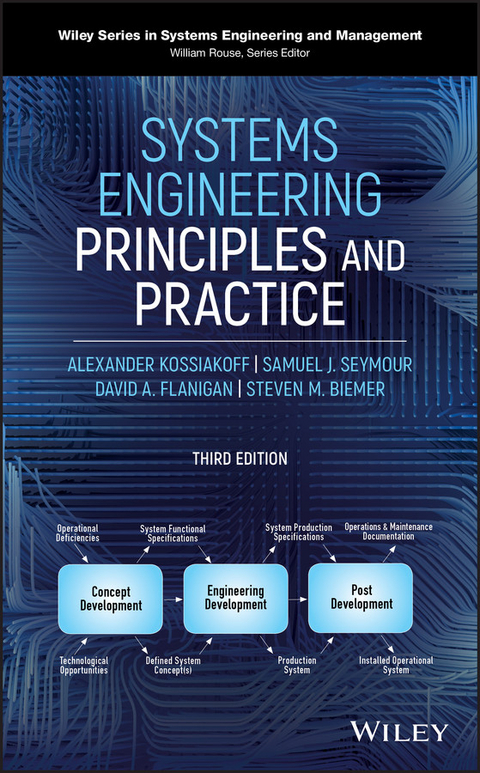
Systems Engineering Principles and Practice (eBook)
John Wiley & Sons (Verlag)
978-1-119-51670-5 (ISBN)
A comprehensive and interdisciplinary guide to systems engineering
Systems Engineering: Principles and Practice, 3rd Edition is the leading interdisciplinary reference for systems engineers. The up-to-date third edition provides readers with discussions of model-based systems engineering, requirements analysis, engineering design, and software design. Freshly updated governmental and commercial standards, architectures, and processes are covered in-depth. The book includes newly updated topics on:
- Risk
- Prototyping
- Modeling and simulation
- Software/computer systems engineering
Examples and exercises appear throughout the text, allowing the reader to gauge their level of retention and learning. Systems Engineering: Principles and Practice was and remains the standard textbook used worldwide for the study of traditional systems engineering. The material is organized in a manner that allows for quick absorption of industry best practices and methods.
Throughout the book, best practices and relevant alternatives are discussed and compared, encouraging the reader to think through various methods like a practicing systems engineer.
ALEXANDER KOSSIAKOFF (deceased) was a former Director and Chief Scientist of Johns Hopkins University Applied Physics Laboratory, and Program Chair of the MS program in Systems Engineering and Technical Management at Johns Hopkins University Whiting School of Engineering.
SAMUEL J. SEYMOUR, PHD, (retired) former Systems Engineering Program Vice Chair, Johns Hopkins University Whiting School of Engineering. He served as Systems Engineering Vice Chair under Professor Kossiakoff for over 15 years and was the lead author of the Second Edition.
DAVID A. FLANIGAN, PHD, is the Systems Engineering Program Vice Chair at Johns Hopkins University Whiting School of Engineering.
STEVEN M. BIEMER is a Professor at Johns Hopkins University Whiting School of Engineering where he teaches Systems Engineering courses. Professor Biemer assisted Professor Kossiakoff in developing the first edition of this book.
ALEXANDER KOSSIAKOFF (deceased) was a former Director and Chief Scientist of Johns Hopkins University Applied Physics Laboratory, and Program Chair of the MS program in Systems Engineering and Technical Management at Johns Hopkins University Whiting School of Engineering. SAMUEL J. SEYMOUR, PHD, (retired) former Systems Engineering Program Vice Chair, Johns Hopkins University Whiting School of Engineering. He served as Systems Engineering Vice Chair under Professor Kossiakoff for over 15 years and was the lead author of the Second Edition. DAVID A. FLANIGAN, PHD, is the Systems Engineering Program Vice Chair at Johns Hopkins University Whiting School of Engineering. STEVEN M. BIEMER is a Professor at Johns Hopkins University Whiting School of Engineering where he teaches Systems Engineering courses. Professor Biemer assisted Professor Kossiakoff in developing the first edition of this book.
LIST OF ILLUSTRATIONS
| 1‐1 | The ideal missile design from the viewpoint of various specialists |
| 1‐2 | Systems engineering principles and practice |
| 1‐3 | Systems engineering |
| 1‐4 | Examples of systems engineering components |
| 1‐5 | Examples of systems engineering approaches |
| 1‐6 | Career opportunities and growth |
| 1‐7 | Systems engineering career elements derived from quality work experiences |
| 1‐8 | Components of employer development of systems engineers |
| 1‐9 | “T” model for systems engineer career development |
| 2‐1 | Knowledge domains of systems engineer and design specialist |
| 2‐2 | Context diagram |
| 2‐3 | Context diagram for an automobile |
| 2‐4 | Environments of a passenger airliner |
| 2‐5 | Functional interactions and physical interfaces |
| 2‐6 | Pyramid of system hierarchy |
| 3‐1 | DoD system life cycle model |
| 3‐2 | System life cycle model |
| 3‐3 | Principal stages in system life cycle |
| 3‐4 | Concept development phases of system life cycle |
| 3‐5 | Engineering development phases in system life cycle |
| 3‐6 | Principal Participants in Typical Aerospace System Development |
| 3‐7 | Systems engineering method’s top‐level flow diagram |
| 3‐8 | Systems engineering method flow diagram |
| 3‐9 | Spiral model of the system life cycle |
| 4‐1 | Systems engineering as a part of project management |
| 4‐2 | System product WBS partial breakdown structure |
| 4‐3 | Place of SEMP in program management plans |
| 5‐1 | Needs analysis phase in the system life cycle |
| 5‐2 | Needs analysis phase flow diagram |
| 5‐3 | Objectives tree structure |
| 5‐4 | Example objectives tree for an automobile |
| 5‐5 | Triumvirate of conceptual design |
| 5‐6 | Hierarchy of scenarios |
| 5‐7 | Analysis pyramid |
| 6‐1 | Concept exploration phase in system life cycle |
| 6‐2 | Concept exploration phase flow diagram |
| 6‐3 | Simple requirements development process |
| 7‐1 | Concept definition phase in system life cycle |
| 7‐2 | Concept definition phase flow diagram |
| 7‐3 | IDEF0 functional model structure |
| 7‐4 | Functional block diagram of a standard coffee maker |
| 7‐5 | Example functional to subsystem allocation matrix |
| 7‐6 | Function category vs. functional media |
| 7‐7 | Functional block diagram development from internal view first |
| 7‐8 | Functional block diagram development from external view first |
| 7‐9 | Functional flow diagram example |
| 7‐10 | Coffee maker functional flow diagram |
| 7‐11 | Coffee maker sequence diagram |
| 8‐1 | Assignment problem to minimize number of machines used |
| 8‐2 | Decision tree example |
| 8‐3 | Decision path |
| 8‐4 | Decision tree solved |
| 8‐5 | Nonmonetary benefits example |
| 8‐6 | Scatterplot of performance and cost comparison |
| 8‐7 | Example context diagram of healthcare costs |
| 9‐1 | Glucose meter example functional architecture |
| 9‐2 | Glucose meter example physical architecture |
| 9‐3 | Glucose meter example allocated architecture |
| 9‐4 | DODAF Version 2.0.2 viewpoints |
| 10‐1 | SysML block definition diagram of NASA’s Apollo spacecraft |
| 10‐2 | Relation map of NASA’s Apollo spacecraft |
| 10‐3 | Apollo part decomposition matrix |
| 10‐4 | Apollo launch vehicle part properties |
| 10‐5 | Internal block diagram |
| 10‐6 | Satellite command and data‐handling state machine diagram |
| 10‐7 | Flight computer SysML state machine |
| 10‐8 | SysML parametric diagram |
| 10‐9 | Driveline parametric diagram |
| 11‐1 | Basic decision process |
| 11‐2 | Decision process |
| 11‐3 | Virtual reality simulation |
| 11‐4 | Candidate utility functions |
| 11‐5 | Example utility function for waiting times |
| 11‐6 | Criteria profile |
| 11‐7 | Queuing alternatives |
| 11‐8 | Trade study utility functions |
| 11‐9 | Trade study analysis examples |
| 11‐10 | MAUT analysis example |
| 11‐11 | MAUT final analysis example plot |
| 11‐12 | Example cost‐effectiveness integration |
| 11‐13 | Example scatterplot of performance cost quadrants |
| 11‐14 | QFD House of Quality |
| 12‐1 | Variation of program risk and effort throughout systems development |
| 12‐2 | Example of a risk mitigation waterfall chart |
| 12‐3 | An example of a risk cube display |
| 12‐4 | Sample risk plan work sheet |
| 12‐5 | Computer failure risk cube plot |
| 13‐1 | Advanced development phase in system life cycle |
| 13‐2 | Advanced development phase flow diagram |
| 13‐3 | Test and evaluation process of a system element |
| 14‐1 | IEEE software systems engineering process |
| 14‐2 | Software hierarchy |
| 14‐3 | Notional three‐tier architecture |
| 14‐4 | Classical waterfall software development cycle |
| 14‐5 | Software incremental model |
| 14‐6 | Spiral model |
| 14‐7 | State transition diagram in concurrent development model |
| 14‐8 | User needs, software requirements, and... |
| Erscheint lt. Verlag | 11.6.2020 |
|---|---|
| Reihe/Serie | Wiley Series in Systems Engineering and Management |
| Wiley Series in Systems Engineering and Management | Wiley Series in Systems Engineering and Management |
| Sprache | englisch |
| Themenwelt | Technik ► Elektrotechnik / Energietechnik |
| Schlagworte | Advances • bestselling • Colleges • Complex Systems • Electrical & Electronics Engineering • Elektrotechnik u. Elektronik • Engineering • enterprise systems engineering • foundational • Interdisciplinary • Knowledge • Leadership • Original • Principles of systems engineering • Professionals • system engineering guide • Systems • Systems Architecture • Systems Engineering & Management • systems engineering foundations • Systems Engineering Fundamentals • systems engineers • systems of systems engineering • systems security engineering • Systemtechnik • Systemtechnik u. -management • Textbook |
| ISBN-10 | 1-119-51670-6 / 1119516706 |
| ISBN-13 | 978-1-119-51670-5 / 9781119516705 |
| Informationen gemäß Produktsicherheitsverordnung (GPSR) | |
| Haben Sie eine Frage zum Produkt? |
 EPUB (Adobe DRM)
Kopierschutz: Adobe-DRM
Adobe-DRM ist ein Kopierschutz, der das eBook vor Mißbrauch schützen soll. Dabei wird das eBook bereits beim Download auf Ihre persönliche Adobe-ID autorisiert. Lesen können Sie das eBook dann nur auf den Geräten, welche ebenfalls auf Ihre Adobe-ID registriert sind.
Details zum Adobe-DRM
Dateiformat: EPUB (Electronic Publication)
EPUB ist ein offener Standard für eBooks und eignet sich besonders zur Darstellung von Belletristik und Sachbüchern. Der Fließtext wird dynamisch an die Display- und Schriftgröße angepasst. Auch für mobile Lesegeräte ist EPUB daher gut geeignet.
Systemvoraussetzungen:
PC/Mac: Mit einem PC oder Mac können Sie dieses eBook lesen. Sie benötigen eine
eReader: Dieses eBook kann mit (fast) allen eBook-Readern gelesen werden. Mit dem amazon-Kindle ist es aber nicht kompatibel.
Smartphone/Tablet: Egal ob Apple oder Android, dieses eBook können Sie lesen. Sie benötigen eine
Geräteliste und zusätzliche Hinweise
Buying eBooks from abroad
For tax law reasons we can sell eBooks just within Germany and Switzerland. Regrettably we cannot fulfill eBook-orders from other countries.
aus dem Bereich