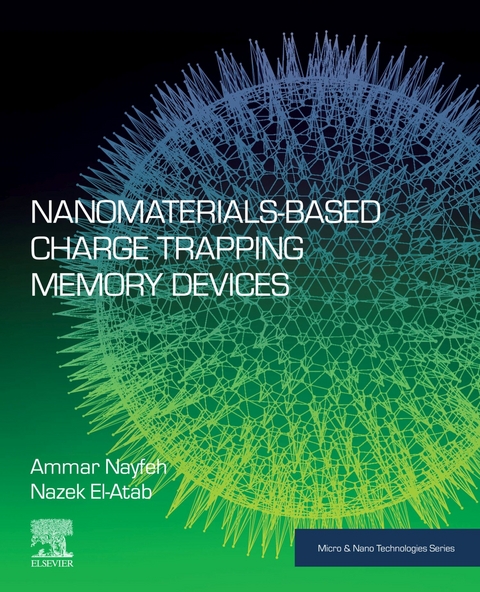
Nanomaterials-Based Charge Trapping Memory Devices (eBook)
192 Seiten
Elsevier Science (Verlag)
978-0-12-822343-7 (ISBN)
Professor Ammar Nayfeh was born in Urbana IL in 1979. He received his bachelor's degree from the University of Illinois Urbana Champaign in 2001 in electrical engineering and his master's degree in 2003 from Stanford University. Dr. Nayfeh earned a Ph.D. in electrical engineering from Stanford University in 2006. His research focused on heteroepitaxy of germanium on silicon for electronic and photonic devices. After his PhD, he joined Advanced Micro Devices as a researcher working in collaboration with IBM. After that he joined a silicon valley startup company, Innovative Silicon (ISi) in 2008. In addition, he was a part time professor at San Jose State University. In June 2010, he joined MIT as a visiting scholar and became a faculty member at the Masdar Institute currently Khalifa University. His research interest focuses on nanotechnology for future more efficient low power electronic and photonic devices. Professor Nayfeh is currently an associate professor in the Department Electrical Engineering and Computer Science (EECS) at Khalifa University. Professor Ammar Nayfeh has authored or co-authored over 100 publications, and holds three patents. He is a member of IEEE, MRS and Stanford Alumni Association. He has received the Material Research Society Graduate Student Award, the Robert C. Maclinche Scholarship at UIUC, and Stanford Graduate Fellowship.
Rising consumer demand for low power consumption electronics has generated a need for scalable and reliable memory devices with low power consumption. At present, scaling memory devices and lowering their power consumption is becoming more difficult due to unresolved challenges, such as short channel effect, Drain Induced Barrier Lowering (DIBL), and sub-surface punch-through effect, all of which cause high leakage currents. As a result, the introduction of different memory architectures or materials is crucial. Nanomaterials-based Charge Trapping Memory Devices provides a detailed explanation of memory device operation and an in-depth analysis of the requirements of future scalable and low powered memory devices in terms of new materials properties. The book presents techniques to fabricate nanomaterials with the desired properties. Finally, the book highlights the effect of incorporating such nanomaterials in memory devices. This book is an important reference for materials scientists and engineers, who are looking to develop low-powered solutions to meet the growing demand for consumer electronic products and devices. - Explores in depth memory device operation, requirements and challenges- Presents fabrication methods and characterization results of new nanomaterials using techniques, including laser ablation of nanoparticles, ALD growth of nano-islands, and agglomeration-based technique of nanoparticles- Demonstrates how nanomaterials affect the performance of memory devices
| Erscheint lt. Verlag | 27.5.2020 |
|---|---|
| Sprache | englisch |
| Themenwelt | Technik ► Maschinenbau |
| ISBN-10 | 0-12-822343-X / 012822343X |
| ISBN-13 | 978-0-12-822343-7 / 9780128223437 |
| Informationen gemäß Produktsicherheitsverordnung (GPSR) | |
| Haben Sie eine Frage zum Produkt? |
 EPUB (Adobe DRM)
Kopierschutz: Adobe-DRM
Adobe-DRM ist ein Kopierschutz, der das eBook vor Mißbrauch schützen soll. Dabei wird das eBook bereits beim Download auf Ihre persönliche Adobe-ID autorisiert. Lesen können Sie das eBook dann nur auf den Geräten, welche ebenfalls auf Ihre Adobe-ID registriert sind.
Details zum Adobe-DRM
Dateiformat: EPUB (Electronic Publication)
EPUB ist ein offener Standard für eBooks und eignet sich besonders zur Darstellung von Belletristik und Sachbüchern. Der Fließtext wird dynamisch an die Display- und Schriftgröße angepasst. Auch für mobile Lesegeräte ist EPUB daher gut geeignet.
Systemvoraussetzungen:
PC/Mac: Mit einem PC oder Mac können Sie dieses eBook lesen. Sie benötigen eine
eReader: Dieses eBook kann mit (fast) allen eBook-Readern gelesen werden. Mit dem amazon-Kindle ist es aber nicht kompatibel.
Smartphone/Tablet: Egal ob Apple oder Android, dieses eBook können Sie lesen. Sie benötigen eine
Geräteliste und zusätzliche Hinweise
Buying eBooks from abroad
For tax law reasons we can sell eBooks just within Germany and Switzerland. Regrettably we cannot fulfill eBook-orders from other countries.
aus dem Bereich