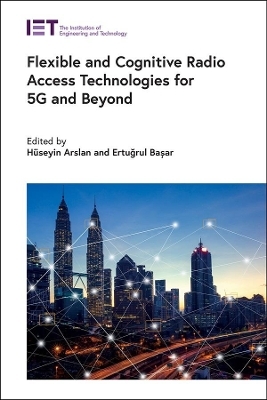
Flexible and Cognitive Radio Access Technologies for 5G and Beyond
Institution of Engineering and Technology (Verlag)
978-1-83953-079-1 (ISBN)
- Titel nicht im Sortiment
- Artikel merken
This comprehensive book is intended to be both a tutorial on flexible and cognitive radio access technologies for 5G and beyond and an advanced overview for technical professionals and managers in the communications industry, as well as researchers in academia and industry. The authors cover enabling radio access technologies for 5G and beyond, not only from a standard specific angle (like 5G) but also by considering future trends beyond 5G. Rather than specific standard implementations, the book covers a wide variety of technologies and their uses. The presentations are both descriptive and mathematical in nature to cater to readers who need mathematical description as well as readers who do not. The book is written at a level suited to readers who already have a background in electrical engineering and basic wireless communications.
Hüseyin Arslan is a professor with the Electrical Engineering Deptartment of the University of South Florida, Tampa, USA. He is also affiliated with the Communication, Signals Processing and Networking Center at Istanbul Medipol University, Turkey. In addition to his academic experience, he has worked for various wireless industry with different roles including research engineer and consultant. He has also served in the editorial board of several IEEE Transactions. Prof. Arslan is an IEEE Fellow. Ertuğrul Başar is an associate professor with the Department of Electrical and Electronics Engineering at Koc University, Istanbul, Turkey and director of the Communications Research and Innovation Laboratory (CoreLab). He is an editor of IEEE Transactions on Communications and Physical Communication, and a senior editor of IEEE Communications Letters. He is a senior member of the IEEE. Dr. Basar is the author/co-author of 120 international journal and conference publications covering next-generation wireless communication technologies.
Part I: Waveform design: an overview
Chapter 1: Introduction to waveform design
Chapter 2: OFDM and alternative waveforms
Chapter 3: Mixed numerology OFDM and interference issues
Part II: Flexible waveform and modulation options for beyond 5G
Chapter 4: Flexibility through hybrid waveforms
Chapter 5: Generalized and flexible modulation options
Chapter 6: Index modulation-based flexible waveform design
Part III: Multiple antenna systems for 5G and beyond
Chapter 7: Massive MIMO for 5G and beyond
Chapter 8: Beamforming and beam management in 5G and beyond
Chapter 9: Spatial modulation techniques for beyond 5G
Chapter 10: Beyond massive MIMO: reconfigurable intelligent surface-assisted wireless communications
Part IV: Channel modeling and new frequency bands
Chapter 11: Channel modeling for 5G and beyond
Chapter 12: On the advances of terahertz communication for 5G and beyond wireless networks
Chapter 13: Visible light communication for 5G and beyond
Part V: Coexistence, interference and radio resource management
Chapter 14: Coordinated networks: past, present and future
Chapter 15: Non-orthogonal radio access technologies
Chapter 16: Cognitive radio spectrum sensing: from conventional approaches to machine-learning-based predictive techniques
Chapter 17: Deep learning and federate learning toward 6G mobile communications
Part VI: Securing wireless communication
Chapter 18: Physical layer security designs for 5G and beyond
Chapter 19: Physical layer security for NOMA systems
| Erscheinungsdatum | 26.10.2020 |
|---|---|
| Reihe/Serie | Telecommunications |
| Verlagsort | Stevenage |
| Sprache | englisch |
| Maße | 156 x 234 mm |
| Themenwelt | Technik ► Elektrotechnik / Energietechnik |
| Technik ► Nachrichtentechnik | |
| ISBN-10 | 1-83953-079-0 / 1839530790 |
| ISBN-13 | 978-1-83953-079-1 / 9781839530791 |
| Zustand | Neuware |
| Informationen gemäß Produktsicherheitsverordnung (GPSR) | |
| Haben Sie eine Frage zum Produkt? |
aus dem Bereich