Crystals and Crystal Structures (eBook)
John Wiley & Sons (Verlag)
978-1-119-54859-1 (ISBN)
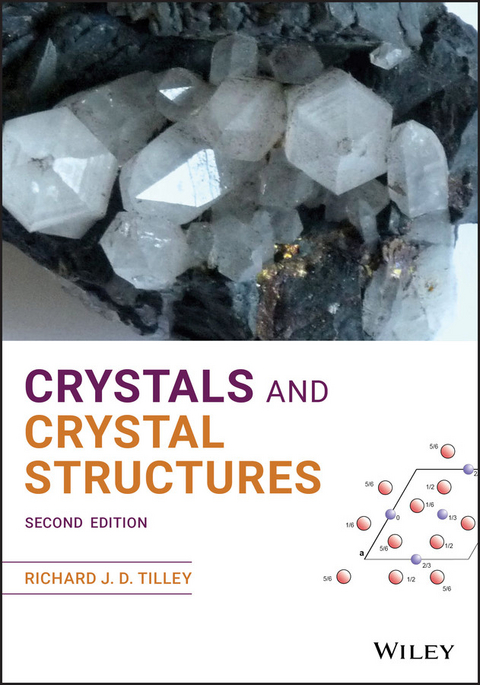
An authoritative, updated text that offers an introduction to crystals and crystal structure with coverage of crystallography, and microscopy of materials
Written in a friendly, non-mathematical style, the updated second edition of Crystals and Crystal Structures offers a comprehensive exploration of the key elements of crystals and crystal structures. Starting with the basics, it includes information on multiple areas of crystallography, including modulated structures, quasicrystals and protein crystallography, and interdisciplinary applications as diverse as the relationship between physical properties and symmetry.
To enhance comprehension of the material presented, the book contains a variety of problems and exercises. The revised second edition offers new material and updates in the field including:
- An introduction to the use of high intensity X-ray analysis of protein structures
- Advances in imaging, scanning electron microscopy, and cryo-electron microscopy
- The relationship between symmetry and physical properties highlighting new findings and an introduction to tensor notation in describing these relationships in a concise fashion
- Nanoparticles as well as crystallographic aspects, defects, surface defects and the impact of these crystallographic features on properties
- Perovskite structures and their variations and the inclusion of their wide-ranging properties
Written for students ofcrystallography, chemistry, physics, materials science, biosciences and geology, Crystals and Crystal Structures, Second Edition provides an understanding of the subject and enables students to read scientific papers and articles describing a crystal structure or use crystallographic databases.
RICHARD J. D. TILLEY D. Sc, Ph. D, is Emeritus Professor in the School of Engineering at the University of Cardiff, Wales, U.K. He has published extensively in the area of solid-state materials science, including nine textbooks (translated into multiple languages), 23 chapters and encyclopedia entries and more than 200 journal papers.
An authoritative, updated text that offers an introduction to crystals and crystal structure with coverage of crystallography, and microscopy of materials Written in a friendly, non-mathematical style, the updated second edition of Crystals and Crystal Structures offers a comprehensive exploration of the key elements of crystals and crystal structures. Starting with the basics, it includes information on multiple areas of crystallography, including modulated structures, quasicrystals and protein crystallography, and interdisciplinary applications as diverse as the relationship between physical properties and symmetry. To enhance comprehension of the material presented, the book contains a variety of problems and exercises. The revised second edition offers new material and updates in the field including: An introduction to the use of high intensity X-ray analysis of protein structures Advances in imaging, scanning electron microscopy, and cryo-electron microscopy The relationship between symmetry and physical properties highlighting new findings and an introduction to tensor notation in describing these relationships in a concise fashion Nanoparticles as well as crystallographic aspects, defects, surface defects and the impact of these crystallographic features on properties Perovskite structures and their variations and the inclusion of their wide-ranging properties Written for students ofcrystallography, chemistry, physics, materials science, biosciences and geology, Crystals and Crystal Structures, Second Edition provides an understanding of the subject and enables students to read scientific papers and articles describing a crystal structure or use crystallographic databases.
RICHARD J. D. TILLEY D. Sc, Ph. D, is Emeritus Professor in the School of Engineering at the University of Cardiff, Wales, U.K. He has published extensively in the area of solid-state materials science, including nine textbooks (translated into multiple languages), 23 chapters and encyclopedia entries and more than 200 journal papers.
Chapter 1
Crystals and Crystal Structures
What is a crystal system?
What are unit cells?
What information is needed to specify a crystal structure?
Crystals are homogeneous solids that possess a long‐range three‐dimensional array of ordered atoms. That is, the arrangement of the atoms in one small volume of a crystal is identical (excepting localised mistakes or defects that can arise during crystal growth or that are inserted deliberately) to that in any other similar but remote part of the crystal. Crystallography is the study of crystals and describes the ways in which the component atoms are arranged in crystals and how the long‐range order is achieved. Many chemical (including biochemical) and physical properties of solids depend upon crystal structure, and knowledge of crystallography is essential if the properties of materials are to be understood and exploited.
1.1 Crystal Families and Crystal Systems
Crystallography first developed as an observational science: an adjunct to the study of minerals. Minerals were (and still are) described by their morphology or habit, the shape that a mineral specimen may exhibit, which may vary from an amorphous mass to a well‐formed gemstone. Indeed, the regular and beautiful shapes of naturally occurring crystals attracted attention from the earliest times, and the relationship between crystal shape and the disposition of crystal faces of a well‐formed crystal provides an obvious means of classification. For example, some crystals resemble cubes or octahedra, whilst others are brick‐like or form prisms with a hexagonal cross‐section (Figure 1.1).
The external shape of a well‐formed crystal reflects the internal order of the solid, especially the presence of internal symmetry. Symmetry will be developed later (especially in Chapters 3 and 4), but for the moment we can note that the most important symmetries displayed by crystals, and used in their classification, are the mirror plane, across which two parts of the crystal are related by reflection, and rotation axes. There are four different rotation axes: the diad or two‐fold, in which successive rotations by (360/2)° leave the crystal unchanged; the triad or three‐fold, in which successive rotations by (360/3)° leave the crystal unchanged; the tetrad or four‐fold, in which successive rotations by (360/4)° leave the crystal unchanged; and the hexad or six‐fold, in which successive rotations by (360/6)° leave the crystal unchanged. Careful measurement of mineral specimens using these symmetry criteria have allowed crystals to be classified in terms of six crystal families – anorthic, monoclinic, orthorhombic, tetragonal, hexagonal, and isometric or cubic – later expanded slightly by crystallographers into seven crystal systems (Table 1.1).
Figure 1.1 (a) Quartz (SiO2) crystals, showing hexagonal morphology; (b) pyrite (FeS2, fool’s gold) crystals showing cubic and octahedral morphology.
The crystal systems are sets of reference axes, which have a direction as well as a magnitude, and hence are vectors.1 The allocation of a crystal to a particular system is made on the basis of the internal symmetries that are inferred from the crystal habit, which includes the apparent external symmetry. For instance, a crystal that resembled a hexagonal prism would be allocated to the hexagonal crystal system. It is common sense to allocate one reference axis to lie parallel to the hexagonal prism length and the other two axes to be normal to two chosen faces of the hexagonal prism. The axis lying along the prism length is really the defining axis for this designation because it is the unique hexad axis about which the crystal could be rotated by successive 60° turns to reproduce the same shape. Similarly, if a crystal has the form of a brick with a square cross‐section, it is assigned to the tetragonal system, and the axes are positioned parallel to the three edges of the crystal. The defining axis this time is a tetrad perpendicular to the square cross‐section, and this time the crystal can be rotated by successive 90° turns to regenerate the same shape. Thus the allocation of the reference axes and the placement of a crystal into a crystal family depends upon the external symmetry of the crystal.
The three reference axes for each family, allocated with respect to the crystal symmetry, are labelled a, b and c, and the angles between the positive directions of the axes are α, β, and γ, where α lies between +b and +c, β lies between +a and +c, and γ lies between +a and +b (Figure 1.2). The angles are chosen to be greater or equal to 90° except for the trigonal crystal system, as described below. In the figures, the a‐axis is represented as projecting out of the plane of the page, towards the reader, the b‐axis points to the right and the c‐axis points towards the top of the page. This arrangement is a right‐handed coordinate system. Measurements on mineral specimens could give absolute values for the inter‐axial angles, but only relative axial lengths could be derived. These relative lengths are written a, b and c.
Table 1.1 The seven crystal systems
| Crystal family | Crystal system | Required symmetrya | Axial relationships |
| Anorthic | Triclinic | None | a ≠ b ≠ c, α ≠ 90°, β ≠ 90°, γ ≠ 90° |
| Monoclinic | Monoclinic | 1 diad or 1 mirror plane | a ≠ b ≠ c, α = 90°, β ≠ 90°, γ = 90° |
| Orthorhombic | Orthorhombic | 3 diads or 1 diad + 2 mirror planes | a ≠ b ≠ c, α = 90°, β = 90°, γ = 90° |
| Tetragonal | Tetragonal | 1 tetrad | a = b ≠ c, α = 90°, β = 90°, γ = 90° |
| Hexagonal | Trigonal | 1 triad | a = b = c, α = β = γ (rhombohedral axes); or a' = b' ≠ c, α' = 90°, β' = 90°, γ' = 120° (hexagonal axes) |
| Hexagonal | 1 hexad | a = b ≠ c, α = 90°, β = 90°, γ = 120° |
| Isometric | Cubic | 3 tetrads | a = b = c, α = 90°, β = 90°, γ = 90° |
a Symmetry nomenclature is expanded in Chapters 3 and 4.
The most symmetric of the crystal systems is the cubic or isometric system, in which the three tetrad axes are arranged at 90° to each other and the axial lengths are identical. These form the familiar Cartesian axes. The tetragonal system is similar, with mutually perpendicular axes, but two of these, usually designated a (= b), are of equal length, whilst the third, the tetrad axis, usually designated c, is longer or shorter than the other two. The orthorhombic system has three mutually perpendicular axes of different lengths parallel to the three diads. The monoclinic system is also defined by three unequal axes. Two of these, conventionally chosen as a and c, are at an oblique angle, β, whilst the third c, normally parallel to the diad axis or mirror normal, is perpendicular to the plane containing a and b. The least symmetrical crystal system is the triclinic, which has three unequal axes at oblique angles.
Figure 1.2 Reference axes used to characterise the seven crystal systems.
The hexagonal crystal system has two axes of equal length, designated a (= b), at an angle, γ, of 120°. The c‐axis lies perpendicular to the plane containing a and b and lies parallel to the hexad axis. The trigonal system has three axes of equal length, each enclosing equal angles α (= β = γ), forming a rhombohedron. The axes are called rhombohedral axes and the triad axis is allocated to the body diagonal of the rhombohedron. Crystals described in terms of rhombohedral axes are often more conveniently described in terms of a hexagonal set of axes. In this case, the hexagonal c‐axis is parallel to the rhombohedral body diagonal, which is parallel to the triad axis (Figure 1.3). The relationship between the two sets of axes is given by the vector equations:
where the subscripts R and H stand for rhombohedral and hexagonal respectively. (Note that in these equations the vectors a, b and c are added vectorially, not arithmetically [see Appendix A].) The arithmetical relationships between...
| Erscheint lt. Verlag | 12.5.2020 |
|---|---|
| Sprache | englisch |
| Themenwelt | Naturwissenschaften ► Chemie ► Physikalische Chemie |
| Technik ► Maschinenbau | |
| Schlagworte | analysis of crystal protein structures • applications of crystals • basics of crystals • Chemie • Chemistry • cryo-electron microscopy</p> • crystallography • Festkörperchemie • Festkörperphysik • introduction to crystals • Kristallographie • <p>Guide to crystals • Materialwissenschaften • Physics • Physik • Protein Crystallography • Quasicrystals • solid state chemistry • Solid state physics • understanding crystals |
| ISBN-10 | 1-119-54859-4 / 1119548594 |
| ISBN-13 | 978-1-119-54859-1 / 9781119548591 |
| Informationen gemäß Produktsicherheitsverordnung (GPSR) | |
| Haben Sie eine Frage zum Produkt? |
 EPUB (Adobe DRM)
Kopierschutz: Adobe-DRM
Adobe-DRM ist ein Kopierschutz, der das eBook vor Mißbrauch schützen soll. Dabei wird das eBook bereits beim Download auf Ihre persönliche Adobe-ID autorisiert. Lesen können Sie das eBook dann nur auf den Geräten, welche ebenfalls auf Ihre Adobe-ID registriert sind.
Details zum Adobe-DRM
Dateiformat: EPUB (Electronic Publication)
EPUB ist ein offener Standard für eBooks und eignet sich besonders zur Darstellung von Belletristik und Sachbüchern. Der Fließtext wird dynamisch an die Display- und Schriftgröße angepasst. Auch für mobile Lesegeräte ist EPUB daher gut geeignet.
Systemvoraussetzungen:
PC/Mac: Mit einem PC oder Mac können Sie dieses eBook lesen. Sie benötigen eine
eReader: Dieses eBook kann mit (fast) allen eBook-Readern gelesen werden. Mit dem amazon-Kindle ist es aber nicht kompatibel.
Smartphone/Tablet: Egal ob Apple oder Android, dieses eBook können Sie lesen. Sie benötigen eine
Geräteliste und zusätzliche Hinweise
Buying eBooks from abroad
For tax law reasons we can sell eBooks just within Germany and Switzerland. Regrettably we cannot fulfill eBook-orders from other countries.
aus dem Bereich