Potassium-ion Batteries (eBook)
432 Seiten
John Wiley & Sons (Verlag)
978-1-119-66324-9 (ISBN)
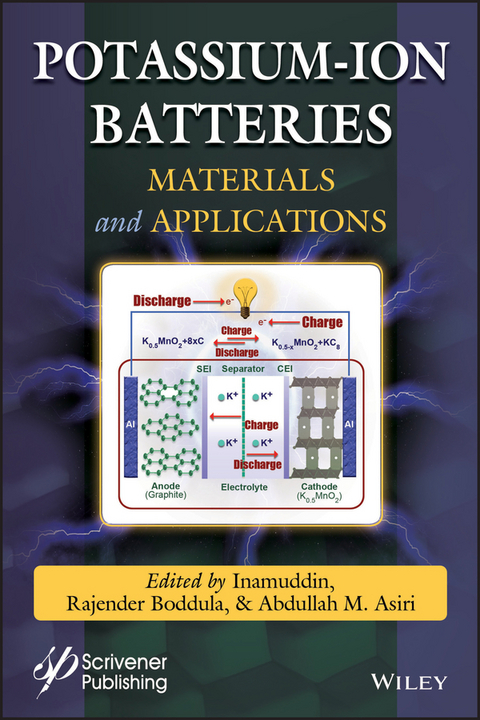
Potassium-ion batteries were first introduced to the world for energy storage in 2004, over two decades after the invention of lithium-ion batteries. Potassium-ion (or "K-ion") batteries have many advantages, including low cost, long cycle life, high energy density, safety, and reliability. Potassium-ion batteries are the potential alternative to lithium-ion batteries, fueling a new direction of energy storage research in many applications and across industries.
Potassium-ion Batteries: Materials and Applications explores the concepts, mechanisms, and applications of the next-generation energy technology of potassium-ion batteries. Also included is an in-depth overview of energy storage materials and electrolytes. This is the first book on this technology and serves as a reference guide for electrochemists, chemical engineers, students, research scholars, faculty, and R&D professionals who are working in electrochemistry, solid-state science, material science, ionics, power sources, and renewable energy storage fields.
Inamuddin, PhD, is an assistant professor at King Abdulaziz University, Jeddah, Saudi Arabia and is also an assistant professor in the Department of Applied Chemistry, Aligarh Muslim University, Aligarh, India. He has published about 150 research articles in various international scientific journals, 18 book chapters, and 60 edited books with multiple well-known publishers. Rajender Boddula, PhD, is currently working for the Chinese Academy of Sciences President's International Fellowship Initiative (CAS-PIFI) at the National Center for Nanoscience and Technology (NCNST, Beijing). He has numerous honors, book chapters, and academic papers to his credit and is an editorial board member and a referee for several reputed international peer-reviewed journals. Abdullah M. Asiri is the Head of the Chemistry Department at King Abdulaziz University and the founder and Director of the Center of Excellence for Advanced Materials Research (CEAMR). He holds multiple patents, has authored ten books, more than one thousand publications in international journals, and multiple book chapters.
| Erscheint lt. Verlag | 14.4.2020 |
|---|---|
| Sprache | englisch |
| Themenwelt | Naturwissenschaften ► Chemie ► Physikalische Chemie |
| Technik ► Elektrotechnik / Energietechnik | |
| Schlagworte | Batterien u. Brennstoffzellen • Batteries & Fuel Cells • Chemie • Chemistry • Energie • Energy • Festkörperphysik • Hydrogen, Batteries & Fuel Cells • Physics • Physik • Solid state physics • Wasserstoff, Batterien u. Brennstoffzellen |
| ISBN-10 | 1-119-66324-5 / 1119663245 |
| ISBN-13 | 978-1-119-66324-9 / 9781119663249 |
| Informationen gemäß Produktsicherheitsverordnung (GPSR) | |
| Haben Sie eine Frage zum Produkt? |
 PDF (Adobe DRM)
Kopierschutz: Adobe-DRM
Adobe-DRM ist ein Kopierschutz, der das eBook vor Mißbrauch schützen soll. Dabei wird das eBook bereits beim Download auf Ihre persönliche Adobe-ID autorisiert. Lesen können Sie das eBook dann nur auf den Geräten, welche ebenfalls auf Ihre Adobe-ID registriert sind.
Details zum Adobe-DRM
Dateiformat: PDF (Portable Document Format)
Mit einem festen Seitenlayout eignet sich die PDF besonders für Fachbücher mit Spalten, Tabellen und Abbildungen. Eine PDF kann auf fast allen Geräten angezeigt werden, ist aber für kleine Displays (Smartphone, eReader) nur eingeschränkt geeignet.
Systemvoraussetzungen:
PC/Mac: Mit einem PC oder Mac können Sie dieses eBook lesen. Sie benötigen eine
eReader: Dieses eBook kann mit (fast) allen eBook-Readern gelesen werden. Mit dem amazon-Kindle ist es aber nicht kompatibel.
Smartphone/Tablet: Egal ob Apple oder Android, dieses eBook können Sie lesen. Sie benötigen eine
Geräteliste und zusätzliche Hinweise
Buying eBooks from abroad
For tax law reasons we can sell eBooks just within Germany and Switzerland. Regrettably we cannot fulfill eBook-orders from other countries.
aus dem Bereich