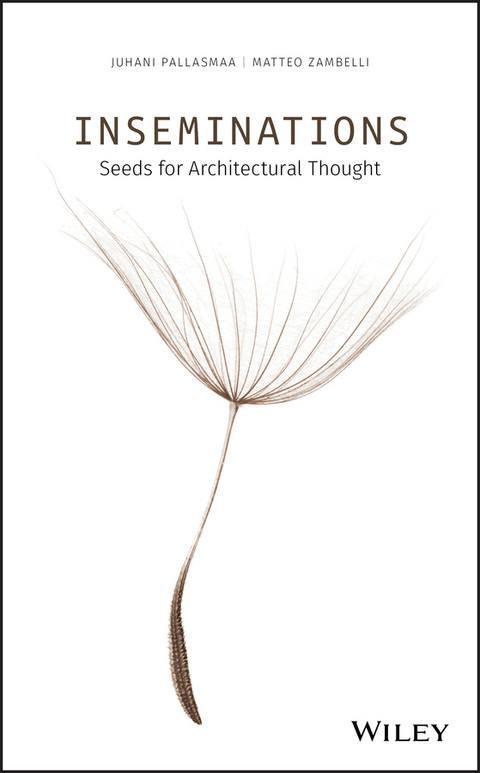
Inseminations (eBook)
John Wiley & Sons (Verlag)
978-1-119-62223-9 (ISBN)
A collection of the writing of the highly influential architect, Juhani Pallasmaa, presented in short, easily accessible, and condensed ideas ideal for students
Juhani Pallasmaa is one of Finland's most distinguished architects and architectural thinkers, publishing around 60 books and several hundred essays and shorter pieces over his career. His influential works have inspired undergraduate and postgraduate students of architecture and related disciplines for decades. In this compilation of excerpts of his writing, readers can discover his key concepts and thoughts in one easily accessible, comprehensive volume.
Inseminations: Seeds for Architectural Thought is a delightful collection of thoughtful ideas and compositions that float between academic essay and philosophical reflection. Wide in scope, it offers entries covering: atmospheres; biophilic beauty; embodied understanding; imperfection; light and shadow; newness and nowness; nostalgia; phenomenology of architecture; sensory thought; silence; time and eternity; uncertainty, and much more.
- Makes the wider work of Pallasmaa accessible to students across the globe, introducing them to his key concepts and thoughts
- Exposes students to a broad range of issues on which Pallasmaa has a view
- Features an alphabetized structure that makes serendipitous discovery or linking of concepts more likely
- Presents material in short, condensed manner that can be easily digested by students
Inseminations: Seeds for Architectural Thought will appeal to undergraduate students in architecture, design, urban studies, and related disciplines worldwide.
JUHANI PALLASMAA is one of Finland's most celebrated architects and architectural intellectuals. His previous positions include: Rector of the Institute of Industrial Arts, Helsinki; Director of the Museum of Finnish Architecture, Helsinki; and Professor and Dean of the Faculty of Architecture, Helsinki University of Technology. He has also held visiting professorships at several universities worldwide. Pallasmaa is the author/editor of around 60 books, including the bestselling The Eyes of the Skin: Architecture and the Senses; The Thinking Hand: Existential and Embodied Wisdom in Architecture; and The Embodied Image: Imagination and Imagery in Architecture.
MATTEO ZAMBELLI holds a degree in Architecture from IUAV (Istituto Universitario di Architettura di Venezia) and a Ph.D. in Civil Engineering from the Faculty of Engineering of Ancona. He has taught courses on Architectural design and History and theory of contemporary architecture at the Faculties of Engineering of Ancona and Trento, and is a researcher at the Department of Architecture at the University of Florence. He has written extensively on contemporary architects and new trends in architecture, design methods and has translated and edited four books by Juhani Pallasmaa from English into Italian.
A collection of the writing of the highly influential architect, Juhani Pallasmaa, presented in short, easily accessible, and condensed ideas ideal for students Juhani Pallasmaa is one of Finland s most distinguished architects and architectural thinkers, publishing around 60 books and several hundred essays and shorter pieces over his career. His influential works have inspired undergraduate and postgraduate students of architecture and related disciplines for decades. In this compilation of excerpts of his writing, readers can discover his key concepts and thoughts in one easily accessible, comprehensive volume. Inseminations: Seeds for Architectural Thought is a delightful collection of thoughtful ideas and compositions that float between academic essay and philosophical reflection. Wide in scope, it offers entries covering: atmospheres; biophilic beauty; embodied understanding; imperfection; light and shadow; newness and nowness; nostalgia; phenomenology of architecture; sensory thought; silence; time and eternity; uncertainty, and much more. Makes the wider work of Pallasmaa accessible to students across the globe, introducing them to his key concepts and thoughts Exposes students to a broad range of issues on which Pallasmaa has a view Features an alphabetized structure that makes serendipitous discovery or linking of concepts more likely Presents material in short, condensed manner that can be easily digested by students Inseminations: Seeds for Architectural Thought will appeal to undergraduate students in architecture, design, urban studies, and related disciplines worldwide.
JUHANI PALLASMAA is one of Finland's most celebrated architects and architectural intellectuals. His previous positions include: Rector of the Institute of Industrial Arts, Helsinki; Director of the Museum of Finnish Architecture, Helsinki; and Professor and Dean of the Faculty of Architecture, Helsinki University of Technology. He has also held visiting professorships at several universities worldwide. Pallasmaa is the author/editor of around 60 books, including the bestselling The Eyes of the Skin: Architecture and the Senses; The Thinking Hand: Existential and Embodied Wisdom in Architecture; and The Embodied Image: Imagination and Imagery in Architecture. MATTEO ZAMBELLI holds a degree in Architecture from IUAV (Istituto Universitario di Architettura di Venezia) and a Ph.D. in Civil Engineering from the Faculty of Engineering of Ancona. He has taught courses on Architectural design and History and theory of contemporary architecture at the Faculties of Engineering of Ancona and Trento, and is a researcher at the Department of Architecture at the University of Florence. He has written extensively on contemporary architects and new trends in architecture, design methods and has translated and edited four books by Juhani Pallasmaa from English into Italian.
Preface
I never intended or deliberately decided to become an architectural writer, critic or theorist. I have unnoticeably drifted from my architectural practice into thinking and writing about this art form, and for almost one decade since I closed the design activities of my office, I have found myself writing practically full time.
I wrote my first article in 1966 and during the past years I have written an essay, lecture, or preface to a book by someone else roughly every second week. I have now published over 60 books and over 400 essays. I confess that I have gradually developed a way of writing that is similar to my way of designing. I write spontaneously without an outline or clear plan, in the same way that I used to sketch my architectural projects. I feel that I have not really changed my craft, as I continue to do the same thing, to imagine architectural situations, encounters and experiences, now in words instead of form and matter.
In the late 1970s, I read Gaston Bachelard's Poetics of Space1 (the book was pointed out to me by Daniel Libeskind in the book shop of the Cranbrook Academy), and it opened up a new world to me, the realm of poetic imagination and imagery, a world where perception, thought, imagination and dreams are united. I realized that the world is not out there objectively, as it is fundamentally of our own perceptual and mental making. I became aware of the existential and poetic ground of architecture as opposed to visual aesthetics, compositions or utilitarian issues. I began to read philosophers, psychologists of creativity, scientists, mainly physicists and natural scientist and later also neuroscientists. I have also eagerly read novels and poetry. Books open up marvellous worlds, those of imagination, the most significant worlds for me.
In 1985, I wrote an essay entitled ‘The Geometry of Feeling’,2 which has later been republished as an example of architectural phenomenology in some anthologies on architectural writing and theory. I must say honestly, that only while working on that essay I became aware of phenomenology as a line of philosophical enquiry, and I added a short chapter on this philosophical approach in this essay, mainly for the purposes of clarifying my own view. Yet, even today, I do not claim to be a phenomenologist, due to my lack of formal philosophical education. I would rather say that my current views of architecture and art are parallel to what I understand the phenomenological stance to be. My ‘phenomenology’ arises from my half a century of experiences as an architect, teacher, writer and collaborator with numerous artists, as well as my excessive travels around the world and my experiences of life in general.
The Dutch phenomenologist JH van den Berg argues surprisingly: ‘Painters and poets are born pheneomenlogists’.3 The neurobiologist Semir Zeki, who studies the neurological ground of art and aesthetics, makes a parallel argument: ‘Most painters are also neurologists’, in the sense of intuitively understanding the neurological principles of brain activities.4 These statements speak for the power of the artist's intuition. I believe that I am similarly a ‘born phenomenologist’ through my formative childhood experiences and observations at my farmer grandfather's humble farm house in Central Finland during the war years of 1939–1945. My thinking is essentially ‘a farm boy’s phenomenology' refined by my later engagement in the artistic world. Yet, in recent years, I have had the opportunity of lecturing with some of the leading phenomenologists in several countries.
I understand phenomenology in accordance with the notion of the founder of the movement, Edmund Husserl, as ‘pure looking’, an innocent and unbiased encounter with phenomena, in the same manner that a painter looks at a landscape, a poet seeks a poetic expression for a particular human experience, and an architect imagines an existentially meaningful space. I have also understood that the original meaning of the Greek word theorein was to observe, not to speculate. My theorizing is an intense look at things in order to see their essences, connections, interactions and meanings. I also feel sympathy for Johann Wolfgang von Goethe's view of science, which he called ‘zarte empirie’, delicate empiricism,5 a thinking that aspires to observe without changing and violating the phenomenon in question. I write in the associative manner of literary essays, and I have no hesitation in combining scientific findings with experiential and sensory observations or phenomenological formulations. I also try to achieve literary qualities in my writings after I have realized that aesthetic qualities of language make the reader more receptive; she receives simultaneously the intellectual meaning and an aesthetic and emotive impact.
In The Book of the Disquiet, the Portuguese poet Fernando Pessoa – who wrote in 52 pseudonyms – confesses: ‘I was a poet animated by philosophy, not a philosopher with poetic faculties’.6 As I have no academic training in philosophy, I wish to paraphrase the poet's confession: I am an architect animated by philosophy, not a philosopher with architectural interests. I must confess that I am an amateur thinker although I have read numerous books by philosophers due to my interest in the enigma of human existence, consciousness and the essence of knowledge. I consider myself a craftsman and amateur, and I have even developed a suspicion for expertise in the manner of the statement of Joseph Brodsky, the poet: ‘A craftsman does not collect expertise, he collects uncertainties’.7 Through my long experience as architect and designer, I have become ever more uncertain, as widening knowledge complicates reality instead of simplifying it.
I have been particularly impressed by the writings of Maurice Merleau‐Ponty, whose thinking I have found inspiringly open‐ended and optimistic. He is a truly poetic philosopher, whose expressions often possess the magic of art. His philosophy has made me understand the chiasmatic way in which the mental and the material worlds intertwine, and that view has opened up new ways of understanding artistic and architectural phenomena. My phenomenological thinking began with an interest in the senses and this led me to critique the hegemony of vision in western culture. This dominance already emerged in Greek philosophy, and has been dramatically accelerated by technology, especially writing and mechanical printing, as Walter J Ong has convincingly suggested in Orality and Literacy.8
After several decades of design work, thinking and writing, I am convinced that the most important sense in architectural experience is not vision, but the existential sense, our sense of self. We exist in ‘the flesh of the world’, to use a notion of Merleau‐Ponty, and architecture gives us our foothold in this very flesh.9 I have also become convinced that peripheral and unfocused perceptions and the understanding of the nature of the human existential reality are more important in architecture than our focused percepts. The continuum of memory, perception and imagination is also more essential than isolated sensations. Simply, focused vision makes us outsiders, whereas embracing peripheral and diffuse perceptions turn us into insiders and participants. This view makes the formal and geometric dominance in architectural theory and education questionable in comparison with an existential, experiential and atmospheric understanding.
In 2010, while working on the translation of two books of mine from English into Italian, Matteo Zambelli, architect and professor, suggested to me the idea of compiling a selection of excerpts of my writings in an encyclopaedic form, organized alphabetically on the basis of keywords identifying the contents of the selected chapters. As I tend to write in fragments, or semi‐autonomous paragraphs, instead of aspiring to forge a seamlessly continuous narrative, I immediately accepted the idea. By the time of our conversation, nearly nine years ago, I had published around 45 books and some 350 essays, prefaces and interviews, mostly on experiential and philosophical views of architecture and the arts (several of them through John Wiley & Sons, London), I felt that there would be enough material for a book based on Matteo's idea. At the same time that the idea of an ‘encyclopaedia’ of my writings sounded somewhat pretentious, it also seemed to project a relaxed attitude in regarding individual essays as mere material for a previously unmeditated entity.
The book was published in Italian by Pendragon, Bologna, in 2011, as Juhani Pallasmaa, Lampi di pensiero. Fenomenologia della percezione in architettura, edited by Mauro Fratta and Matteo Zambelli. Now, at the time of writing the preface for the largely expanded English version of the book, the total number of my books is over 60, and I must have published well over 400 articles and essays. The number of entries in this English edition of Inseminations has likewise roughly been doubled. As students today tend to read short fragments rather than full essays or entire books, a collection of condensed chapters on distinct themes could well be attractive to student readers.
My way of thinking and writing is to focus on a subject matter or view point at a time, record my observations, thoughts and associations on that subject and move on to the next view point or theme of my interest, related to...
| Erscheint lt. Verlag | 9.4.2020 |
|---|---|
| Sprache | englisch |
| Themenwelt | Technik ► Architektur |
| Schlagworte | architectural encyclopedia • architectural theory • Architecture • architecture essays</p> • Architektur • Architektur / Theorie • Design • Design, Drawing & Presentation • Design Philosophy • drawing • drawing technique • Entwurf, Zeichnung u. Präsentation • Essays • Intellectual architecture • <p>Juhani Pallasmaa • philosophical writing • Philosophy • Scholarly writings |
| ISBN-10 | 1-119-62223-9 / 1119622239 |
| ISBN-13 | 978-1-119-62223-9 / 9781119622239 |
| Informationen gemäß Produktsicherheitsverordnung (GPSR) | |
| Haben Sie eine Frage zum Produkt? |
 EPUB (Adobe DRM)
Kopierschutz: Adobe-DRM
Adobe-DRM ist ein Kopierschutz, der das eBook vor Mißbrauch schützen soll. Dabei wird das eBook bereits beim Download auf Ihre persönliche Adobe-ID autorisiert. Lesen können Sie das eBook dann nur auf den Geräten, welche ebenfalls auf Ihre Adobe-ID registriert sind.
Details zum Adobe-DRM
Dateiformat: EPUB (Electronic Publication)
EPUB ist ein offener Standard für eBooks und eignet sich besonders zur Darstellung von Belletristik und Sachbüchern. Der Fließtext wird dynamisch an die Display- und Schriftgröße angepasst. Auch für mobile Lesegeräte ist EPUB daher gut geeignet.
Systemvoraussetzungen:
PC/Mac: Mit einem PC oder Mac können Sie dieses eBook lesen. Sie benötigen eine
eReader: Dieses eBook kann mit (fast) allen eBook-Readern gelesen werden. Mit dem amazon-Kindle ist es aber nicht kompatibel.
Smartphone/Tablet: Egal ob Apple oder Android, dieses eBook können Sie lesen. Sie benötigen eine
Geräteliste und zusätzliche Hinweise
Buying eBooks from abroad
For tax law reasons we can sell eBooks just within Germany and Switzerland. Regrettably we cannot fulfill eBook-orders from other countries.
aus dem Bereich