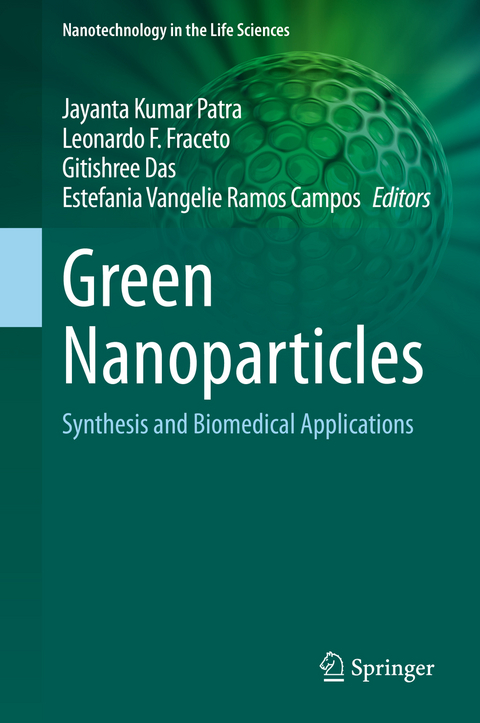
Green Nanoparticles (eBook)
394 Seiten
Springer International Publishing (Verlag)
978-3-030-39246-8 (ISBN)
Jayanta Kumar
Preface 6
Contents 8
About the Editors 10
Chapter 1: Biomedical Applications of Stimuli-Responsive Hydrogels 12
1 Introduction 12
2 PEG-Based Temperature-Sensitive Hydrogels: Structural and Physicochemical Properties 14
2.1 Hydrogels Mechanical Properties and Phase Organization Studied by Rheological Analysis and Small-Angle X-Ray Scattering (SAXS): Implications on Drug-Controlled Release 15
2.2 Biomedical Applications of Thermosensitive PEG-Based Hydrogels: From Structural Organization to Biopharmaceutical Use 18
2.3 pH-Sensitive PEG-Based Hydrogels: Theoretical Principles in pH-Sensitive Delivery Systems 20
2.4 Strategies to Make PEG pH-Sensitive: Chemical Modifications and Their Biomedical Applications 23
3 Conclusion and Prospects 27
References 28
Chapter 2: Viral and Nonviral Drug Delivery Systems for Medical Health Care: An Overview 32
1 Introduction 33
2 Necessity for Delivery Vectors in Biological Systems 34
2.1 Physical Protection 34
2.2 Targeted Delivery 34
2.3 Sustained Release 34
2.4 Regulated Rate of Clearance 36
3 General Overview of Viral Delivery Vectors 36
3.1 Adenovirus 36
3.2 Retrovirus 37
3.3 Designing a Retroviral Vector 38
3.4 Phage Virus 38
3.5 Filamentous Phage 38
3.6 Lambda Phage 39
4 General Overview of Non-viral Delivery Vectors 39
4.1 Liposomes 39
4.1.1 Ongoing Research and Clinically Approved Liposomal-Based Delivery Systems in Therapeutics 41
4.2 Microparticles 41
5 Microparticles for Delivery of Therapeutic Drugs 41
6 Microparticles for the Delivery of Genetic Material 42
6.1 Nanoparticles 43
7 Nanoparticulate-Based Drug Delivery in Cancer 44
8 Nanoparticle-Based Drug Delivery for the Treatment for Tuberculosis 44
9 Hazards Associated with Various Delivery Systems 45
10 Latest Trends in the Field of Vector-Mediated Delivery Systems 45
10.1 Niosomes 46
11 Conclusion 46
References 49
Chapter 3: Nanotoxicology in Plants 53
1 Introduction 53
2 Nanomaterials 54
2.1 Classification of Nanomaterials 55
2.1.1 Carbon-Based Nanomaterials 55
2.1.2 Inorganic-Based Nanomaterials 56
2.1.3 Quantum Dots 56
2.1.4 Organic-Based Nanomaterials (Biomaterials) 57
2.2 Nanomaterial Production 57
2.3 Transport, Distribution, and the Fate of Nanomaterials in the Environment 58
3 Plants 58
3.1 Nonvascular Plants 61
3.2 Vascular Plants 61
3.2.1 Tissues 61
3.2.2 Seeds 65
3.2.3 Germination 66
3.3 Associations with Microorganisms 67
3.4 Plant Stress Response Mechanisms 68
4 Plant Nanotoxicology 68
4.1 Uptake of Nanomaterials in Plant Tissues 69
4.2 Toxic Effects of Nanomaterials on Plants 71
5 Nanotoxicological Evaluation Techniques in Plants 71
6 Conclusions 77
References 78
Chapter 4: Carbon Nanotubes as Plant Growth Regulators: Prospects 87
1 Introduction 88
2 Classification of the CNTs and Their Main Characteristics 88
2.1 Classification of the CNT According to the Wall Structure 89
2.2 Classification of the SWCNT by Carbon Configuration 89
2.3 Characteristics 91
3 Repository, Movement, Fate, and Bioavailability of Natural or Engineering CNTs in the Environment 92
3.1 Effects and Fate of CNTs in Plants 92
3.2 Release of CNTs 94
4 Main Uses of CNTs in the Agriculture Sector 95
4.1 Fertilizers 96
4.2 Pesticide 98
4.3 Other Concerns 99
5 Uptake, Transport, and Accumulation of CNTs in Plant Cells 99
6 Beneficial and Harmful Effects of CNTs in Plants 103
7 Effects of CNTs on Soils and Their Organisms 110
8 Conclusion 114
References 115
Chapter 5: Nanobiosensors for Bioclinical Applications: Pros and Cons 126
1 Introduction 126
2 Nanotechnology as a Revolution in Biosensor Design 127
2.1 Carbon-Based Nanomaterials 130
2.1.1 Carbon Nanotubes 130
2.1.2 Graphene 131
2.2 Metal Nanoparticles 133
2.3 Titanium Dioxide Nanotubes 134
2.4 Zinc Oxide Nanoparticles 134
3 Immobilization Strategies at the Nanoscale 134
4 Nanomaterials as Mediators 137
5 Nanomaterials as Signal Amplifiers 138
6 Nanomaterials for Bioreceptor Labelling 140
7 Nanomaterials to Project Microfluidics, Lab-on-a-Chip and Point-of-Care 141
8 Nanoelectronics 143
9 Nanoparticle Toxicity 145
10 Green Nanomaterials 146
11 Conclusions 149
References 150
Chapter 6: Stimuli-Responsive Nano-Drug Delivery Systems for Cancer Therapy 159
1 Introduction 159
2 Stimuli-Used for Trigger Drug Release 160
3 Internal Stimuli-Responsive Drug Delivery Systems 160
3.1 pH-Responsive Drug Delivery System 160
3.2 Redox-Responsive Drug Delivery System 162
3.3 Enzyme-Responsive Drug Delivery Systems 164
4 Exogenous Stimuli-Responsive Drug Delivery System 165
4.1 Thermo-responsive Drug Delivery System 165
4.2 Photo-/Light-Responsive Drug Delivery System 165
4.3 Magnetic-Responsive Drug Delivery System 166
4.4 Ultrasound-Responsive Drug Delivery System 166
5 Dual- and Multi-responsive Drug Delivery System 166
6 Conclusion and Future Prospects 168
References 168
Chapter 7: Plant-Mediated Synthesis of Silver and Gold Nanoparticles for Antibacterial and Anticancer Applications 171
1 Introduction: Integration of Biology and Nanotechnology 171
2 Approaches of Synthesis 172
3 Plant-Derived Biosynthesis of Silver and Gold Nanoparticles 175
4 Techniques for Characterization of Nanoparticles 181
5 Plant-Derived Silver and Gold Nanoparticles as Antibacterial Agents 181
6 Antibacterial Modes of Action of p-AgNPs and p-AuNPs 184
7 Cytotoxic Studies of p-AgNPs and p-AuNPs 185
8 Conclusion 187
References 187
Chapter 8: Challenges in Nanobiosensor Aiming Bioscience Applications 195
1 Introduction 195
2 pH Sensing Theory 198
3 pH Sensitivity and Linearity 200
4 Measurement Processes of pH Sensing 200
References 201
Chapter 9: Topical Delivery of Drugs for Skin Disease Treatment: Prospects and Promises 204
1 Introduction 204
2 Plant-Based Green Synthesis of Nanoparticles 206
3 Protein-Based Drug Delivery System 207
4 The Recent Development of Topical Delivery on Skin 210
5 How Nanoparticles Used as Drug Delivery System? Nanoparticles Are Used as Drug Delivery System? 212
6 Application of Nanoparticles Used in Various Fields 214
7 Conclusion and Future Prospects 215
References 216
Chapter 10: Biosynthesis of Nanoparticles and Their Potential Application in Food and Agricultural Sector 220
1 Introduction 220
2 Biosynthesis of Nanoparticles 222
3 Biosynthesis of Nanoparticle Through Plants 223
4 Biosynthesis of Nanoparticle Through Bacteria 225
5 Biosynthesis of Nanoparticle Through Yeast 226
6 Status on Food Nanotechnology 226
7 Status on Agriculture Nanotechnology 227
8 Toxicological Fundamentals and Risk Assessment 227
9 Future Prospects and Conclusion 228
References 228
Chapter 11: Nanoparticles in Biomedical Applications 233
1 Introduction 233
2 Applications of Nanoparticles 235
3 Role of Nanotechnology in Biomedical Applications 236
3.1 In Drug Delivery 236
3.2 Biosensing/Immunosensing 238
3.3 Bioimaging 239
3.4 In Therapeutics 241
3.5 The Radiotherapy 243
3.6 In Diagnosis 244
3.7 Animal Cell Culture 244
3.8 Tissue and Implant Engineering 245
3.8.1 Alteration of Biomaterial Surfaces by Nanotechnology 245
3.8.2 Alteration of Surface Topographically 246
3.8.3 Introduction of Nanoscale Chemical Molecules on a Surface 246
3.9 Antimicrobial Effects 247
3.10 Scaffolds Based on Nanomaterials 247
4 Conclusion 249
References 249
Chapter 12: Nanoparticles and Their Applications in DNA Technology 257
1 Introduction 257
2 Structure and Function of DNA 258
3 DNA Nanotechnology 259
3.1 Structural DNA Nanotechnology 260
3.1.1 G-quadruplexes and Z-DNA 261
3.1.2 I-motifs 261
3.1.3 Catenanes 262
3.1.4 Aptamers 262
3.1.5 DNAzymes 262
3.1.6 DNA Origami 263
3.2 Dynamic DNA Nanotechnology 263
3.2.1 DNA Actuators 264
3.2.2 DNA Walkers 264
3.2.3 DNA Origami Machines 264
4 Nanoparticles and DNA 265
4.1 Nanoparticles Integrated into DNA Structures 265
4.2 Nanoparticles Integrated into or Templated by DNA 265
4.2.1 Gold Nanoparticles 266
4.2.2 Silver Nanoparticles 267
4.2.3 Copper, Platinum, and Palladium Nanoparticles 268
4.2.4 Magnetic Nanoparticles 270
4.2.5 Quantum Dots 270
4.2.6 Other DNA-Based Nanosystems 271
4.2.7 Biodegradable and Metal DNA Nanoparticles for Transfection 271
5 Conclusion and Future Perspective 273
References 273
Chapter 13: Nanoparticles on Photosynthesis of Plants: Effects and Role 278
1 Introduction 278
2 Nanoparticles and Its Effects on Plant System 280
3 Influence of Nanoparticles on Photosynthesis 282
4 Different Nanoparticles Affecting Plant Photosynthesis 283
4.1 Metallic Nanoparticle 285
4.2 Nonmetallic Nanoparticle 287
5 Conclusion 287
References 288
Chapter 14: Biomedical Applications of Nanoparticles Synthesized from Mushrooms 293
1 Introduction 293
2 Mushroom-Mediated Synthesis of Metallic NPs 294
2.1 Silver Nanoparticles 294
2.2 Gold Nanoparticles 294
2.3 Selenium Nanoparticles 295
2.4 Iron Nanoparticles 295
2.5 Zinc Sulfide Nanoparticles 295
2.6 Cadmium Sulfide Nanoparticles 296
3 Biomedical Applications of Mushroom NPs 296
3.1 Antibacterial Activity 296
3.2 Antifungal Activity 299
3.3 Antioxidant Activity 301
3.4 Anticancer Activity 301
4 Conclusion and Future Prospects 303
References 303
Chapter 15: Green Synthesis of Nanoparticles by Mangrove Plants and Its Biomedical Application 308
1 Introduction 308
2 Biomedical Application of Green Synthesized Nanoparticles 313
2.1 Drug Delivery 313
2.2 Bioimaging 314
2.3 Biosensors and Labeling 314
2.4 Medicine and Dentistry 315
3 Synthesis of Nanoparticles by Mangroves and Their Application 316
4 Conclusion 317
References 318
Chapter 16: Nanoemulsion Formulation as an Effective Therapeutic Drug Delivery System in Diabetes Mellitus 320
1 Introduction 320
2 Nanoemulsion and Drug Delivery 321
3 Nanoemulsion, Its Preparation, and Applications as Drug Delivery 322
4 Diabetes Mellitus (DM) 323
5 Applications of NE as Therapeutics in DM 325
6 Conclusion and Challenges 329
References 330
Chapter 17: Synthesis of Pigment-Mediated Nanoparticles and Its Pharmacological Applications 333
1 Introduction 334
2 Microbial Pigments 334
3 Nanoparticle Synthesis 336
4 Different Methods of Metallic Nanoparticle Synthesis 336
5 Pharmacological Applications of Pigment-Mediated Metallic Nanoparticles 337
6 Antibacterial Activities of Metallic Nanoparticles 337
7 Antifungal Activities of Metallic Nanoparticles 339
8 Anti-Inflammatory Activities of Metallic Nanoparticles 339
9 Anticancer Activity on Pigment-Mediated Nanoparticles 340
10 Antioxidant Mechanisms of Pigment-Mediated Nanoparticles 340
11 Factors Influencing Synthesis of Pigment-Mediated Nanoparticles 341
11.1 Method 341
11.2 pH Effect 341
11.3 Temperature Influence 342
11.4 Time 342
11.5 Particle Shape and Size 342
11.6 Concentration 343
11.7 Zeta Potential 343
11.8 Environment 343
12 Challenges in Nanotechnology 343
13 Conclusions 344
References 344
Chapter 18: Nanotechnology and Its Role in Malaria Treatment 349
1 Introduction 349
1.1 Nanotechnology 350
2 Role of Nanotechnology in Malaria Treatment 351
2.1 Lipid-Based Nanoparticles 351
2.2 Nucleic Acid–Based Nanotherapy 353
2.3 Protein-Based Nanotechnology for Malaria Treatment 353
2.4 Green Nanotechnology for the Therapy of Malaria 354
2.5 Nanotechnology for the Control of Malaria Vectors 355
3 Nanotechnology and Its Limitations 355
4 Conclusion 356
References 357
Chapter 19: Plant-Mediated Synthesis of Metal Oxide Nanocomposites for Environmental Remediation 361
1 Introduction 361
2 Multifunctional Activities of Plant-Mediated Synthesized Metal Oxide Nanocomposites Towards Pollution Abatement 363
2.1 Degradation of Toxic Dyes 363
2.2 Degradation of Toxic Elements Present in Water Other Than Dyes 366
2.3 Biosynthesized Metal Oxide Nanocomposites as Sensors 367
2.4 Biosynthesized Metal Oxide Nanocomposites as Adsorbents 367
3 Conclusion and Future Prospects 368
References 368
Chapter 20: Actinobacterial Nanoparticles: Green Synthesis, Evaluation and Applications 372
1 Introduction 372
2 Nanoparticles: Different Types 374
3 Actinobacterial Nanoparticle Biosynthesis 374
3.1 Extracellular Synthesis of Actinobacterial Nanoparticles 375
3.2 Intracellular Synthesis of Actinobacterial Nanoparticles 376
4 Characterisation and Evaluation of Actinobacterial Nanoparticles 377
5 Applications 378
5.1 Antibacterial Properties 379
5.2 Antifungal Properties 379
5.3 Anti-biofouling Properties 380
5.4 Antioxidative Properties 380
5.5 Anti-parasitic Properties 380
5.6 Anti-malarial Properties 380
5.7 Anticancerous Properties 381
5.8 Biosensing Properties 381
6 Conclusion 381
References 382
Index 386
| Erscheint lt. Verlag | 6.4.2020 |
|---|---|
| Reihe/Serie | Nanotechnology in the Life Sciences | Nanotechnology in the Life Sciences |
| Zusatzinfo | X, 394 p. 72 illus., 64 illus. in color. |
| Sprache | englisch |
| Themenwelt | Naturwissenschaften ► Biologie ► Botanik |
| Technik | |
| Schlagworte | Biomedical Applications • Drug Delivery • green nanotechnology • nanobiotechnology • Plant-based nanoparticles • systematic botany |
| ISBN-10 | 3-030-39246-5 / 3030392465 |
| ISBN-13 | 978-3-030-39246-8 / 9783030392468 |
| Informationen gemäß Produktsicherheitsverordnung (GPSR) | |
| Haben Sie eine Frage zum Produkt? |
 PDF (Wasserzeichen)
DRM: Digitales Wasserzeichen
Dieses eBook enthält ein digitales Wasserzeichen und ist damit für Sie personalisiert. Bei einer missbräuchlichen Weitergabe des eBooks an Dritte ist eine Rückverfolgung an die Quelle möglich.
Dateiformat: PDF (Portable Document Format)
Mit einem festen Seitenlayout eignet sich die PDF besonders für Fachbücher mit Spalten, Tabellen und Abbildungen. Eine PDF kann auf fast allen Geräten angezeigt werden, ist aber für kleine Displays (Smartphone, eReader) nur eingeschränkt geeignet.
Systemvoraussetzungen:
PC/Mac: Mit einem PC oder Mac können Sie dieses eBook lesen. Sie benötigen dafür einen PDF-Viewer - z.B. den Adobe Reader oder Adobe Digital Editions.
eReader: Dieses eBook kann mit (fast) allen eBook-Readern gelesen werden. Mit dem amazon-Kindle ist es aber nicht kompatibel.
Smartphone/Tablet: Egal ob Apple oder Android, dieses eBook können Sie lesen. Sie benötigen dafür einen PDF-Viewer - z.B. die kostenlose Adobe Digital Editions-App.
Buying eBooks from abroad
For tax law reasons we can sell eBooks just within Germany and Switzerland. Regrettably we cannot fulfill eBook-orders from other countries.
aus dem Bereich