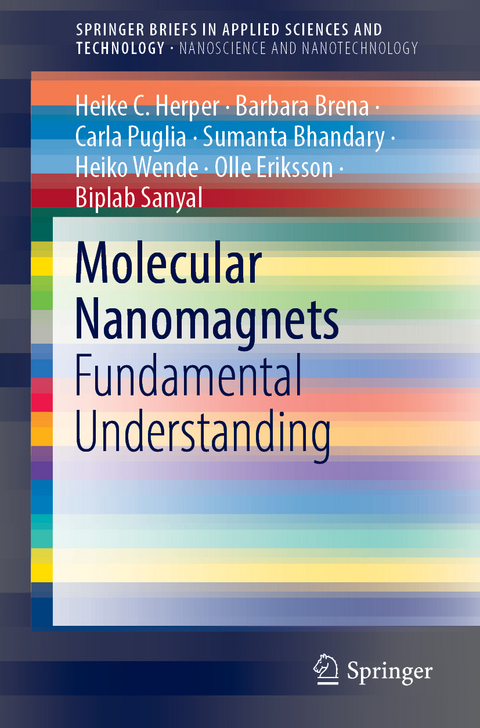
Molecular Nanomagnets (eBook)
XIV, 73 Seiten
Springer Singapore (Verlag)
978-981-15-3719-6 (ISBN)
This book focuses on 3d transition metal centered phthalocyanine molecules and their deposition on different substrates. Phthalocyanines are an ideal prototype since they can be grown flat on many surfaces. It highlights the molecule-substrate interaction and its influence on the magnetic and spectroscopic properties of the molecules as well as the influence of ligands - reviewing both experiential and theoretical data. Since experimental setups differ and approximations in theory vary and can influence the result, a substantial part is dedicated to a thorough discussion of the different experimental and computational methods from the point of view of reliability and predictive power.
Heike Herper is a researcher in the Division of Materials Theory at Uppsala University, Sweden. Her research focuses on the investigation of magnetic materials reaching from bulk to molecules deposited on metals aiming to identify new candidates for applications, in particular to find non-hazardous replacement materials for existing permanent magnets.
Barbara Brena is a researcher in the Division of Materials Theory at Uppsala University, Sweden. Her research focuses on electronic structure calculations, in particular she is interested in modeling soft x-ray spectroscopies of organic molecular materials, which are hot candidates for novel and environmental friendly technologies.
Carla Puglia is an Associate Professor in the division of Molecular and Condensed Matter Physics at Uppsala University, Sweden. Her research focus is on Many-body effects and excitonic features in materials.
Heiko Wende is a Professor and Head of the Magnetic Nanostructures group at the University of Duisburg-Essen. His research interests are in the area of Magnetic molecules; Magnetic Nanoparticles; Magnetic thin films and heterostructures.
Olle Eriksson is a Professor in the Division of Materials Theory at Uppsala University, Sweden. His research interests are in first principles calculations of bulk and surfaces, including magnetism and chemical bonding.
Biplab Sanyal is currently and Associate Professor in the Division of Materials Theory at Uppsala University, Sweden. His research interests are in the area of material structures. To his credit he has over 200 publications and 70 invited talks. He is a member of IEEE and the American Physical Society.
This book focuses on 3d transition metal centered phthalocyanine molecules and their deposition on different substrates. Phthalocyanines are an ideal prototype since they can be grown flat on many surfaces. It highlights the molecule-substrate interaction and its influence on the magnetic and spectroscopic properties of the molecules as well as the influence of ligands - reviewing both experiential and theoretical data. Since experimental setups differ and approximations in theory vary and can influence the result, a substantial part is dedicated to a thorough discussion of the different experimental and computational methods from the point of view of reliability and predictive power.
Foreword 6
Preface 8
Acknowledgements 9
Contents 10
Acronyms 12
1 Introduction 14
References 16
2 Experimental Techniques 18
2.1 X-ray Absorption Spectroscopy (XAS) 18
2.1.1 Coupling of FePc to Co Film 20
2.2 Photoelectron Spectroscopy (PES) 24
2.3 Adsorbate Core Level Shift: Final State Effects 26
2.4 Scanning Tunneling Microscopy (STM) 27
References 29
3 Theoretical Methods 31
3.1 Density Functional Theory 31
3.2 Hybrid Functionals 31
3.3 Electron Correlation 32
3.4 van der Waals Interaction 33
3.5 Magneto-Crystalline Anisotropy 34
3.6 Spin Dipole Moment 35
References 36
4 Electronic Structure of Isolated Molecules 37
4.1 Phthalocyanines with Transition Metal Center 37
4.2 MnPc 39
4.3 FePc 41
4.4 CoPc 43
4.5 NiPc 43
4.6 CuPc 44
References 45
5 Electron Correlation and Spin Transition 47
5.1 Electron Correlation: DFT++ 47
5.2 Dynamical Hybridization Function 49
5.3 The Spin Transition 50
5.4 Kondo Effect and Hybrdization Function 53
References 54
6 Interaction with Substrates 56
6.1 Metal Substrates 56
6.1.1 Structural Aspects 57
6.1.2 Magnetic Coupling 63
6.1.3 Spin Moments and the Spin Dipole Contribution 68
6.2 Nonmetallic and Complex Substrates 71
References 72
7 Influence of Ligands 76
7.1 Phthalocyanine Molecules with Ligands 76
References 78
8 Applications 79
8.1 Spin Filtering Concept 79
8.2 Molecular Multilayers/Molecular Films 80
References 83
| Erscheint lt. Verlag | 28.3.2020 |
|---|---|
| Reihe/Serie | Nanoscience and Nanotechnology |
| Nanoscience and Nanotechnology | |
| Nanoscience and Nanotechnology | |
| SpringerBriefs in Applied Sciences and Technology | SpringerBriefs in Applied Sciences and Technology |
| Zusatzinfo | XIV, 73 p. 23 illus., 21 illus. in color. |
| Sprache | englisch |
| Themenwelt | Technik ► Maschinenbau |
| Schlagworte | 3d Transition Metal • Electron Correlation Effects • Magnetic molecules • Magnetic Nanoparticles • magnetocrystalline anisotropy • photoelectron spectroscopy • Phthalocyanine Molecules • Scanning Tunneling Microscopy • Spin-dipole Moments • x-ray magnetic circular dichroism |
| ISBN-10 | 981-15-3719-4 / 9811537194 |
| ISBN-13 | 978-981-15-3719-6 / 9789811537196 |
| Informationen gemäß Produktsicherheitsverordnung (GPSR) | |
| Haben Sie eine Frage zum Produkt? |
 PDF (Wasserzeichen)
DRM: Digitales Wasserzeichen
Dieses eBook enthält ein digitales Wasserzeichen und ist damit für Sie personalisiert. Bei einer missbräuchlichen Weitergabe des eBooks an Dritte ist eine Rückverfolgung an die Quelle möglich.
Dateiformat: PDF (Portable Document Format)
Mit einem festen Seitenlayout eignet sich die PDF besonders für Fachbücher mit Spalten, Tabellen und Abbildungen. Eine PDF kann auf fast allen Geräten angezeigt werden, ist aber für kleine Displays (Smartphone, eReader) nur eingeschränkt geeignet.
Systemvoraussetzungen:
PC/Mac: Mit einem PC oder Mac können Sie dieses eBook lesen. Sie benötigen dafür einen PDF-Viewer - z.B. den Adobe Reader oder Adobe Digital Editions.
eReader: Dieses eBook kann mit (fast) allen eBook-Readern gelesen werden. Mit dem amazon-Kindle ist es aber nicht kompatibel.
Smartphone/Tablet: Egal ob Apple oder Android, dieses eBook können Sie lesen. Sie benötigen dafür einen PDF-Viewer - z.B. die kostenlose Adobe Digital Editions-App.
Buying eBooks from abroad
For tax law reasons we can sell eBooks just within Germany and Switzerland. Regrettably we cannot fulfill eBook-orders from other countries.
aus dem Bereich