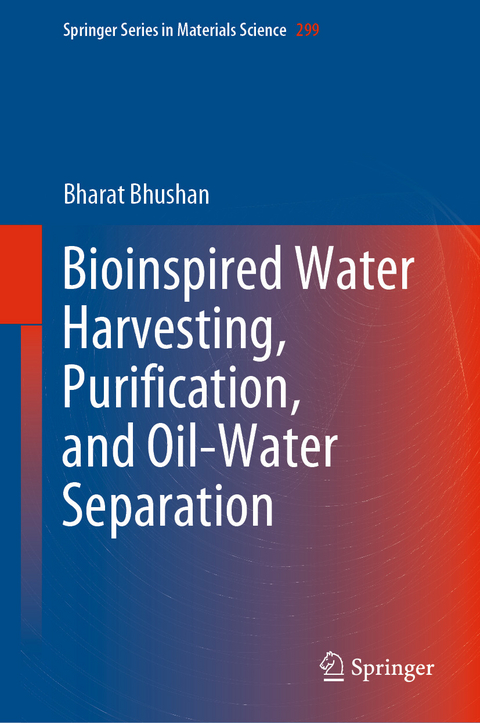
Bioinspired Water Harvesting, Purification, and Oil-Water Separation (eBook)
XIX, 232 Seiten
Springer International Publishing (Verlag)
978-3-030-42132-8 (ISBN)
Preface 9
Contents 11
About the Author 16
1 Introduction: Water Supply and Management 19
1.1 Water Supply 19
1.2 Water Consumption 23
1.3 Water Contamination 25
1.4 Human Impact from Lack of Safe Water Supply 26
1.5 Lessons from Nature to Supplement Water Supply and Remove Contamination 26
1.6 Organization of the Book 27
References 28
2 Overview of Arid Desert Conditions, Water Sources, and Desert Plants and Animals 29
2.1 Water Sources 34
2.1.1 Fog and Mist 34
2.1.2 Condensation of Water Vapor 39
2.2 Desert Plants and Water Harvesting Mechanisms 40
2.2.1 Wildflowers 41
2.2.2 Cacti and Other Succulents 43
2.2.3 Trees and Shrubs 43
2.2.4 Grasses, Mosses and Lichens 44
2.2.5 Summary of Water Harvesting Mechanisms 44
2.3 Desert Animals and Water Harvesting Mechanisms 47
2.3.1 Mammals 48
2.3.2 Birds 49
2.3.3 Reptiles 50
2.3.3.1 Snakes 50
2.3.3.2 Lizards 51
2.3.3.3 Tortoises 51
2.3.4 Fish 51
2.3.5 Amphibians 52
2.3.6 Invertebrates 52
2.3.6.1 Beetles 53
2.3.6.2 Flat Bugs 53
2.3.6.3 Crustaceans 54
2.3.7 Summary of Water Harvesting Mechanisms 54
References 59
3 Selected Water Harvesting Mechanisms—Lessons from Living Nature 65
3.1 Cactus 66
3.2 Grass 69
3.3 Desert Moss 69
3.4 Bushes 70
3.5 Namib Desert Beetles 70
3.6 Lizards 70
3.7 Rattlesnakes 71
3.8 Spider Webs 72
3.9 Summary 72
Appendix 3.A: Laplace Pressure Gradient on a Conical Surface 75
Appendix 3.B: Definition of Various Wetting States 76
References 77
4 Bioinspired Flat and Conical Surfaces for Water Harvesting 80
4.1 Experimental Details 81
4.1.1 Fabrication of Water Collector Surfaces for Fog 81
4.1.1.1 Flat Surfaces with Homogeneous and Heterogeneous Wettability 81
4.1.1.2 Conical Surfaces With and Without Grooves and Homogeneous and Heterogeneous Wettability 83
4.1.2 Fabrication of Water Collector Surfaces for Condensation 86
4.1.2.1 Single Cone 86
4.1.2.2 Array 88
4.1.3 Experimental Apparatuses for Water Collection 89
4.1.3.1 Single Droplet Experiments 89
4.1.3.2 Water Collection from Fog 89
4.1.3.3 Water Collection from Condensation 91
4.1.3.4 Water Collection Measurements 92
4.2 Results and Discussion—Fog Water Collection Studies 92
4.2.1 Flat Surfaces with Various Wettability and Beetle-Inspired Surfaces at 45° and 0° Inclination Angles 93
4.2.2 Cylinder Versus Cone at 0° Inclination Angle 95
4.2.3 Cones at 45° Inclination Angle and Comparison with Flat Surfaces 97
4.2.4 Single Droplet Experiments on Cones 98
4.2.5 Cones—Effect of Geometry, Inclination, Grooves and Heterogeneous Wettability 102
4.2.5.1 Two Tip Angles with Same Surface Area 102
4.2.5.2 Two Tip Angles with Same Length 104
4.2.5.3 Inclination Angle 104
4.2.5.4 Velocity of Droplets 106
4.2.5.5 Grooves 107
4.2.5.6 Heterogeneous Wettability 109
4.2.5.7 Conical Array 110
4.2.5.8 Summary 111
4.2.6 Nonlinear Cones 111
4.2.7 Projection for Water Collection Rates 114
4.3 Results and Discussion—Water Condensation Studies 117
4.3.1 Cylinder Versus Cone 117
4.3.2 Two Tip Angles with Same Surface Area 119
4.3.3 Two Tip Angles with Same Length 121
4.3.4 Inclination Angle 121
4.3.5 Array 123
4.3.6 Trends in Water Collection in Condensation Versus Fog 123
4.4 Design Guidelines for Water Harvesting Systems 126
References 129
5 Bioinspired Triangular Patterns on Flat Surfaces for Water Harvesting 130
5.1 Experimental Details 131
5.1.1 Fabrication of Water Collection Surfaces 131
5.1.1.1 Single Triangular Patterns and Triangular Array 131
5.1.1.2 Rectangular and Triangular Patterns with Multistep Wettability Gradient 133
5.1.1.3 Nested Triangular Patterns 134
5.1.2 Experimental Apparatuses for Water Collection 135
5.1.2.1 Water Collection from Condensation 135
5.1.2.2 Water Collection from Fog 136
5.1.2.3 Water Collection from Fog and Condensation 137
5.1.2.4 Water Collection Measurements 138
5.2 Results and Discussion—Water Condensation Studies 138
5.2.1 Rectangular Versus Triangular Pattern and Various Wettabilities 139
5.2.2 Single Droplet Experiments on Hydrophilic Triangular Patterns 140
5.2.3 Hydrophilic Triangular Patterns—Effect of Geometry and Relative Humidity 143
5.2.3.1 Included Angles 144
5.2.3.2 Relative Humidity 144
5.2.4 Array of Hydrophilic Triangular Patterns 146
5.2.5 Summary 147
5.3 Results and Discussion—Fog Water Collection Studies 149
5.3.1 Included Angles 149
5.3.2 Array of Triangular Patterns 149
5.3.3 Summary 152
5.4 Results and Discussion—Fog Water Collection and Condensation Studies 152
5.4.1 Flat Hydrophilic Surfaces Under Different Conditions 152
5.4.2 Triangular Patterns Under Different Conditions 155
5.4.3 Array of Triangular Patterns Under Fog and Condensation 156
5.4.4 Summary 157
5.5 Results and Discussion—Water Condensation Studies Using Surfaces with Multistep Wettability Gradient 158
5.5.1 Single Droplet Experiments on Flat Surfaces 159
5.5.2 Rectangular Sample Patterns 160
5.5.3 Triangular Patterns 163
5.5.4 Summary 165
5.6 Results and Discussion—Water Condensation Studies Using Nested Triangular 166
5.6.1 Single Droplet Experiment 166
5.6.2 Water Condensation and Transport on Patterns 167
5.6.3 Summary 169
5.7 Design Guidelines for Water Harvesting Systems 169
References 169
6 Commercial Applications, Projections of Water Collection, and Design of Water Harvesting Towers 171
6.1 Commercial Applications 171
6.2 Projection of Water Collection Rates in Water Harvesting 171
6.3 Design of Water Harvesting Towers 172
6.4 Operational and Maintenance Cost 174
6.5 Scaleup and Commercialization Issues 175
References 176
7 Bioinspired Water Desalination and Water Purification Approaches Using Membranes 177
7.1 Multi-cellular Structures 180
7.2 Aquaporins 181
7.2.1 Pore-Forming Molecules 182
7.2.2 Carbon Nanotubes 184
7.2.3 Self-assembled Block Copolymers 185
7.3 Dual pH- and Ammonia-Vapor-Responsive Electrospun Nanofibrous Polymer Membranes with Superliquiphilic/Phobic Properties 186
7.4 Summary 187
References 188
8 Selected Oil-Water Separation Techniques—Lessons from Living Nature 191
8.1 Lotus Leaf and Shark Skin for Superliquiphobicity/philicy 191
8.2 Fabrication Approaches for Superliquiphobic/philic Porous Surfaces for Oil-Water Separation 193
References 195
9 Bioinspired Oil-Water Separation and Water Purification Approaches Using Superliquiphobic/philic Porous Surfaces and External Stimuli 197
9.1 Coated Stainless Steel Mesh for Separation of Immiscible Oil-Water Mixtures 198
9.1.1 Fabrication Technique 200
9.1.2 Characterization of Coated Glass Surfaces 202
9.1.2.1 Surface Morphology 202
9.1.2.2 Wettability 203
9.1.2.3 Wear Resistance 203
9.1.3 Characterization of Coated Stainless Steel Mesh Surfaces for Oil-Water Separation 205
9.1.4 Applications to Oil Spill Cleanup and Water Purification 205
9.1.5 Summary 208
9.2 Coated Cotton Fabric for Separation of Immiscible Oil-Water Mixtures 208
9.2.1 Fabrication and Characterization Techniques 209
9.2.2 Surface Morphology and Wettability 210
9.2.3 Physical and Chemical Durability 211
9.2.4 Self-cleaning Properties 214
9.2.5 Separation of Immiscible Oil-Water Mixtures 215
9.2.6 Summary 216
9.3 Coated Cotton for Separation of Oil-Water Emulsions 216
9.3.1 Fabrication and Characterization Techniques 217
9.3.1.1 Fabrication Technique 217
9.3.1.2 Preparation of Emulsions 218
9.3.1.3 Wettability 219
9.3.1.4 Separation Method of Immiscible Mixtures and Emulsions 219
9.3.2 Surface Morphology and Wettability 220
9.3.3 Separation of Oil-Water Mixtures 221
9.3.3.1 Immiscible Oil-Water Mixtures 221
9.3.3.2 Oil-in-Water Emulsions 221
9.3.4 Summary 225
9.4 TiO2-Based Material Using UV Stimulus for Water Purification 225
9.4.1 Fabrication Technique of a Switchable Superliquiphobic/philic Coating 226
9.4.2 Photocatalytic Degradation of Contaminants for Water Purification 227
9.4.3 Water Purification Studies 227
9.4.4 Summary 230
9.5 Closure 230
Appendix 9.A: Introduction to Various Oil-Water Separation Techniques Commercially Used for Oil Spill Cleanup 233
9.A.1 Dispersants 234
9.A.2 Controlled Burning 235
9.A.3 Sorbents 235
9.A.4 Skimmers 237
9.A.5 Booms 238
References 238
10 Closure 241
References 243
Index 244
| Erscheint lt. Verlag | 24.3.2020 |
|---|---|
| Reihe/Serie | Springer Series in Materials Science | Springer Series in Materials Science |
| Zusatzinfo | XIX, 232 p. 153 illus., 91 illus. in color. |
| Sprache | englisch |
| Themenwelt | Technik ► Maschinenbau |
| Schlagworte | Bioinspired Surfaces for Water Collection • Oil-Water Separation • Superhydrophobic Surfaces • Superoleophobic Surfaces • Water Collection and Purification • water industry and water technology • Water Supply and Management |
| ISBN-10 | 3-030-42132-5 / 3030421325 |
| ISBN-13 | 978-3-030-42132-8 / 9783030421328 |
| Informationen gemäß Produktsicherheitsverordnung (GPSR) | |
| Haben Sie eine Frage zum Produkt? |
 PDF (Wasserzeichen)
DRM: Digitales Wasserzeichen
Dieses eBook enthält ein digitales Wasserzeichen und ist damit für Sie personalisiert. Bei einer missbräuchlichen Weitergabe des eBooks an Dritte ist eine Rückverfolgung an die Quelle möglich.
Dateiformat: PDF (Portable Document Format)
Mit einem festen Seitenlayout eignet sich die PDF besonders für Fachbücher mit Spalten, Tabellen und Abbildungen. Eine PDF kann auf fast allen Geräten angezeigt werden, ist aber für kleine Displays (Smartphone, eReader) nur eingeschränkt geeignet.
Systemvoraussetzungen:
PC/Mac: Mit einem PC oder Mac können Sie dieses eBook lesen. Sie benötigen dafür einen PDF-Viewer - z.B. den Adobe Reader oder Adobe Digital Editions.
eReader: Dieses eBook kann mit (fast) allen eBook-Readern gelesen werden. Mit dem amazon-Kindle ist es aber nicht kompatibel.
Smartphone/Tablet: Egal ob Apple oder Android, dieses eBook können Sie lesen. Sie benötigen dafür einen PDF-Viewer - z.B. die kostenlose Adobe Digital Editions-App.
Buying eBooks from abroad
For tax law reasons we can sell eBooks just within Germany and Switzerland. Regrettably we cannot fulfill eBook-orders from other countries.
aus dem Bereich