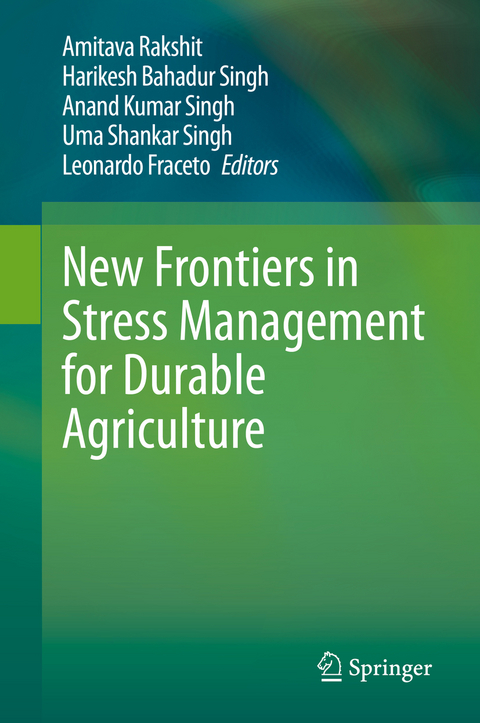
New Frontiers in Stress Management for Durable Agriculture (eBook)
660 Seiten
Springer Singapore (Verlag)
978-981-15-1322-0 (ISBN)
Using accessible farming practices to meet the growing demands on agriculture is likely to result in more intense competition for natural resources, increased greenhouse gas emissions, and further deforestation and land degradation, which will in turn produce additional stress in the soil-water-plant-animal continuum. Stress refers to any unfavorable force or condition that inhibits customary functioning in plants. Concurrent manifestations of different stresses (biotic and abiotic) are very frequent in the environment of plants, which consequently reduces yield.
Better understanding stress not only changes our perspective on the current environment, but can also bring a wealth of benefits, like improving sustainable agriculture and human beings' living standards. Innovative systems are called for that protect and enhance the natural resource base, while increasing productivity via 'holistic' approaches, such as agroecology, agro-forestry, climate-smart agriculture and conservation agriculture, which also incorporate indigenous and traditional knowledge. The book 'New Frontiers in Stress Management for Durable Agriculture' details the current state of knowledge and highlights scientific advances concerning novel aspects of plant biology research on stress, biotic and abiotic stress responses, as well as emergent amelioration and reclamation technologies to restore normal functioning in agroecology.
Amitava Rakshit, an IIT, Kharagpur alumnus is presently the faculty member in the Department of Soil Science and Agricultural Chemistry at Institute of Agricultural Sciences, Banaras Hindu University(IAS, BHU). Dr.Rakshit worked in the Department of Agriculture, Government of West Bengal in administration and extension roles. He has visited Scandinavia, Europe and Africa pertaining to his research work and presentation. He was awarded with TWAS Nxt Fellow (Italy),BiovisionNxt Fellow (France), Darwin Now Bursary(British Council),Young achiever award and Best Teacher's Award at UG and PG level . He is serving as review college member of British Ecological Society, London since 2011, member of Global Forum on Food Security and Nutrition of FAO, Rome and Commission on Ecosystem Management of IUCN. He has published 70 research papers, 35 book chapters, 28 popular articles, one manual and co-authored twenty books.
Harikesh Bahadur Singh is presently a retired Professor of Mycology and Plant Pathology from IAS, BHU. Over the past 35 years, Professor Singh has served at Central Universities and CSIR Institutes with his teaching and research. Based on his scientific contribution and leadership in the field of plant pathology, Professor Singh has been honoured with prestigious awards, such as the CSIR technology award, M.S. Swaminathan award, Mundkur Memorial award, and BRSI Industrial Medal. His research has resulted in more than 300 publications and 17 books.
Anand Kumar Singh is presently the deputy director general of horticulture, Indian Council of Agricultural Research, has a bachelor's degree in Agriculture from Banars Hindu University, a master's and PhD in Horticulture with a specialization in Pomology from Indian Agricultural Research Institute, New Delhi. His research area include genetic improvement of fruit crops, plant Tissue culture and transcriptome analysis of mango. He was honored with several prestigious awards, notable being, Mombusho Award (1989) by Japanese Govt. ,visiting scientist award by Association of International Education, Japan (1999); DBT Overseas Associateship Award (2006); Gold Medal: The Horticultural Society of India (2008); Fellow of National Academy of Agricultural Sciences(2016) and many more.
Uma Shankar Singh did his graduation from Delhi University; Master and PhD in Plant Pathology from G.B. Pant University of Agriculture & Technology (GBPUAT), Pantnagar, India. Presently Dr. Singh is South Asia Regional Coordinator & India Country Manager at International Potato Center. He was Director of IRRI South Asia Regional Center (ISARC) & Principal Scientist at International Rice Research Institute (IRRI). Dr. Singh is the main architect of three historical regional seed agreements on varietal and seed sharing among 6 countries from South & South East Asia. These innovative interventions helped to achieve an unprecedented speed of diffusion of STRVs benefiting millions of poor farmers in South Asia.Dr. Singh has authored/co-authored 188 scientific papers, 51 book chapters, ten books in 17 volumes and 9 technical bulletins.
Leonardo Fernandes Fraceto has a bachelor's degree in Chemistry from the State University of Campinas (1997), a master's in Functional and Molecular Biology from the State University of Campinas (2000) and a PhD in Functional and Molecular Biology from the State University of Campinas (2003). He is currently an Associate Professor at the Institute of Science and Technology of São Paulo State University (UNESP), Campus Sorocaba at the Environmental Engineering undergraduate course and at the postgraduate in Environmental Sciences. He coordinated the Postgraduate Program in Environmental Sciences of Unesp/Sorocaba (from 2012 to 2016). He has experience in chemistry and biochemistry, with an emphasis on environmental nanotechnology and applications of nanotechnology in agriculture.
Using accessible farming practices to meet the growing demands on agriculture is likely to result in more intense competition for natural resources, increased greenhouse gas emissions, and further deforestation and land degradation, which will in turn produce additional stress in the soil-water-plant-animal continuum. Stress refers to any unfavorable force or condition that inhibits customary functioning in plants. Concurrent manifestations of different stresses (biotic and abiotic) are very frequent in the environment of plants, which consequently reduces yield. Better understanding stress not only changes our perspective on the current environment, but can also bring a wealth of benefits, like improving sustainable agriculture and human beings' living standards. Innovative systems are called for that protect and enhance the natural resource base, while increasing productivity via 'holistic' approaches, such as agroecology, agro-forestry, climate-smart agriculture and conservation agriculture, which also incorporate indigenous and traditional knowledge. The book 'New Frontiers in Stress Management for Durable Agriculture' details the current state of knowledge and highlights scientific advances concerning novel aspects of plant biology research on stress, biotic and abiotic stress responses, as well as emergent amelioration and reclamation technologies to restore normal functioning in agroecology.
| Erscheint lt. Verlag | 23.3.2020 |
|---|---|
| Zusatzinfo | XXIV, 660 p. 72 illus., 53 illus. in color. |
| Sprache | englisch |
| Themenwelt | Naturwissenschaften ► Biologie ► Ökologie / Naturschutz |
| Naturwissenschaften ► Biologie ► Zellbiologie | |
| Naturwissenschaften ► Geowissenschaften | |
| Technik ► Umwelttechnik / Biotechnologie | |
| Weitere Fachgebiete ► Land- / Forstwirtschaft / Fischerei | |
| Schlagworte | abiotic stress • Agriculture • biotic stress • Ecosystem Restoration • Priming |
| ISBN-10 | 981-15-1322-8 / 9811513228 |
| ISBN-13 | 978-981-15-1322-0 / 9789811513220 |
| Informationen gemäß Produktsicherheitsverordnung (GPSR) | |
| Haben Sie eine Frage zum Produkt? |
 PDF (Wasserzeichen)
DRM: Digitales Wasserzeichen
Dieses eBook enthält ein digitales Wasserzeichen und ist damit für Sie personalisiert. Bei einer missbräuchlichen Weitergabe des eBooks an Dritte ist eine Rückverfolgung an die Quelle möglich.
Dateiformat: PDF (Portable Document Format)
Mit einem festen Seitenlayout eignet sich die PDF besonders für Fachbücher mit Spalten, Tabellen und Abbildungen. Eine PDF kann auf fast allen Geräten angezeigt werden, ist aber für kleine Displays (Smartphone, eReader) nur eingeschränkt geeignet.
Systemvoraussetzungen:
PC/Mac: Mit einem PC oder Mac können Sie dieses eBook lesen. Sie benötigen dafür einen PDF-Viewer - z.B. den Adobe Reader oder Adobe Digital Editions.
eReader: Dieses eBook kann mit (fast) allen eBook-Readern gelesen werden. Mit dem amazon-Kindle ist es aber nicht kompatibel.
Smartphone/Tablet: Egal ob Apple oder Android, dieses eBook können Sie lesen. Sie benötigen dafür einen PDF-Viewer - z.B. die kostenlose Adobe Digital Editions-App.
Buying eBooks from abroad
For tax law reasons we can sell eBooks just within Germany and Switzerland. Regrettably we cannot fulfill eBook-orders from other countries.
aus dem Bereich