


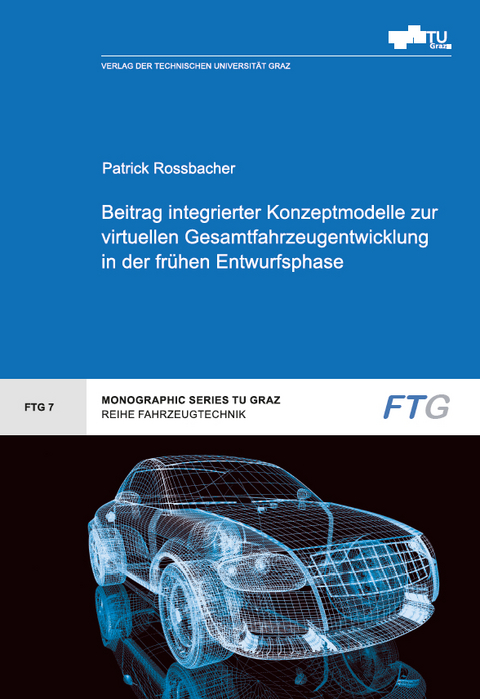
Beitrag integrierter Konzeptmodelle zur virtuellen Gesamtfahrzeugentwicklung in der frühen Entwurfsphase
Seiten
2020
Verlag d. Technischen Universität Graz
978-3-85125-730-4 (ISBN)
Verlag d. Technischen Universität Graz
978-3-85125-730-4 (ISBN)
- Titel nicht im Sortiment
- Artikel merken
Das vorliegende Buch beschreibt einen möglichen Ansatz zur virtuellen Abbildung geometrischer und funktionaler Produktmerkmale eines Fahrzeugs in der frühen Phase der Automobilentwicklung. Damit lassen sich mögliche Potentiale und Risiken eines Fahrzeugentwurfs effizient sowie nachvollziehbar darstellen und bewerten.
Die Automobilentwicklung befindet sich in einem radikalen Umbruch. Der zunehmende Klimawandel verstärkt die Forderung nach umweltverträglicheren Antriebssystemen und regenerativen Kraftstoffen. Zusätzlich führt der Wandel in ökologischer, ökonomischer, sozialer und technologischer Hinsicht zu einem komplexen Anforderungsspektrum. Daraus resultiert ein Bedarf an flexiblen Fahrzeugarchitekturen, um die vielfältigen und teils gegensätzlichen Anforderungen erfüllen zu können. Da die Fahrzeugarchitektur durch ihre Gestalt einen hohen Einfluss auf zentrale Fahrzeugeigenschaften aufweist, ist die frühzeitige Kenntnis über deren Ausprägung von essentieller Bedeutung. Hierzu wird ein sog. integriertes Konzeptmodell vorgestellt. Dieses besteht im Kern aus unterschiedlichen Teilmodellen, die über ein flexibles parametrisches Framework konsistent zu einem virtuellen Gesamtfahrzeugmodell verknüpft werden. Damit lassen sich geometrische und funktionale Eigenschaften eines Fahrzeugkonzeptes durchgängig virtuell abbilden und analysieren. Die praktische Anwendung des vorgestellten Ansatzes wird anhand von ausgewählten Beispielen aus der automobilen Konzeptauslegung gezeigt. Today, automotive development has to face a broad spectrum of numerous exciting challenges. For instance, the imminent shortage of fossil energy in combination with the increasing urbanisation leads to discussions in the direction of alternative and innovative drive-trains, usage of regenerative energy sources and lighter as well as more efficient cars. This causes automotive companies to think about new vehicle architectures, which can be flexibly adapted to the specific market and customer needs. Because of today's globalisation of the automotive customer market, vehicle producers have to face a growing number of competitors. This leads to the attempt to reduce the required development time, to be present on the global market with innovative product solutions as fast as possible. From the process point of view there are two basic mechanisms, which are used simultaneously to meet this challenge: On the one hand there are strong efforts to increase the product knowledge in early phases of the development process (front-loading). On the other hand there are attempts to parallelise specific sections of the development process, in order to reduce the required development time or to use the gained time to analyse more concept variants (concurrent engineering). This has extensive implications on the entire vehicle: The so called vehicle architecture department is accounted for the overall physical representation of the vehicle. This department defines the authorised technological spaces within the car and moderates spatial conflicts during the technical development and solution finding process. Because of the increasing number of vehicle functions and rising demands the available technical space within the car decreases despite the trend of rising exterior dimensions. This requires the exploration of functional aspects of the vehicle concept besides the traditional sole geometrical considerations already in the preliminary development phase. In order to support the entire vehicle development in the early concept phase, a novel approach for an integrated concept model is introduced. The basic idea of the approach is to enable a consistent interconnection between CAx-applications and expert tools in the context of the entire vehicle, in order to allow the efficient evaluation of geometrical and functional vehicle aspects of a concept. Because of the strong geometric focus of a vehicle architecture department, the core of the approach is a parametric-associative master-model, which contains all essential elements for the representation of the geometrical aspects of a concept. The use of interfaces and automation-based routines allows the bidirectional linkage with calculations and simulation models with the master-model. The master-model is fully maintained by implemented control routines, which allows the provision of a flexible parametrisation within the integrated concept model. This enables a variable adaptation of the implemented model relations according to the requirements of the concept. Furthermore, the data model allows the representation of different states (e.g. target-state, current-state), in order to satisfy the process-related demands within the conceptual development. Besides the representation of a virtual vehicle model, the presented approach offers a knowledge-based dimension. The application of a specialised evaluation system and archiving logic allows the storage of the engineering knowledge generated during the conceptual development. This supports an efficient and comprehensible reuse of the engineering knowledge in later project phases or in new vehicle projects./parThe practical realisation of the stated approach is shown by means of selected examples in the area of conceptual development.
Die Automobilentwicklung befindet sich in einem radikalen Umbruch. Der zunehmende Klimawandel verstärkt die Forderung nach umweltverträglicheren Antriebssystemen und regenerativen Kraftstoffen. Zusätzlich führt der Wandel in ökologischer, ökonomischer, sozialer und technologischer Hinsicht zu einem komplexen Anforderungsspektrum. Daraus resultiert ein Bedarf an flexiblen Fahrzeugarchitekturen, um die vielfältigen und teils gegensätzlichen Anforderungen erfüllen zu können. Da die Fahrzeugarchitektur durch ihre Gestalt einen hohen Einfluss auf zentrale Fahrzeugeigenschaften aufweist, ist die frühzeitige Kenntnis über deren Ausprägung von essentieller Bedeutung. Hierzu wird ein sog. integriertes Konzeptmodell vorgestellt. Dieses besteht im Kern aus unterschiedlichen Teilmodellen, die über ein flexibles parametrisches Framework konsistent zu einem virtuellen Gesamtfahrzeugmodell verknüpft werden. Damit lassen sich geometrische und funktionale Eigenschaften eines Fahrzeugkonzeptes durchgängig virtuell abbilden und analysieren. Die praktische Anwendung des vorgestellten Ansatzes wird anhand von ausgewählten Beispielen aus der automobilen Konzeptauslegung gezeigt. Today, automotive development has to face a broad spectrum of numerous exciting challenges. For instance, the imminent shortage of fossil energy in combination with the increasing urbanisation leads to discussions in the direction of alternative and innovative drive-trains, usage of regenerative energy sources and lighter as well as more efficient cars. This causes automotive companies to think about new vehicle architectures, which can be flexibly adapted to the specific market and customer needs. Because of today's globalisation of the automotive customer market, vehicle producers have to face a growing number of competitors. This leads to the attempt to reduce the required development time, to be present on the global market with innovative product solutions as fast as possible. From the process point of view there are two basic mechanisms, which are used simultaneously to meet this challenge: On the one hand there are strong efforts to increase the product knowledge in early phases of the development process (front-loading). On the other hand there are attempts to parallelise specific sections of the development process, in order to reduce the required development time or to use the gained time to analyse more concept variants (concurrent engineering). This has extensive implications on the entire vehicle: The so called vehicle architecture department is accounted for the overall physical representation of the vehicle. This department defines the authorised technological spaces within the car and moderates spatial conflicts during the technical development and solution finding process. Because of the increasing number of vehicle functions and rising demands the available technical space within the car decreases despite the trend of rising exterior dimensions. This requires the exploration of functional aspects of the vehicle concept besides the traditional sole geometrical considerations already in the preliminary development phase. In order to support the entire vehicle development in the early concept phase, a novel approach for an integrated concept model is introduced. The basic idea of the approach is to enable a consistent interconnection between CAx-applications and expert tools in the context of the entire vehicle, in order to allow the efficient evaluation of geometrical and functional vehicle aspects of a concept. Because of the strong geometric focus of a vehicle architecture department, the core of the approach is a parametric-associative master-model, which contains all essential elements for the representation of the geometrical aspects of a concept. The use of interfaces and automation-based routines allows the bidirectional linkage with calculations and simulation models with the master-model. The master-model is fully maintained by implemented control routines, which allows the provision of a flexible parametrisation within the integrated concept model. This enables a variable adaptation of the implemented model relations according to the requirements of the concept. Furthermore, the data model allows the representation of different states (e.g. target-state, current-state), in order to satisfy the process-related demands within the conceptual development. Besides the representation of a virtual vehicle model, the presented approach offers a knowledge-based dimension. The application of a specialised evaluation system and archiving logic allows the storage of the engineering knowledge generated during the conceptual development. This supports an efficient and comprehensible reuse of the engineering knowledge in later project phases or in new vehicle projects./parThe practical realisation of the stated approach is shown by means of selected examples in the area of conceptual development.
| Erscheinungsdatum | 13.03.2020 |
|---|---|
| Reihe/Serie | Monographic Series TU Graz | Reihe Fahrzeugtechnik ; 7 |
| Verlagsort | Graz |
| Sprache | deutsch |
| Maße | 155 x 225 mm |
| Einbandart | kartoniert |
| Themenwelt | Technik ► Fahrzeugbau / Schiffbau |
| Technik ► Maschinenbau | |
| Schlagworte | Automobilentwicklung • CAD • Fahrzeug-Package • Integrierte Entwicklung • parametrisch-assoziative Konstruktion • virtuelle Entwicklung • virtuelles Gesamtfahrzeug |
| ISBN-10 | 3-85125-730-8 / 3851257308 |
| ISBN-13 | 978-3-85125-730-4 / 9783851257304 |
| Zustand | Neuware |
| Informationen gemäß Produktsicherheitsverordnung (GPSR) | |
| Haben Sie eine Frage zum Produkt? |
Mehr entdecken
aus dem Bereich
aus dem Bereich
Grundlagen, Komponenten und Systeme für assistiertes und …
Buch | Hardcover (2024)
Springer Vieweg (Verlag)
CHF 389,95
Biomechanik, Unfallvermeidung, Insassenschutz, Sensorik, Sicherheit …
Buch | Hardcover (2024)
Springer Vieweg (Verlag)
CHF 139,95


