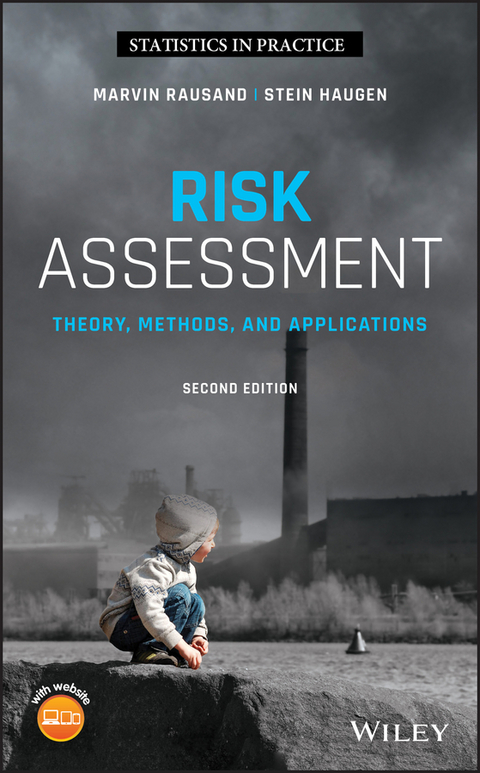
Risk Assessment (eBook)
John Wiley & Sons (Verlag)
978-1-119-37722-1 (ISBN)
Introduces risk assessment with key theories, proven methods, and state-of-the-art applications
Risk Assessment: Theory, Methods, and Applications remains one of the few textbooks to address current risk analysis and risk assessment with an emphasis on the possibility of sudden, major accidents across various areas of practice-from machinery and manufacturing processes to nuclear power plants and transportation systems. Updated to align with ISO 31000 and other amended standards, this all-new 2nd Edition discusses the main ideas and techniques for assessing risk today.
The book begins with an introduction of risk analysis, assessment, and management, and includes a new section on the history of risk analysis. It covers hazards and threats, how to measure and evaluate risk, and risk management. It also adds new sections on risk governance and risk-informed decision making; combining accident theories and criteria for evaluating data sources; and subjective probabilities. The risk assessment process is covered, as are how to establish context; planning and preparing; and identification, analysis, and evaluation of risk. Risk Assessment also offers new coverage of safe job analysis and semi-quantitative methods, and it discusses barrier management and HRA methods for offshore application. Finally, it looks at dynamic risk analysis, security and life-cycle use of risk.
- Serves as a practical and modern guide to the current applications of risk analysis and assessment, supports key standards, and supplements legislation related to risk analysis
- Updated and revised to align with ISO 31000 Risk Management and other new standards and includes new chapters on security, dynamic risk analysis, as well as life-cycle use of risk analysis
- Provides in-depth coverage on hazard identification, methodologically outlining the steps for use of checklists, conducting preliminary hazard analysis, and job safety analysis
- Presents new coverage on the history of risk analysis, criteria for evaluating data sources, risk-informed decision making, subjective probabilities, semi-quantitative methods, and barrier management
- Contains more applications and examples, new and revised problems throughout, and detailed appendices that outline key terms and acronyms
- Supplemented with a book companion website containing Solutions to problems, presentation material and an Instructor Manual
Risk Assessment: Theory, Methods, and Applications, Second Edition is ideal for courses on risk analysis/risk assessment and systems engineering at the upper-undergraduate and graduate levels. It is also an excellent reference and resource for engineers, researchers, consultants, and practitioners who carry out risk assessment techniques in their everyday work.
MARVIN RAUSAND, is Professor Emeritus in the Department of Mechanical and Industrial Engineering at the Norwegian University of Science and Technology, Norway, and author of System Reliability Theory: Models, Statistical Methods, and Applications and Reliability of Safety-Critical Systems: Theory and Applications, both published by Wiley.
STEIN HAUGEN, PHD, is Professor in the Department of Marine Technology at Norwegian University of Science and Technology, Norway.
MARVIN RAUSAND, is Professor Emeritus in the Department of Mechanical and Industrial Engineering at the Norwegian University of Science and Technology, Norway, and author of System Reliability Theory: Models, Statistical Methods, and Applications and Reliability of Safety-Critical Systems: Theory and Applications, both published by Wiley. STEIN HAUGEN, PHD, is Professor in the Department of Marine Technology at Norwegian University of Science and Technology, Norway.
Chapter 1
Introduction
1.1 Risk in Our Modern Society
In the Middle Ages, some of the leading engineers and architects were employed as church builders. In this period, churches changed from being built in the Romanesque style to the Gothic style. This transition implied a move from fairly massive stone structures with thick walls, limited height, and relatively small and few windows to a style with much more slender structures, rising higher, and with more and larger openings in the walls for windows. This technological development had a price, with frequent collapses of the new churches. A prominent example is the collapse of Cathedrale Saint‐Pierre de Beauvais in 1284 and then again in 1573 (Murray 1989).
Figure 1.1 The Beauvais Cathedral (Source: Photo by David Iliff. License: CC‐BY‐SA 3.0).This is a good example of how technology traditionally has evolved, through trying and failing. The church builders of the Middle Ages moved beyond what had been done earlier, and this sometimes led to catastrophic failures.
In the Middle Ages, accidents were seen as acts of God, punishing man for attempting to construct such huge buildings. Today, we have a different view on why accidents occur, and society is not willing to accept failure to the same degree as in the Middle Ages. Accidents result in loss of life or serious environmental damage and are often very expensive. Over the last few decades, concepts and techniques have been developed to help us understand and prevent failures and accidents before they happen, rather than just trying to learn from failures that occur. Application of these techniques is what we normally call risk analysis or risk assessment.
Risk assessments are systematic studies of what can go wrong in the future, describing it and evaluating if we need to do something to reduce risk. They might have been able to predict and prevent the collapse of the Beauvais Cathedral (Figure 1.1) and the consequences of this if these methods were available in 1284. This book is mainly about methods for performing risk analyses, and the theoretical basis for these.
Using a word from everyday language, we may say that risk assessment is a method for systematization of foresight. The Merriam‐Webster online dictionary defines foresight as “an act of looking forward” and this is exactly what we are trying to do when we analyze risk.
We have now started using terms, such as risk, risk analysis, and risk assessment, without really explaining what they mean. For the purpose of this introductory chapter, it is sufficient with a layman's understanding, but proper definitions and discussions are given in Chapters 2 and 3.
1.2 Important Trends
Many trends in society have led to increased focus on risk and risk assessment. Partly, this is due to increased attention to and reduced willingness to accept risk, partly due to increased risk, and partly due to new and different risk sources being introduced or emerging.
Increased attention and reduced willingness to accept risk often go hand in hand. When accidents occur, in particular serious accidents, the media attention is very high and the interest among the general public is correspondingly high. More rapid and comprehensive access to news about accidents, through the Internet, has further increased our attention (and fear) of accidents.
The increasing focus and our reduced preparedness to accept accidents may be seen as a result of our increasing wealth. In the rich part of the world, many of the dangers that we were exposed to earlier, such as life‐threatening diseases, hunger, and war are far less prominent in our lives. Our basic needs are generally well attended to and our attention has therefore turned to other causes of death and losses. This can explain why there are large differences in legislation, regulations, and general attention to risk in rich and poor countries. From this point of view, the expectation that accidents should be avoided can be seen as a result of the increasing standards of living.
Many new trends and developments either increase risk, change existing risk, or introduce new sources of risk. Some examples of different character are given in the following.
- Higher speed. In recent decades, high‐speed trains have become increasingly common. Higher speed implies more severe consequences if an accident occurs.
- Increasingly connected computer networks. More and more devices are linked through the Internet. This does not just apply to computers, but many other devices such as cars, kitchen appliances, power systems, electrical meters, heating systems in homes, and mobile phones. This introduces possibilities for accessing and hacking devices from anywhere in the world. The increased number of connected devices increases the possible consequences and the magnitude of the consequences. With the rapid expansion of the Internet of things this problem increases day by day.
- Increased competition and production pressure have several aspects that influence risk. Processes are moving faster with less time for preparation and planning, with increasing pressure to be efficient, leaving less time to take care to avoid accidents. Cost cutting may also increase risk.
- Autonomous systems is a new technology that changes risk. Less people are involved, meaning that fewer are exposed if an accident should occur. On the other hand, people not directly involved may be more exposed (e.g. pedestrians being hit by autonomous cars). Machines may be more reliable for routine tasks than operators, reducing the probability of making errors, but operators are usually better at adapting to unexpected or unusual circumstances. Autonomous systems are complex, and we may not be able to predict all the ways they can fail.
- Terrorism has existed for a long time, but mainly locally. It is only in the last couple of decades that this has become a global phenomenon.
- Climate change is a global problem that changes risk in many ways. Risk related to natural hazards changes, with not only more violent storms, frequent flooding but also droughts. The world can be affected in different ways, among others reduced food production and lack of drinking water. This can in turn lead to hunger and more refugees.
To manage the effect of all these changes, we need to understand them and this requires systematic methods to identify them and to analyze them.
1.3 Major Accidents
When used in risk research, a major accident is an accident with large and even catastrophic consequences. During the previous decades, a number of major accidents have made the public increasingly aware of the risk posed by certain technical systems and activities. A common denominator of these is that they not only have immediate effects in terms of loss of life, environmental damage, or economical effects but also long‐term effects by changing the public's and the authorities' attitudes toward the systems that have been involved in the accidents. A result of this is that changes in regulations often are made after major accidents. For companies involved, the consequences of these accidents not only incur enormous costs but may even force a company out of business and seriously damage the image of an entire industry. Examples of some past accidents with far‐reaching effects are listed in Table 1.1 . These accidents are representative of a large number of accidents that have served to remind us that safety can never be taken for granted. Macza (2008) discusses several of these accidents and the society's response to each accident with respect to legislation changes and other actions.
Table 1.1 Some past major accidents.
| Location of accident | Year | Consequences |
| North Atlantic | 1912 | Titanic colliding with an iceberg and sinking, 1500 killed. |
| Flixborough, UK | 1974 | Explosion and fire, 28 killed, more than 100 injured. |
| Seveso, Italy | 1976 | Dioxin release, 2000 poisoned, contamination of environment, mass evacuation. |
| North Sea, Norway | 1977 | Oil/gas blowout on Bravo platform, pollution of sea. |
| Three Mile Island, USA | 1979 | Nuclear accident. Limited actual consequences, but had potential for a major release of radiation. |
| Bhopal, India | 1984 | Release of toxic gas (MIC), 3800 killed, 500 000 exposed to gas. |
| Mexico City, Mexico | 1984 | Explosion and fire at LPG storage and distribution depot at San Juan Ixhautepec. Around 500 killed. |
| USA | 1986 | Explosion of Challenger space shuttle, 7 killed. |
| Chernobyl, Ukraine | 1986 | Explosion and atomic fallout at nuclear power station. |
| Basel, Switzerland | 1986 | Fire at Sandoz warehouse. Rhine River contaminated, severe environmental damage. |
| Erscheint lt. Verlag | 3.3.2020 |
|---|---|
| Reihe/Serie | Statistics in Practice |
| Statistics in Practice | Statistics in Practice |
| Sprache | englisch |
| Themenwelt | Mathematik / Informatik ► Mathematik ► Statistik |
| Mathematik / Informatik ► Mathematik ► Wahrscheinlichkeit / Kombinatorik | |
| Technik ► Elektrotechnik / Energietechnik | |
| Schlagworte | accident risk • Electrical & Electronics Engineering • Elektrotechnik u. Elektronik • Engineering • Engineering statistics • Finance & Investments • Finanz- u. Anlagewesen • hazard analysis • hazard identification</p> • Human Factors & Risk Assessment • Insurance & Risk Management • ISO 31000 • <p>risk assessment • Menschliche Faktoren u. Risikobewertung • Probability • Reliability • Risk • risk analysis • Risk Management • risk theory • security assessment • Statistics • Statistik • Statistik in den Ingenieurwissenschaften • System safety • Systems Engineering • Versicherungswesen u. Risikomanagement |
| ISBN-10 | 1-119-37722-6 / 1119377226 |
| ISBN-13 | 978-1-119-37722-1 / 9781119377221 |
| Informationen gemäß Produktsicherheitsverordnung (GPSR) | |
| Haben Sie eine Frage zum Produkt? |
 EPUB (Adobe DRM)
Kopierschutz: Adobe-DRM
Adobe-DRM ist ein Kopierschutz, der das eBook vor Mißbrauch schützen soll. Dabei wird das eBook bereits beim Download auf Ihre persönliche Adobe-ID autorisiert. Lesen können Sie das eBook dann nur auf den Geräten, welche ebenfalls auf Ihre Adobe-ID registriert sind.
Details zum Adobe-DRM
Dateiformat: EPUB (Electronic Publication)
EPUB ist ein offener Standard für eBooks und eignet sich besonders zur Darstellung von Belletristik und Sachbüchern. Der Fließtext wird dynamisch an die Display- und Schriftgröße angepasst. Auch für mobile Lesegeräte ist EPUB daher gut geeignet.
Systemvoraussetzungen:
PC/Mac: Mit einem PC oder Mac können Sie dieses eBook lesen. Sie benötigen eine
eReader: Dieses eBook kann mit (fast) allen eBook-Readern gelesen werden. Mit dem amazon-Kindle ist es aber nicht kompatibel.
Smartphone/Tablet: Egal ob Apple oder Android, dieses eBook können Sie lesen. Sie benötigen eine
Geräteliste und zusätzliche Hinweise
Buying eBooks from abroad
For tax law reasons we can sell eBooks just within Germany and Switzerland. Regrettably we cannot fulfill eBook-orders from other countries.
aus dem Bereich