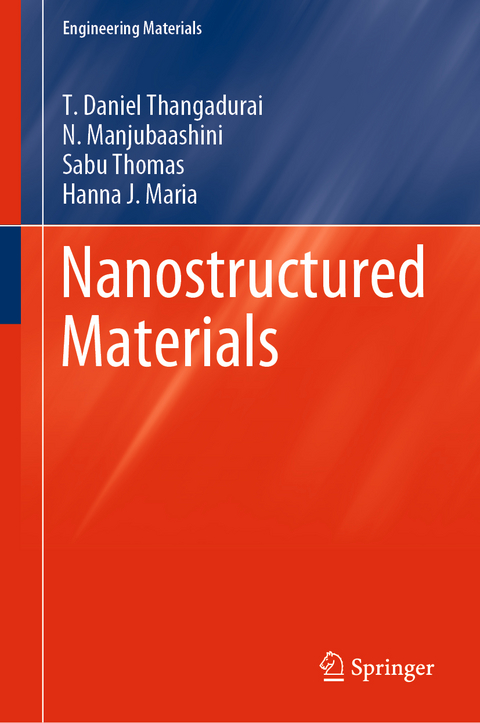
Nanostructured Materials (eBook)
210 Seiten
Springer International Publishing (Verlag)
978-3-030-26145-0 (ISBN)
This book discusses the early stages of the development of nanostructures, including synthesis techniques, growth mechanisms, the physics and chemistry of nanostructured materials, various innovative characterization techniques, the need for functionalization and different functionalization methods as well as the various properties of nanostructured materials. It focuses on the applications of nanostructured materials, such as mechanical applications, nanoelectronics and microelectronic devices, nano-optics, nanophotonics and nano-optoelectronics, as well as piezoelectric, agriculture, biomedical and, environmental remediation applications, and anti-microbial and antibacterial properties. Further, it includes a chapter on nanomaterial research developments, highlighting work on the life-cycle analysis of nanostructured materials and toxicity aspects.
Contents 6
1 Nanotechnology and Dimensions 13
1.1 Fundamentals of Nanomaterials 13
1.2 Dimensions of Nanomaterials 14
1.2.1 2D Confinement 14
1.2.2 1D Confinement 14
1.2.3 Zero Dimensional Confinement 15
1.3 Features of Nanoparticles 16
1.3.1 Activation of Particle Surface 16
1.3.2 Particle Size 16
1.3.3 Particle Shape 17
1.3.4 Two-Dimensional Particle Projection Image 17
1.3.5 Three-Dimensional Particle Image 17
1.4 Significances of Nanotechnology 19
1.5 Basic Concept of Nanotechnology 20
References 21
2 Nanomaterials, Properties and Applications 22
2.1 Brief Notes on Nanomaterials 22
2.2 Nanomaterial Properties 24
2.2.1 Structural Properties 24
2.2.2 Thermal Properties 25
2.2.3 Chemical Properties 26
2.2.4 Mechanical Properties 27
2.2.5 Magnetic Properties 27
2.2.6 Optical Properties 28
2.2.7 Electronic Properties 29
2.2.8 Physiochemical Properties of Nanomaterials 29
2.2.9 Specific Surface Area and Pore 34
2.3 Nanomaterial Synthesis Process 34
2.3.1 Top-Down Approach 34
2.3.2 Bottom-Up Approach 35
2.4 Applications of Nanomaterials 36
2.4.1 Environmental Sector 36
2.4.2 Health Sector 36
2.4.3 Energy Sector 37
References 38
3 Fundamentals of Nanostructures 40
3.1 Nanostructures Definition 40
3.2 Nanostructured Materials 41
3.2.1 1D Nanostructures 43
3.2.2 2D Nanostructures 43
3.2.3 3D Nanostructures 44
3.3 Features of Nanostructures 44
3.4 Theoretical Substantiation of the Approaches Proposed 45
3.5 Types of Nanostructured Material 47
3.5.1 Nanostructures in Plants 48
3.5.2 Nanostructures in Insects 50
3.5.3 Nanostructures in the Human Body 51
3.5.4 Ceramic Nanostructures 53
3.5.5 Polymer Nanostructures 53
3.5.6 Nanocomposites 53
3.5.7 Thin Films 54
3.5.8 Nanostructure Computation 54
References 55
4 Physics and Chemistry of Nanostructures 57
4.1 Nanostructured Materials 57
References 63
5 Quantum Effects, CNTs, Fullerenes and Dendritic Structures 64
5.1 Fullerenes Structures 64
5.2 Nanostructures 67
5.3 Laser-Assisted Metal-Catalyzed Nanowire Growth 68
5.4 Hierarchal Complexity in 1-D Nanostructures 69
5.5 Mechanical and Thermal Properties 72
5.6 Electronic Properties of Nanowires 73
5.7 Optical Properties of Nanowires 75
References 76
6 Semiconductors, Organic and Hybrid Nanostructures 78
6.1 Semiconductor Nanostructures 78
6.1.1 Quasi-One-Dimensional Systems 78
6.1.2 Double Quantum Well 79
6.1.3 The Size of Semiconductor Nanostructures 79
6.1.4 Electrostatics of a GaAs/AlGaAs Heterostructure 80
6.1.5 Applications of Semiconductor Nanostructures 80
6.2 Organic Nanostructures 81
6.2.1 Structures and Applications of Organic Nanostructures 82
6.2.2 Miscellaneous Application of Organic Nanostructures 82
6.3 Hybrid Nanostructures 83
6.3.1 Physical Deposition to Synthesize the Hybrid Nanostructures of Metal NPs/2D Materials 83
6.3.2 Chemical Reduction to Synthesize the Hybrid Nanostructures of Metal NPs/2D Materials 84
6.3.3 Applications of Hybrid Nanostructures 84
References 85
7 Properties of Nanostructured Materials 86
7.1 Unique Properties of Nanostructures 86
7.2 Physical Properties of Nanowires 87
7.2.1 Thermal Stability 87
7.2.2 Optical Properties 87
7.2.3 Electronic Properties 88
7.2.4 Mechanical Properties 88
7.2.5 Field Emission Properties 89
7.3 Grain Boundaries in Nanostructured Materials 89
7.4 Multifunctional Properties of Nanostructured Metallic Materials 90
7.4.1 Mechanical Properties 90
7.4.2 Strength Measurement 92
7.4.3 Superstrength and Ductility 96
7.4.4 Electrical Conductivity 97
7.4.5 Magnetic Properties 98
7.4.6 Corrosion Resistance 99
7.4.7 Reliability of Nanostructured Materials 100
7.4.8 Thermal Properties of Nanostructures 101
7.4.9 Thermal Conductance 102
References 103
8 Nanostructured Materials—Design and Approach 105
8.1 Synthesis of Nanostructured Materials 105
8.2 Nanostructure Synthesis and Fabrication Methods 106
8.2.1 Physical Vapor Deposition 107
8.3 Chemical Vapor Deposition 110
8.3.1 Thermal Chemical Vapor Deposition 111
8.3.2 Metal–Organic Chemical Vapor Deposition (MOCVD) 113
8.4 Solution-Based Chemistry 114
8.4.1 Hydrothermal Synthesis 114
8.4.2 Hydrolysis 115
8.4.3 Aqueous Chemical Growth 115
References 115
9 Functionalization of Nanostructures 117
9.1 Aspects of Nanostructure System 117
9.2 Chemistry of Nanostructure Functionalization 118
9.3 Need for Functionalization 118
9.4 Methods of Functionalization 119
9.5 Class of Functionalization 120
9.5.1 Thiol/Aminothiol 120
9.5.2 Bio-functionalization 120
9.5.3 Asymmetric Group 121
9.5.4 Polymers in Functionalization 122
9.5.5 Functionalization of Metals 122
9.5.6 Rare-Earth in Functionalization 122
9.6 Miscellaneous Functionalized Nanostructures 125
References 126
10 Characterization and Technical Analysis of Nanostructured Materials 127
10.1 Atomic Force Microscopy (AFM) 128
10.2 X-Ray Diffraction (XRD) 128
10.3 Scanning Probe Microscopies (SPM) 129
10.4 Field Ion Microscopy (FIM) 129
10.5 Raman Spectroscopy 130
10.6 Absorption Spectroscopy (UV-Vis) 131
10.7 Photoluminescence Spectroscopy (PL) 131
10.8 Field Emission Scanning Electron Microscopy (FESEM) 132
10.9 Confocal Microscopy 132
10.10 Transmission Electron Microscope (TEM) 133
10.11 X-Ray Photoelectron Spectroscopy (XPS) 134
10.12 Auger Electron Spectroscopy (AES) 135
References 135
11 Fabrication of Nanostructures 137
11.1 Lithography 137
11.1.1 Photolithography 137
11.1.2 Contact-Mode Photolithography (CMP) 139
11.1.3 Deep Ultra-Violet Lithography (DUV) 140
11.1.4 Phase-Shifting Photolithography 140
11.1.5 Electron Beam Lithography 141
11.1.6 X-Ray Lithography 143
11.1.7 Focused Ion Beam (FIB) Lithography 144
11.1.8 Neutral Atomic Beam Lithography 144
11.2 Nanolithography 146
11.2.1 AFM Based Nanolithography 147
11.2.2 Soft Lithography 147
11.2.3 Microcontact Printing 147
11.2.4 Molding 149
11.2.5 Nanoimprint 151
11.2.6 Dip-Pen Nanolithography 152
11.3 Etching 153
References 154
12 Nanostructured Materials for Optical and Electronic Applications 156
12.1 Applications of Nanostructured Materials in Solar Cells 156
12.1.1 Dye-Sensitized Nanostructured ZnO Electrodes for Solar Cell Applications 157
12.2 Photoconductive Oxide Nanowires as Nanoscale Optoelectronic Switches 157
12.3 Energy Storage, Batteries, Fuel Cells 159
12.4 Nanostructured Semiconductor Materials for Optoelectronic Applications 160
12.5 Carbon-Based Sensors and Electronics 162
References 166
13 Nanostructured Materials for Bioapplications 167
13.1 Nanostructured Ti and Ti Alloys for Biomedical Engineering 168
13.2 Nanostructured Materials for Biosensors 168
13.3 Nanobiotechnology 169
13.4 Gene Therapy 171
13.5 Bioimaging 171
13.6 Tissue Engineering and Regenerative Medicine 171
13.7 Bone Implant 172
13.8 Modulated Drug Delivery System 172
13.9 DNA Biosensor 173
13.10 Glucose Biosensor 173
13.11 Therapies 174
13.11.1 Photodynamic Therapy 174
13.11.2 Chemotherapy 175
13.11.3 Photothermal Therapy 175
References 176
14 Nanostructured Materials for Photonic Applications 177
14.1 Optical Waveguides Based on Small Organic Molecules 178
14.2 Optically Pumped Organic Lasers 179
14.3 3D Photonic Crystals 179
14.4 Photonic LEDs 180
14.5 Photonic Crystal Filters 180
14.6 Photonic Crystals: Bright Structural Colour from Functional Morphology 182
References 184
15 Nanostructured Materials for Environmental Remediation 185
15.1 Gas Treatment: Nano-Array Based Catalytic Converters 186
15.2 Remediation of Organohalides by Dye Sensitized TiO2 186
15.3 Water Split Application of the Nanostructure Photocatalyst 187
15.4 Nanostructure Photocatalyst for Water and Wastewater Treatment 187
15.5 Sensing the Chemical Environment with Semiconductor Nanostructures 189
15.6 Pollution Control Using Nanostructures 189
15.6.1 Air Pollution 189
15.6.2 Water Pollution 189
15.7 Field-Effect Transistor (FET) Sensors 190
References 191
16 Miscellaneous Applications of Nanostructures 193
16.1 Nanostructures in Aerospace Application 193
16.2 Nanostructures in RADAR Application 194
16.3 Nanostructures in Stealth Application 194
16.4 Nanostructured Electrode 195
16.5 Nanostructures in Antimicrobial Application 197
16.6 Nanostructures in Cosmetic Application 198
16.6.1 Chitin Nanofibril 198
16.6.2 Nanoparticles as UV Protective Filters in Sun Screens 198
References 199
17 Nanostructured Materials Life Time and Toxicity Analysis 200
17.1 Impact of Nanomaterials to Human Health and Ecosystems 201
17.2 Nanomaterial Toxicity 202
17.3 A Consideration of All Pertinent Sources of Nanomaterials 203
17.4 Nanoparticle Toxicity 204
17.4.1 Mechanisms of Toxicity 205
17.5 Interference of Nanoparticles with in Vitro Toxicity Assays 205
17.6 Nanotoxicology 205
References 206
18 Nanomaterials Research and Development 208
18.1 LCA—Life Cycle Assessment of Nanomaterials 208
18.2 The Role of Life Cycle Assessment in the Field of Nanotechnology 208
18.3 LCA Procedure 210
18.4 Life-Cycle Assessment of Engineered Nanomaterials 210
18.5 LCA of an Emerging Technology 211
18.6 Life Cycle Inventory (LCI) 212
18.7 Life Cycle Impact Assessment (LCIA) 213
18.8 LCA of Nanomaterials 214
References 214
| Erscheint lt. Verlag | 27.2.2020 |
|---|---|
| Reihe/Serie | Engineering Materials | Engineering Materials |
| Zusatzinfo | XI, 210 p. 88 illus., 31 illus. in color. |
| Sprache | englisch |
| Themenwelt | Technik ► Maschinenbau |
| Schlagworte | materials applications • materials characterization • Nanomaterials Synthesis • nanoparticle synthesis • Nanostructures formation |
| ISBN-10 | 3-030-26145-X / 303026145X |
| ISBN-13 | 978-3-030-26145-0 / 9783030261450 |
| Informationen gemäß Produktsicherheitsverordnung (GPSR) | |
| Haben Sie eine Frage zum Produkt? |
 PDF (Wasserzeichen)
DRM: Digitales Wasserzeichen
Dieses eBook enthält ein digitales Wasserzeichen und ist damit für Sie personalisiert. Bei einer missbräuchlichen Weitergabe des eBooks an Dritte ist eine Rückverfolgung an die Quelle möglich.
Dateiformat: PDF (Portable Document Format)
Mit einem festen Seitenlayout eignet sich die PDF besonders für Fachbücher mit Spalten, Tabellen und Abbildungen. Eine PDF kann auf fast allen Geräten angezeigt werden, ist aber für kleine Displays (Smartphone, eReader) nur eingeschränkt geeignet.
Systemvoraussetzungen:
PC/Mac: Mit einem PC oder Mac können Sie dieses eBook lesen. Sie benötigen dafür einen PDF-Viewer - z.B. den Adobe Reader oder Adobe Digital Editions.
eReader: Dieses eBook kann mit (fast) allen eBook-Readern gelesen werden. Mit dem amazon-Kindle ist es aber nicht kompatibel.
Smartphone/Tablet: Egal ob Apple oder Android, dieses eBook können Sie lesen. Sie benötigen dafür einen PDF-Viewer - z.B. die kostenlose Adobe Digital Editions-App.
Buying eBooks from abroad
For tax law reasons we can sell eBooks just within Germany and Switzerland. Regrettably we cannot fulfill eBook-orders from other countries.
aus dem Bereich