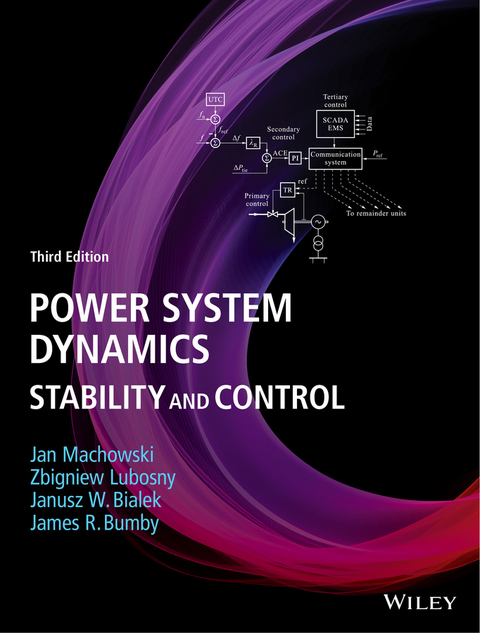
Power System Dynamics (eBook)
John Wiley & Sons (Verlag)
978-1-119-52636-0 (ISBN)
An authoritative guide to the most up-to-date information on power system dynamics
The revised third edition of Power System Dynamics and Stability contains a comprehensive, state-of-the-art review of information on the topic. The third edition continues the successful approach of the first and second editions by progressing from simplicity to complexity. It places the emphasis first on understanding the underlying physical principles before proceeding to more complex models and algorithms. The book is illustrated by a large number of diagrams and examples.
The third edition of Power System Dynamics and Stability explores the influence of wind farms and virtual power plants, power plants inertia and control strategy on power system stability. The authors-noted experts on the topic-cover a range of new and expanded topics including:
- Wide-area monitoring and control systems.
- Improvement of power system stability by optimization of control systems parameters.
- Impact of renewable energy sources on power system dynamics.
- The role of power system stability in planning of power system operation and transmission network expansion.
- Real regulators of synchronous generators and field tests.
- Selectivity of power system protections at power swings in power system.
- Criteria for switching operations in transmission networks.
- Influence of automatic control of a tap changing step-up transformer on the power capability area of the generating unit.
- Mathematical models of power system components such as HVDC links, wind and photovoltaic power plants.
- Data of sample (benchmark) test systems.
Power System Dynamics: Stability and Control, Third Edition is an essential resource for students of electrical engineering and for practicing engineers and researchers who need the most current information available on the topic.
Jan Machowski is Full Professor at the Warsaw University of Technology, Faculty of Electrical Engineering, Poland.
Zbigniew Lubosny is Full Professor at Gdansk University of Technology, Faculty of Electrical and Control Engineering, Poland.
Janusz W. Bialek, formerly Professor at Durham University and Edinburgh University, UK.
James R. Bumby, formerly Reader at Durham University, UK.
Jan Machowski is Full Professor at the Warsaw University of Technology, Faculty of Electrical Engineering, Poland. Zbigniew Lubosny is Full Professor at Gdansk University of Technology, Faculty of Electrical and Control Engineering, Poland. Janusz W. Bialek, formerly Professor at Durham University and Edinburgh University, UK. James R. Bumby, formerly Reader at Durham University, UK.
List of Symbols & Abbreviations
Notation
Italic type denotes scalar physical quantity (e.g. R, L, C) or numerical variable (e.g. x, y).
Phasor or complex quantity or numerical variable is underlined (e.g. , , ).
Italic with arrow on top of a symbol denotes a spatial vector (e.g. ).
Italic boldface denotes a matrix or a vector (e.g. A, B, x, y).
Unit symbols are written using roman type (e.g. Hz, A, kV).
Standard mathematical function are written using roman type (e.g. sin, cos).
Numbers are written using roman type (e.g. 5, 6).
Symbols representing numbers are written using roman type (e.g. π, e = 2.718282 – John Napier number, j – angular shift by 90°, a – angular shift by 120°).
Matrix transposition T is written using roman type.
Differential and partial differential coefficients are written using roman type (e.g. , ).
Symbols describing objects are written using roman type (e.g. TRAFO, LINE).
Subscript relating to objects is written using roman type (e.g. , ).
Subscript relating to physical quantity or numerical variable is written using italic type (e.g. Aij, xk).
Subscripts A, B, C refer to three‐phase axes of a generator.
Subscripts d, q refer to the direct‐ (d‐axis) and quadrature‐axis (q‐axis) components.
Lower case symbols normally denote instantaneous values (e.g. v, i).
Upper case symbols normally denote RMS or peak values (e.g. V, I).
Symbols
- a, a2
- operators shifting the angle by 120° and 240°, respectively.
- Bμ
- magnetizing susceptance of a transformer.
- Bsh
- susceptance of a shunt element.
- D
- damping coefficient.
- k
- kinetic energy of the rotor relative to the synchronous speed.
- p
- potential energy of the rotor with respect to the equilibrium point.
- ef
- field voltage referred to the fictitious q‐axis armature coil.
- eq
- steady‐state emf induced in the fictitious q‐axis armature coil proportional to the field winding self‐flux linkages.
- transient emf induced in the fictitious d‐axis armature coil proportional to the flux linkages of the q‐axis coil representing the solid steel rotor body (round‐rotor generators only).
- transient emf induced in the fictitious q‐axis armature coil proportional to the field winding flux linkages.
- subtransient emf induced in the fictitious d‐axis armature coil proportional to the total q‐axis rotor flux linkages (q‐axis damper winding and q‐axis solid steel rotor body).
- subtransient emf induced in the fictitious q‐axis armature coil proportional to the total d‐axis rotor flux linkages (d‐axis damper winding and field winding).
- steady‐state internal emf.
- excitation emf proportional to the excitation voltage Vf.
- Efm
- peak value of the excitation emf.
- Ed
- d‐axis component of the steady‐state internal emf proportional to the rotor self‐linkages due to currents induced in the q‐axis solid steel rotor body (round‐rotor generators only).
- Eq
- q‐axis component of the steady‐state internal emf proportional to the field winding self‐flux linkages (i.e. proportional to the field current itself).
- transient internal emf proportional to the flux linkages of the field winding and solid steel rotor body (includes armature reaction).
- d‐axis component of the transient internal emf proportional to flux linkages in the q‐axis solid steel rotor body (round‐rotor generators only).
- q‐axis component of the transient internal emf proportional to the field winding flux linkages.
- subtransient internal emf proportional to the total rotor flux linkages (includes armature reaction).
- d‐axis component of the subtransient internal emf proportional to the total flux linkages in the q‐axis damper winding and q‐axis solid steel rotor body.
- q‐axis component of the subtransient internal emf proportional to the total flux linkages in the d‐axis damper winding and the field winding.
- resultant air‐gap emf.
- Erm
- amplitude of the resultant air‐gap emf.
- EG
- vector of the generator emf's.
- f
- mains frequency.
- fn
- rated frequency.
- magnetomotive force (mmf) due to the field winding.
- armature reaction mmf.
- Fa ac
- ac armature reaction mmf (rotating).
- Fa dc
- dc armature reaction mmf (stationary).
- ,
- d‐ and q‐axis components of the armature reaction mmf.
- resultant mmf.
- GFe
- core loss conductance of a transformer.
- Gsh
- conductance of a shunt element.
- Hii, Hij
- self and mutual synchronizing power.
- iA, iB, iC
- instantaneous currents in phases A, B, and C.
- iA dc, iB dc, iC dc
- DC component of the current in phases A, B, and C.
- iA ac, iB ac, iC ac
- ac component of the current in phases A, B, and C.
- id, iq
- currents flowing in the fictitious d‐ and q‐axis armature coils.
- iD, iQ
- instantaneous d‐ and q‐axis damper winding current.
- if
- instantaneous field current of a generator.
- iABC
- vector of instantaneous phase currents.
- ifDQ
- vector of instantaneous currents in the field winding and the d‐ and q‐axis damper windings.
- i0dq
- vector of armature currents in the rotor reference frame.
- armature current.
- ,
- d‐ and q‐axis component of the armature current.
- ,
- currents at the sending and receiving end of a transmission line.
- ,
- vector of complex current injections to the retained and eliminated nodes.
- ,
- vector of complex generator and load currents.
- vector of load corrective complex currents.
- J
- moment of inertia.
- j
- operator shifting the angle by 90°.
- kPV, kQV
- voltage sensitivities of the load (the slopes of the real and reactive power demand characteristics as a function of voltage).
- kPf, kQf
- frequency sensitivities of the load (the slopes of the real and reactive power demand characteristics as a function of frequency).
- steady‐state synchronizing power coefficient (the slope of the steady‐state power angle curve ).
- transient synchronizing power coefficient (the slope of the transient power angle curve ).
- transient synchronizing power coefficient (the slope of the transient power angle curve ).
- Ki
- reciprocal of droop for the i‐th generating unit.
- KL
- frequency sensitivity coefficient of the system real power demand.
- KT
- reciprocal of droop for the total system generation characteristic.
- l
- length of a transmission line.
- LAA, LBB, LCC, Lff, LDD, LQQ
- self‐inductances of the windings of the phase windings A, B, and C; the field winding; and the d‐and the q‐axis damper winding.
- Ld, Lq
- inductances of the fictitious d‐ and q‐axis armature windings.
- , , ,
- d‐ and q‐axis transient and subtransient inductances.
- Lxy
- where x, y∈{A, B, C, D, Q, f} and x ≠ y are the mutual inductances between the windings denoted by the indices as described above.
- LS
- minimum value of the self‐inductance of a phase winding.
- ΔLS
- amplitude of the variable part of the self‐inductance of a phase winding.
- LR
- submatrix of the rotor self‐ and mutual inductances.
- LS
- submatrix of the stator self‐ and mutual inductances.
- LSR, LRS
- submatrices of the stator‐to‐rotor and rotor‐to‐stator mutual inductances.
- M
- coefficient of inertia.
- Mf, MD, MQ
- amplitude of the mutual inductance between a phase winding and, respectively, the field winding and the d‐ and q‐axis damper winding.
- N
- generally, number of turns of a winding.
- p
- number of poles.
- P, Q
- active (real) and reactive power, respectively.
- Pacc
- accelerating power.
- PD
- damping...
| Erscheint lt. Verlag | 25.2.2020 |
|---|---|
| Sprache | englisch |
| Themenwelt | Technik ► Elektrotechnik / Energietechnik |
| Schlagworte | classification of power systems • components of power systems • Electrical & Electronics Engineering • Elektrotechnik u. Elektronik • Energie • Energietechnik • Energy • Leistungselektronik • <p>dynamics of power systems • Power Electronics • Power Technology & Power Engineering • Qualität u. Zuverlässigkeit • Quality & Reliability • stability of power systems • supply quality electric energy • voltage stability</p> • Wind Power |
| ISBN-10 | 1-119-52636-1 / 1119526361 |
| ISBN-13 | 978-1-119-52636-0 / 9781119526360 |
| Informationen gemäß Produktsicherheitsverordnung (GPSR) | |
| Haben Sie eine Frage zum Produkt? |
 EPUB (Adobe DRM)
Kopierschutz: Adobe-DRM
Adobe-DRM ist ein Kopierschutz, der das eBook vor Mißbrauch schützen soll. Dabei wird das eBook bereits beim Download auf Ihre persönliche Adobe-ID autorisiert. Lesen können Sie das eBook dann nur auf den Geräten, welche ebenfalls auf Ihre Adobe-ID registriert sind.
Details zum Adobe-DRM
Dateiformat: EPUB (Electronic Publication)
EPUB ist ein offener Standard für eBooks und eignet sich besonders zur Darstellung von Belletristik und Sachbüchern. Der Fließtext wird dynamisch an die Display- und Schriftgröße angepasst. Auch für mobile Lesegeräte ist EPUB daher gut geeignet.
Systemvoraussetzungen:
PC/Mac: Mit einem PC oder Mac können Sie dieses eBook lesen. Sie benötigen eine
eReader: Dieses eBook kann mit (fast) allen eBook-Readern gelesen werden. Mit dem amazon-Kindle ist es aber nicht kompatibel.
Smartphone/Tablet: Egal ob Apple oder Android, dieses eBook können Sie lesen. Sie benötigen eine
Geräteliste und zusätzliche Hinweise
Buying eBooks from abroad
For tax law reasons we can sell eBooks just within Germany and Switzerland. Regrettably we cannot fulfill eBook-orders from other countries.
aus dem Bereich