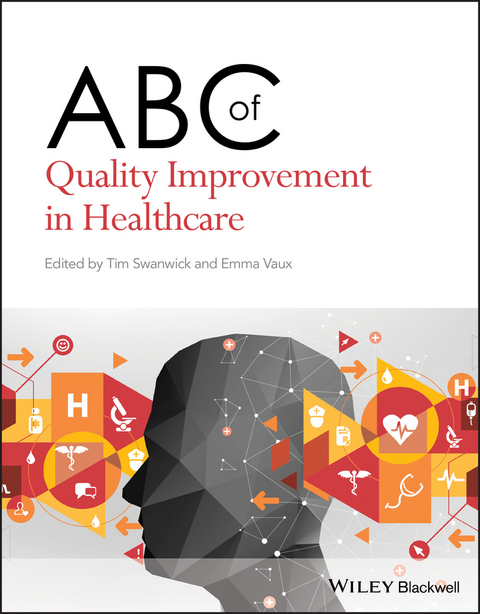
ABC of Quality Improvement in Healthcare (eBook)
John Wiley & Sons (Verlag)
978-1-119-56533-8 (ISBN)
Quality improvement (QI) is embedded in the fabric of successful healthcare organisations across the world, with healthcare professionals increasingly expected to develop and lead improvement as a core part of their clinical responsibilities. As a result, QI is rapidly becoming a feature of the education and training programmes of all healthcare professionals.
Written and edited by some of the leading clinicians and managers in the field, ABC of Quality Improvement is designed for clinicians new to the discipline, as well as experienced leaders of change and improvement. Providing comprehensive coverage and clear, succinct descriptions of the major tools, techniques and approaches, this new addition to the ABC series demystifies quality improvement and develops a broader understanding of what constitutes quality in healthcare. With practical examples of improvement interventions and the common pitfalls that can befall them, this book will support and enable readers to manage change projects within their own organisations.
Relevant to doctors, dentists, nurses, health service managers and support staff, medical students and doctors in training, their tutors and trainers, and other healthcare professionals at various levels, ABC of Quality Improvement will give readers the confidence to embark on their own improvement projects, whoever, and wherever they may be.
Tim Swanwick is Director of Clinical Leadership Development at NHS Leadership Academy, NHS England and NHS Improvement, Leeds, UK. A General Practitioner by background, he is the editor of several books including Understanding Medical Education: Evidence, Theory, and Practice and ABC of Clinical Leadership.
Emma Vaux is a Consultant Nephrologist and General Physician, Royal Berkshire NHS Foundation Trust, and Vice President for Education and Training at the Royal College of Physicians (RCP), London, UK. She has been the clinical lead at RCP and the Academy of Medical Royal Colleges on how to embed quality improvement into postgraduate medical training.
Tim Swanwick is Director of Clinical Leadership Development at NHS Leadership Academy, NHS England and NHS Improvement, Leeds, UK. A General Practitioner by background, he is the editor of several books including Understanding Medical Education: Evidence, Theory, and Practice and ABC of Clinical Leadership. Emma Vaux is a Consultant Nephrologist and General Physician, Royal Berkshire NHS Foundation Trust, and Vice President for Education and Training at the Royal College of Physicians (RCP), London, UK. She has been the clinical lead at RCP and the Academy of Medical Royal Colleges on how to embed quality improvement into postgraduate medical training.
Contributors vi
Preface vii
1 What is Quality? 1
Tim Swanwick and Emma Vaux
2 Quality Improvement 5
Cat Chatfield
3 Quality Improvement and the Healthcare Professional 10
Tricia Woodhead
4 Models of Improvement 14
Karen Evans
5 Getting People on Board 21
Lourda Geoghegan
6 Identifying a Problem 25
Ruth Glassborow
7 Understanding the Problem 29
Joanna Bircher
8 Developing and Testing Solutions 34
James Mountford
9 Measurement 39
Paul Sullivan
10 Embedding and Sustaining a Solution 45
John Dean
11 Spread and Dissemination 50
Aidan Fowler
12 Understanding Change 55
Brian Marshall
13 Creating Cultures of Improvement 59
Kiran Chauhan
14 The Future for Quality Improvement 64
Emma Vaux and Tim Swanwick
Index 69
CHAPTER 2
Quality Improvement
Cat Chatfield
Quality Improvement Editor, The BMJ (British Medical Journal), London, UK
OVERVIEW
- Quality improvement (QI) uses an understanding of our complex healthcare environment and applies a systematic approach to designing, testing and implementing changes using real‐time measurement in order to improve the quality of patient care.
- Much of the history of QI is rooted in the manufacturing industry and a relentless focus on production quality control and organisational change.
- The key concepts in QI include establishing an aim, a diagnostic phase understanding the problem, a problem‐solving phase to test out changes, an evaluation phase measuring the response and an iteration phase developing or sustaining any improvement.
- Quality improvement is a broad umbrella term under which many approaches sit. QI includes audit for improvement, is complementary to patient safety activities, but differs from research and improvement science.
What is quality improvement?
In its broadest sense, quality improvement (QI) in healthcare means improving the quality of care that patients experience; a definition that might include practising evidence‐based medicine or auditing how much care is delivered according to gold standard guidance. In practice, though, QI often describes a specific approach to improving care. The most well‐known definition is probably that of Batalden and Davidoff (2007) who describe QI as:
‘The combined and unceasing efforts of everyone ‐ healthcare professionals, patients and their families, researchers, payers, planners and educators ‐ to make the changes that will lead to better patient outcomes (health), better system performance (care) and better professional development (learning).’
This considers what QI might be but lacks detail on how we might undertake it. John Ovretveit (2009) addresses this, defining QI as:
‘Better patient experience and outcomes achieved through changing provider behaviour and organisation through using a systematic change method and strategies.’
Fully understanding QI requires us to combine and contextualise these ideas, which can be done under four headings. First, the desired goal. Second, the process by which change is made. Third, those responsible for ensuring these goals are achieved. Fourth, the context within which improvement must take place. See Box 2.1.
Box 2.1 What is quality improvement?
WHAT (goal): Better patient outcomes and experience
+
HOW (process): Systematic methods and behaviour change
+
WHO (people): Healthcare professionals, patients and families, researchers,
organisations, commissioners/payers
+
WHERE (context): In complex health and social systems
Historical context
Epidemiological approaches – dating back to John Snow’s identification of a water‐pump as the source of a cholera outbreak in London in 1854 – evolved in the twentieth century into clinical epidemiology and the evidence‐based medicine movement (Parry 2014). The paradigm of evidence‐based medicine (EBM) still underpins much of medical culture.
EBM focuses on a nuanced understanding of research evidence – generated through studies of populations – and then applying this evidence to the care of individual patients. This is a highly effective way of determining what care we should be delivering. But by itself, EBM provides only limited information about how research knowledge should best enter into practice, who should undertake this knowledge transfer and how it can be reliably delivered in a way that improves outcomes for individual patients.
Driven in part by evidence that not all patients were receiving recommended care (McGlynn et al., 2003), and by an increased awareness of the harms caused by healthcare, QI has over the last few decades sought to address these questions by learning from sectors where there has been a relentless focus on quality control and organisational change in implementing and sustaining improvement. These industries have been as diverse as car manufacturing (Deming, Toyota and Lean), management consultancy (the Juran triangle) and telephone engineering (Shewart) with a common grounding in ideas of production, purchase and delivery.
QI challenges us to see outcomes for patients as things that are both produced (based on standards of care defined by evidence‐based medicine) and purchased (either by patients or others payers) and so demand a form of thinking aligned not only with epidemiology and EBM, but also with the intricacies of modern manufacturing and service delivery. In this, QI remains nascent and evolving, not least in its ongoing engagement with the ways in which healthcare systems are unique and where (and how) manufacturing paradigms, while useful, fall short of capturing their complexity.
Underpinning concepts
While many thinkers have challenged the idea of thinking about healthcare as producing outcomes as if they were cars on a production line (Batalden, 2018) – particularly the absence of patients as partners in such a mental model – this ‘industrial’ approach informs many of QI’s underpinning ideas. Given that few healthcare professionals are familiar with (say) car manufacturing processes, the following lexicon offers some biological analogues.
Systems
The respiratory and circulatory systems are linked structures and biological processes, each with their own sets of rules, that deliver certain outcomes for our body: oxygenated blood to end‐organs, for example. Although we may learn about each individual system, they are all interconnected and, more importantly, dependent upon each other.
When thinking about healthcare and how to do QI, it’s important to recognise that the healthcare system is itself a series of interconnected, interdependent processes and pathways. This is particularly important when considering unexpected consequences in different parts of the system: for example, how changing the way patients are discharged from the medical assessment unit in a hospital might impact on the pharmacy, discharge lounge or transport. It’s also important for understanding how complex systems may resist change – and how different parts of the systems have different priorities and approaches.
Processes
Thinking in terms of processes can help us understand the work or actions done within a system by breaking them down into a series of discrete steps, linked in a particular order.
Consider the process of obtaining energy from the food we eat: we put food in our mouth, tear it up with our teeth, release salivary enzymes, swallow the food into our oesophagus, etc. We can view a process in primary care along similar lines: a patient is running out of their medication, submits a repeat prescription request via email, it goes into the reception inbox, an administrator passes it on to a GP for re‐authorisation, etc.
Understanding the work we do as a process helps us to see which parts of the system are working well or not so well, how different sections of the system overlap, and where we might change them.
Flow
Once we start seeing healthcare as a system of interconnected processes and pathways, we can think about how patients move through this system: the concept of flow.
Consider symptoms of poor urinary flow: we need to understand where the obstruction is occurring – a urethral stricture or an enlarged prostate, for example. Each have very different treatments. The same applies to our healthcare systems.
Looking at patient flow helps us to identify where bottlenecks occur – those parts of a process that slow down patient flow – or where patients are having to go through ‘waste’ processes that don’t improve their experience or outcomes.
One major challenge for flow is that patients move across the whole system, from home to primary care, out of hours care, secondary care and back again. Making improvement across these boundaries is vitally important when trying to achieve better outcomes.
Variation
Variation describes when processes or outcomes of care differ from what might be recommended. Anyone working in healthcare is familiar with variation: not every hip fracture is the same, not every patient with a hip fracture receives the same treatment.
Warranted or ‘good’ variation is when clinical care differs from guideline‐recommended care for good reasons, such as patient preference, priorities or clinical judgement. A patient with a hip fracture secondary to a bony metastasis may benefit more from radiotherapy or analgesia than a surgical intervention, for example.
By contrast, unwarranted variation describes care that differs from recommended standards for no obviously good reason: a clear target for improving the quality of healthcare.
Common cause and special variation are terms used in statistical process control when interpreting Shewart or Control charts (see Chapter 9).
The quality improvement...
| Erscheint lt. Verlag | 20.2.2020 |
|---|---|
| Reihe/Serie | ABC Series |
| ABC Series | ABC Series |
| Sprache | englisch |
| Themenwelt | Medizin / Pharmazie ► Allgemeines / Lexika |
| Medizin / Pharmazie ► Gesundheitswesen | |
| Medizin / Pharmazie ► Medizinische Fachgebiete | |
| Medizin / Pharmazie ► Studium | |
| Technik ► Medizintechnik | |
| Schlagworte | Evidence-based Health Care • Evidenzbasierte Forschung im Gesundheitswesen • <p>quality improvement healthcare • medical education • Medical Professional Development • Medical Science • Medizin • Medizinstudium • Perspektiven in medizinischen Berufen • QI healthcare guide • QI healthcare models • QI health</p> • QI medical students • quality improvement doctor • quality improvement healthcare guide • quality improvement healthcare handbook • quality improvement medical student |
| ISBN-10 | 1-119-56533-2 / 1119565332 |
| ISBN-13 | 978-1-119-56533-8 / 9781119565338 |
| Informationen gemäß Produktsicherheitsverordnung (GPSR) | |
| Haben Sie eine Frage zum Produkt? |
 EPUB (Adobe DRM)
Kopierschutz: Adobe-DRM
Adobe-DRM ist ein Kopierschutz, der das eBook vor Mißbrauch schützen soll. Dabei wird das eBook bereits beim Download auf Ihre persönliche Adobe-ID autorisiert. Lesen können Sie das eBook dann nur auf den Geräten, welche ebenfalls auf Ihre Adobe-ID registriert sind.
Details zum Adobe-DRM
Dateiformat: EPUB (Electronic Publication)
EPUB ist ein offener Standard für eBooks und eignet sich besonders zur Darstellung von Belletristik und Sachbüchern. Der Fließtext wird dynamisch an die Display- und Schriftgröße angepasst. Auch für mobile Lesegeräte ist EPUB daher gut geeignet.
Systemvoraussetzungen:
PC/Mac: Mit einem PC oder Mac können Sie dieses eBook lesen. Sie benötigen eine
eReader: Dieses eBook kann mit (fast) allen eBook-Readern gelesen werden. Mit dem amazon-Kindle ist es aber nicht kompatibel.
Smartphone/Tablet: Egal ob Apple oder Android, dieses eBook können Sie lesen. Sie benötigen eine
Geräteliste und zusätzliche Hinweise
Buying eBooks from abroad
For tax law reasons we can sell eBooks just within Germany and Switzerland. Regrettably we cannot fulfill eBook-orders from other countries.
aus dem Bereich