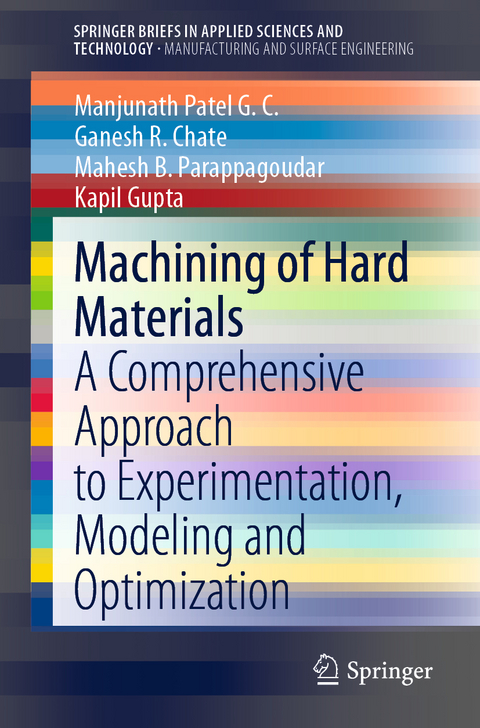
Machining of Hard Materials (eBook)
129 Seiten
Springer International Publishing (Verlag)
978-3-030-40102-3 (ISBN)
This book presents the potential applications of hard materials as well as the latest trends and challenges in machining hard materials. Models for online monitoring to adjust parameters to obtain desired machining characteristics (i.e. reverse modelling) are discussed in this book. The conflicting requirements (i.e. maximize: material removal rate, roundness and minimize: surface roughness, dimensional ovality, co axiality, tool wear) in machining for industry personal is solved using advanced optimization tools. In addition, the framework for experimental modelling, predictive physic-based forward and reverse process models and optimization for better machining characteristics applicable to industry are proposed.
Dr. Manjunath Patel GC is an Assistant Professor in the Mechanical Engineering Department at PES Institute of Technology and Management, Shivamogga, India. He obtained Ph.D. in Mechanical Engineering with specialization in Manufacturing from National Institute of Technology Karnataka, Surathkal, India in 2015. Modelling and Optimization of Advanced Metal Casting, Welding and Machining Processes are the areas of Interest and specialization. Currently, he is doing research in advanced machining, and Hydrid Casting Processes.
Mr. Ganesh R Chate is an Assistant Professor in Mechanical Engineering Department at KLS Gogte Institute of Technology Belagavi, Karnataka State, India. He holds a Master's degree in Production Management from KLS Gogte Institute of Technology, Belagavi.His research areas include manufacturing process, 3D printing, CAD and automation.
Prof. Mahesh B Parappagoudar joined Indian Institute of Technology, Kharagpur in 2004 as a research scholar, in the mechanical engineering department under the quality improvement program funded by MHRD, Govt. of India. Further, he obtained his PhD degree in Mechanical Engineering from Indian Institute of Technology, Kharagpur - 721302, India in 2008. Presently he is working as the principal and professor in Padre Conceicao College of Engineering, GOA, INDIA. His total experience (Industry, Teaching,Research, and Administration) extends over a period of 28 years. His research interests include applicationof statistical and soft computing tools in manufacturing and industrial engineering.
Prof. Kapil Gupta is an Associate Professor in the Dept. of Mechanical and Industrial Engineering Technology at the University of Johannesburg. He obtained Ph.D. in mechanical engineering with specialization in Avanced Manufacturing from Indian Institute of Technology Indore, India in 2014. Advanced machining processes, sustainable manufacturing, precision engineering and gear technology are the areas of his interest and specialization. Currently, he is doing research in advanced/modern machining, sustainable manufacturing and gear engineering.
Preface 6
Contents 8
1 Introduction to Hard Materials and Machining Methods 11
1.1 Introduction 11
1.2 Hard Materials 14
1.3 Machining Methods of Hard Materials 14
1.3.1 Hard Turning 15
1.3.2 Hard Broaching 16
1.3.3 Hard Boring 17
1.3.4 Hard Milling 18
1.4 Challenges in Machining of Hard Materials 19
1.4.1 Steels 19
1.4.2 Titanium and Its Alloys 19
1.4.3 Super-Alloys 20
1.4.4 Composite Materials and Metal Matrix Composites 20
1.4.5 Ceramics 22
1.5 Industrial Applications of Machined Hard Materials 22
1.6 Cutting Tool Materials 23
1.6.1 High-Speed Steel (HSS) 24
1.6.2 Cemented Carbides 24
1.6.3 Ceramics 25
1.6.4 Carbon Boron Nitride (CBN) Tools 26
1.6.5 Polycrystalline Diamond (PCD) 27
1.7 Selection of Cutting Tool Materials and Geometry 27
1.8 Advantages in Machining Hard Materials with Conventional Machining 29
References 30
2 Studies on Machining of Hard Materials 35
2.1 Hard Turning Process 35
2.2 Classical Engineering Experimental Approach or One Factor at a Time (OFAT) 37
2.3 Numerical Modelling Approach 37
2.4 Input–Output and In-Process Parameter Relationship Modelling 40
2.4.1 Taguchi Method 41
2.4.2 Response Surface Methodology (RSM) 46
2.4.3 Desirability Function Approach (DFA) 48
2.4.4 Soft Computing Optimization Tools 49
2.5 Capabilities of Hard Turning Process 50
2.5.1 Variables of Hard Turning Process 50
2.6 Conclusion 55
References 55
3 Experimentation, Modelling, and Analysis of Machining of Hard Material 62
3.1 Selection of Experimental Design 64
3.2 Workpiece and Tool Material 66
3.3 Experiment Details 66
3.3.1 Material Removal Rate 67
3.3.2 Surface Roughness 68
3.3.3 Cylindricity and Circularity Error 68
3.4 Results and Discussion 69
3.4.1 Response: MRR 69
3.4.2 Response: SR 70
3.4.3 Response: CE 74
3.4.4 Response: Ce 76
3.5 Regression Model Validation 76
3.6 Concluding Remarks 79
References 80
4 Intelligent Modelling of Hard Materials Machining 81
4.1 Advantages of Artificial Intelligence Over Statistical Methods 81
4.2 Neural Networks 82
4.3 Modelling of Hard Turning Process 84
4.4 Data Collection for NN Modelling 85
4.4.1 Training Data 85
4.4.2 Testing Data 86
4.5 NN Modelling of Hard Turning Process 86
4.5.1 Forward Modelling 87
4.5.2 Reverse Modelling 87
4.6 Back-Propagation Neural Network (BPNN) 89
4.6.1 Weights 90
4.6.2 Hidden Layers and Neurons 90
4.6.3 Learning Rate and Momentum Constant 90
4.6.4 Constants of Activation Function 91
4.6.5 Bias 91
4.7 Genetic Algorithm Neural Network (GA-NN) 91
4.7.1 Selection 92
4.7.2 Crossover 92
4.7.3 Mutation 92
4.8 Results of Forward Mapping 93
4.8.1 BPNN 93
4.8.2 GA-NN 93
4.8.3 Summary Results of Forward Mapping 95
4.9 Reverse Mapping 100
4.9.1 Back-Propagation NN 101
4.9.2 Genetic Algorithm NN 101
4.9.3 Summary Results of Reverse Mapping 102
4.10 Conclusions 106
References 107
5 Optimization of Machining of Hard Material 111
5.1 Genetic Algorithm 112
5.2 Particle Swarm Optimization (PSO) 114
5.3 Teaching–Learning-Based Algorithm (TLBO) 115
5.3.1 Teacher Phase 116
5.3.2 Learner Phase 118
5.4 JAYA Algorithm 118
5.5 Modelling and Optimization for Machining Process 119
5.6 Mathematical Formulation for Multi-objective Optimization 124
5.7 Results of Parameter Study of Algorithms (GA, PSO, TLBO, and JAYA) 126
5.7.1 Genetic Algorithm 126
5.7.2 Particle Swarm Optimization 127
5.7.3 Teaching–Learning-Based Optimization and JAYA Algorithm 127
5.8 Summary of Optimization Results 130
5.9 Validation Experiments 130
5.10 Tool Wear Studies 132
5.11 Conclusions 133
References 134
Index 137
| Erscheint lt. Verlag | 14.2.2020 |
|---|---|
| Reihe/Serie | Manufacturing and Surface Engineering |
| Manufacturing and Surface Engineering | |
| Manufacturing and Surface Engineering | |
| SpringerBriefs in Applied Sciences and Technology | SpringerBriefs in Applied Sciences and Technology |
| Zusatzinfo | IX, 129 p. 39 illus., 19 illus. in color. |
| Sprache | englisch |
| Themenwelt | Technik ► Maschinenbau |
| Schlagworte | Hard materials • Hard turning process • Intelligent modelling • nose radius • Optimization processes • Surface Roughness • tool materials • tool wear |
| ISBN-10 | 3-030-40102-2 / 3030401022 |
| ISBN-13 | 978-3-030-40102-3 / 9783030401023 |
| Informationen gemäß Produktsicherheitsverordnung (GPSR) | |
| Haben Sie eine Frage zum Produkt? |
 PDF (Wasserzeichen)
DRM: Digitales Wasserzeichen
Dieses eBook enthält ein digitales Wasserzeichen und ist damit für Sie personalisiert. Bei einer missbräuchlichen Weitergabe des eBooks an Dritte ist eine Rückverfolgung an die Quelle möglich.
Dateiformat: PDF (Portable Document Format)
Mit einem festen Seitenlayout eignet sich die PDF besonders für Fachbücher mit Spalten, Tabellen und Abbildungen. Eine PDF kann auf fast allen Geräten angezeigt werden, ist aber für kleine Displays (Smartphone, eReader) nur eingeschränkt geeignet.
Systemvoraussetzungen:
PC/Mac: Mit einem PC oder Mac können Sie dieses eBook lesen. Sie benötigen dafür einen PDF-Viewer - z.B. den Adobe Reader oder Adobe Digital Editions.
eReader: Dieses eBook kann mit (fast) allen eBook-Readern gelesen werden. Mit dem amazon-Kindle ist es aber nicht kompatibel.
Smartphone/Tablet: Egal ob Apple oder Android, dieses eBook können Sie lesen. Sie benötigen dafür einen PDF-Viewer - z.B. die kostenlose Adobe Digital Editions-App.
Buying eBooks from abroad
For tax law reasons we can sell eBooks just within Germany and Switzerland. Regrettably we cannot fulfill eBook-orders from other countries.
aus dem Bereich