


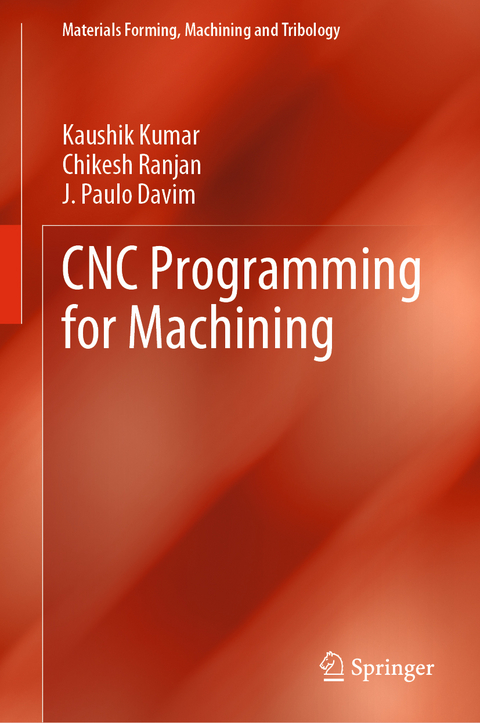
CNC Programming for Machining (eBook)
XVI, 136 Seiten
Springer International Publishing (Verlag)
978-3-030-41279-1 (ISBN)
Dr. Kaushik Kumar, B.Tech (Mechanical Engineering, REC (Now NIT), Warangal), MBA (Marketing, IGNOU) and Ph.D (Engineering, Jadavpur University), is presently an Associate Professor in the Department of Mechanical Engineering, Birla Institute of Technology, Mesra, Ranchi, India. He has 17 years of Teaching & Research and over 11 years of industrial experience in a manufacturing unit of Global repute. His areas of teaching and research interest are Composites, Optimization, Non-conventional machining, CAD / CAM, Rapid Prototyping and Quality Management Systems. He has 9 Patents, 23 Book, 12 Edited Book, 38 Book Chapters, 135 international Journal publications, 18 International and 8 National Conference publications to his credit. He is on the editorial board and review panel of 7 International and 1 National Journals of repute. He has been felicitated with many awards and honours.
Chikesh Ranjan, (BE, Mechanical Engineering, Marathwara Institute of Technology, Aurangabad, Maharastra, India), M.E. (Design of Mechanical Equipment, BIT Mesra), presently pursuing PhD (BIT Mesra). He has over 5 years of Teaching and Research experience. His areas of interests are Product and Process Design, CAD/CAM/CAE, Rapid prototyping and Composites. He has 10 Books, 10 international journal and 4 International Conference publications to his credit.
Prof. J. Paulo Davim received his Ph.D. degree in Mechanical Engineering, M.Sc. degree in Mechanical Engineering (materials and manufacturing processes), Mechanical Engineering degree (5 years), from the University of Porto (FEUP), the Aggregate title (Full Habilitation) from the University of Coimbra and the D.Sc. from London Metropolitan University. He is EurIng by FEANI-Brussels and Senior Chartered Engineer by the Portuguese Institution of Engineers with an MBA and Specialist title in Engineering and Industrial Management. Currently, he is Professor at the Department of Mechanical Engineering of the University of Aveiro, Portugal. He has more than 30 years of teaching and research experience in Manufacturing, Materials, Mechanical and Industrial Engineering, with special emphasis in Machining & Tribology. He has also interest in Management, Engineering Education and Higher Education for Sustainability. He has guided large numbers of postdoc, Ph.D. and master's students as well as has coordinated and participated in several financed research projects. He has received several scientific awards. He has worked as evaluator of projects for international research agencies as well as examiner of Ph.D. thesis for many universities, in different countries. He is the Editor in Chief of several international journals, Guest Editor of journals, books Editor, book Series Editor and Scientific Advisory for many international journals and conferences. Presently, he is an Editorial Board member of 30 international journals and acts as reviewer for more than 100 prestigious SCI-Web of Science journals. In addition, he has also published as editor (and co-editor) more than 100 books and as author (and co-author) more than 10 books, 80 book chapters and 400 articles in journals and conferences (more than 200 articles in journals indexed in SCI-Web of Science core collection/h-index 47+/6500+ citations and SCOPUS/h-index 54+/9000+ citations).Preface 6
Contents 10
About the Authors 16
I Introduction 18
1 CNC Programming 19
1.1 Part Programming 19
1.1.1 Methods of Part Programming 19
1.2 Part Programming Structure 21
1.2.1 Character 21
1.2.2 Word 22
1.2.3 Block 23
1.2.4 Program 24
1.3 Programming Formats 24
1.3.1 Fixed Block Format 24
1.3.2 Tab Sequential Format 25
1.3.3 Word Address Format 25
1.4 Standard Codes 25
1.4.1 Preparatory Functions (G) 25
1.4.2 Miscellaneous Functions (M) 26
1.5 Co-ordinates System 26
1.5.1 Absolute System 26
1.5.2 Incremental System 26
1.6 Reference Points 27
1.6.1 Zero Points and Reference Points 27
1.6.2 Machine Zero 27
1.6.3 Work Zero 27
1.6.4 Zero Shift 28
1.7 Conclusion 28
II Programming for Conventional Machining 29
2 Lathe Operation 30
2.1 Facing Operation 30
2.1.1 Introduction 30
2.1.2 Problem Description 30
2.1.3 G Code and M Code Used 30
2.1.4 Programming 31
2.2 Straight Turning Operation 32
2.2.1 Introduction 32
2.2.2 Problem Description 32
2.2.3 G Code and M Code Used 32
2.2.4 Programming 33
2.3 Step Turning Operation 33
2.3.1 Introduction 33
2.3.2 G Code and M Code Used 33
2.3.3 Problem Description 35
2.3.4 Programming 35
2.4 Taper Turning Operation 35
2.4.1 Introduction 35
2.4.2 Problem Description 35
2.4.3 G Code and M Code Used 37
2.4.4 Programming 37
2.5 Grooving Operation 38
2.5.1 Introduction 38
2.5.2 Problem Description 38
2.5.3 G Code and M Code Used 38
2.5.4 Programming 39
2.6 Threading Operation 39
2.6.1 Introduction 39
2.6.2 Problem Description 39
2.6.3 G Code and M Code Used 40
2.6.4 Programming 41
2.7 Contour Turning Operation 41
2.7.1 Introduction 41
2.7.2 Problem Description 42
2.7.3 G Code and M Code Used 43
2.7.4 Programming 43
2.8 Conclusion 44
3 Milling Operation 45
3.1 Profile Milling 45
3.1.1 Introduction 45
3.1.2 Problem Description 45
3.1.3 G Code and M Code Used 45
3.1.4 Programming 46
3.2 Circular Interpolation 46
3.2.1 Introduction 46
3.2.2 Problem Description 46
3.2.3 G Code and M Code Used 47
3.2.4 Programming 48
3.3 Circular Pocket Milling 49
3.3.1 Introduction 49
3.3.2 Problem Description 50
3.3.3 G Code and M Code Used 50
3.3.4 Programming 50
3.4 Rectangular Pocket Milling 51
3.4.1 Introduction 51
3.4.2 Problem Description 51
3.4.3 G Code and M Code Used 51
3.4.4 Programming 52
3.5 Surface Milling 52
3.5.1 Introduction 52
3.5.2 Problem Description 53
3.5.3 G Code and M Code Used 53
3.5.4 Programming 54
3.6 Conclusion 54
4 Drilling Operation 56
4.1 Point to Point Drilling Operation 56
4.1.1 Introduction 56
4.1.2 Case-1 56
4.1.3 Case-2 57
4.2 Peck Drilling Operation 59
4.2.1 Introduction 59
4.2.2 Problem Description 59
4.2.3 G Code and M Code Used 59
4.2.4 Programming 60
4.3 Conclusion 61
5 Boring Operation 62
5.1 Boring Operation 62
5.1.1 Introduction 62
5.1.2 Problem Description 62
5.1.3 G Code and M Code Used 62
5.1.4 Programming 63
5.2 Conclusion 64
III Programming for Machining Centre 65
6 Drilling and Milling Operation 66
6.1 Drilling and Milling Operation 66
6.1.1 Introduction 66
6.1.2 Problem Description 66
6.1.3 G Code and M Code Used 66
6.1.4 Programming 67
6.2 Milling and Drilling Operation 68
6.2.1 Introduction 68
6.2.2 Problem Description 68
6.2.3 G Code and M Code Used 69
6.2.4 Programming 70
6.3 Conclusion 71
7 Five Axis CNC Machines 72
7.1 Multiple Machining Process 72
7.1.1 Introduction 72
7.1.2 Problem Description 72
7.1.3 G Code and M Code Used 72
7.1.4 Programming 73
7.2 Straight Line Multiple Machining 73
7.2.1 Introduction 73
7.2.2 Problem Description 75
7.2.3 G Code and M Code Used 75
7.2.4 Programming 77
7.3 Multiple Machining in an Arc 78
7.3.1 Introduction 78
7.3.2 Problem Description 78
7.3.3 G Code and M Code Used 78
7.3.4 Programming 79
7.4 Conclusion 80
IV Programming for Non-conventional Machining 81
8 Non-conventional Machining 82
8.1 Electrical Discharge Machining 82
8.1.1 Tapered Polygon Cycle EDM 82
8.1.2 Tapered Vector Cycle EDM 84
8.1.3 Vector Circular Orbit EDM 85
8.1.4 Vector Cycle EDM 87
8.1.5 Spherical Cycle EDM 89
8.1.6 Polygon Cycle EDM 91
8.2 Wire Electrical Discharge Machining 92
8.2.1 Introduction 92
8.2.2 Problem Description 93
8.2.3 G Code and M Code Used 94
8.2.4 Programming 94
8.3 Wire Cutting EDM Machine 94
8.3.1 Introduction 94
8.3.2 Problem Description 95
8.3.3 G Code and M Code Used 95
8.3.4 Programming 96
8.4 Conclusion 96
V Programming for Auxiliary Operation 97
9 Canned Cycle 98
9.1 Canned Cycle Formats 98
9.1.1 Multiple Turning Cycle 98
9.1.2 Multiple Facing Cycle 99
9.1.3 Multiples Turning Cycle 99
9.1.4 End Face Peck Drilling Cycle 101
9.2 Drilling Canned Cycle 101
9.2.1 Introduction 101
9.2.2 Problem Description 102
9.2.3 G Code and M Code Used 102
9.2.4 Programming 103
9.3 Drilling Canned Cycle with Tool Length 103
9.3.1 Introduction 103
9.3.2 Problem Description 104
9.3.3 Tool Used 104
9.3.4 G Code and M Code Used 105
9.3.5 Programming 105
9.4 Rectangular Pocket Milling Canned Cycle 105
9.4.1 Introduction 105
9.4.2 Problem Description 106
9.4.3 Tool Used 106
9.4.4 G Code and M Code Used 107
9.4.5 Programming 107
9.5 Conclusion 108
10 Do Loop Cycle 109
10.1 Drilling Operation 109
10.1.1 Introduction 109
10.1.2 Case 1 109
10.1.3 Case 2 111
10.2 Equally Spaced Grooves Operation 112
10.2.1 Introduction 112
10.2.2 Problem Description 112
10.2.3 G Code and M Code Used 113
10.2.4 Programming 113
10.3 Conclusion 114
11 Subroutine 115
11.1 Drilling Operation 115
11.1.1 Introduction 115
11.1.2 Problem Description 115
11.1.3 G Code and M Code Used 115
11.1.4 Programming 116
11.2 Square Recess 117
11.2.1 Introduction 117
11.2.2 Problem Description 117
11.2.3 G Code and M Code Used 117
11.2.4 Programming 118
11.3 Conclusion 118
12 Polar Coordinates 119
12.1 Profile Making Operation 119
12.1.1 Introduction 119
12.1.2 Problem Description 119
12.1.3 G Code and M Code Used 119
12.1.4 Programming 120
12.2 Spiral Making Operation 121
12.2.1 Introduction 121
12.2.2 Problem Description 121
12.2.3 G Code and M Code Used 121
12.2.4 Programming 122
12.3 Conclusion 123
Appendix A 124
G Code 124
Appendix B 128
M-Codes 128
Appendix C 131
Prefix References 131
Appendix D 133
Special Characters 133
Appendix E 134
Address Letters 134
Suggested Readings 135
Index 137
| Erscheint lt. Verlag | 15.2.2020 |
|---|---|
| Reihe/Serie | Materials Forming, Machining and Tribology | Materials Forming, Machining and Tribology |
| Zusatzinfo | XVI, 136 p. 108 illus., 17 illus. in color. |
| Sprache | englisch |
| Themenwelt | Mathematik / Informatik ► Informatik ► Programmiersprachen / -werkzeuge |
| Technik ► Maschinenbau | |
| Schlagworte | CNC Drilling Machine • CNC Lathe • CNC Milling Machine • Computer Numerical Control Programming • Electro Discharge Machines • G–Codes • Machining Centres • M–Codes • Part Program • programming • Ultrasonic Machines • Water Jet Machines |
| ISBN-10 | 3-030-41279-2 / 3030412792 |
| ISBN-13 | 978-3-030-41279-1 / 9783030412791 |
| Informationen gemäß Produktsicherheitsverordnung (GPSR) | |
| Haben Sie eine Frage zum Produkt? |
 PDF (Wasserzeichen)
DRM: Digitales Wasserzeichen
Dieses eBook enthält ein digitales Wasserzeichen und ist damit für Sie personalisiert. Bei einer missbräuchlichen Weitergabe des eBooks an Dritte ist eine Rückverfolgung an die Quelle möglich.
Dateiformat: PDF (Portable Document Format)
Mit einem festen Seitenlayout eignet sich die PDF besonders für Fachbücher mit Spalten, Tabellen und Abbildungen. Eine PDF kann auf fast allen Geräten angezeigt werden, ist aber für kleine Displays (Smartphone, eReader) nur eingeschränkt geeignet.
Systemvoraussetzungen:
PC/Mac: Mit einem PC oder Mac können Sie dieses eBook lesen. Sie benötigen dafür einen PDF-Viewer - z.B. den Adobe Reader oder Adobe Digital Editions.
eReader: Dieses eBook kann mit (fast) allen eBook-Readern gelesen werden. Mit dem amazon-Kindle ist es aber nicht kompatibel.
Smartphone/Tablet: Egal ob Apple oder Android, dieses eBook können Sie lesen. Sie benötigen dafür einen PDF-Viewer - z.B. die kostenlose Adobe Digital Editions-App.
Buying eBooks from abroad
For tax law reasons we can sell eBooks just within Germany and Switzerland. Regrettably we cannot fulfill eBook-orders from other countries.
aus dem Bereich


