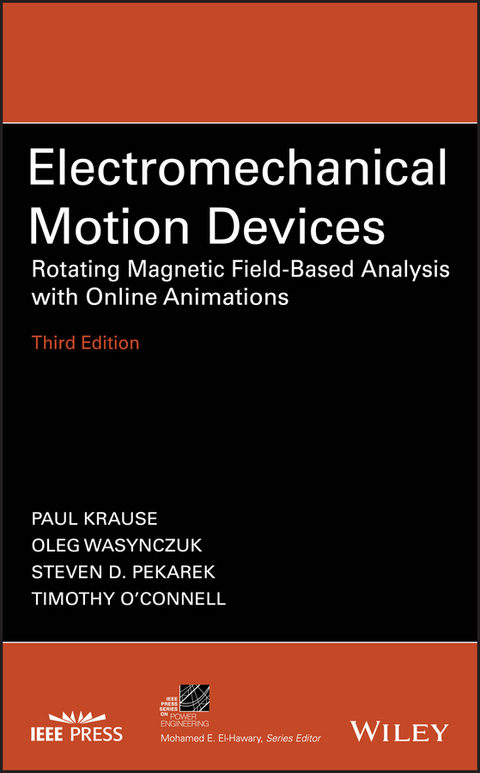
Electromechanical Motion Devices (eBook)
John Wiley & Sons (Verlag)
978-1-119-48983-2 (ISBN)
The updated third edition of the classic book that provides an introduction to electric machines and their emerging applications
The thoroughly revised and updated third edition of Electromechanical Motion Devices contains an introduction to modern electromechanical devices and offers an understanding of the uses of electric machines in emerging applications such as in hybrid and electric vehicles. The authors-noted experts on the topic-put the focus on modern electric drive applications. The book includes basic theory, illustrative examples, and contains helpful practice problems designed to enhance comprehension.
The text offers information on Tesla's rotating magnetic field, which is the foundation of reference frame theory and explores in detail the reference frame theory. The authors also review permanent-magnet ac, synchronous, and induction machines. In each chapter, the material is arranged so that if steady-state operation is the main concern, the reference frame derivation can be de-emphasized and focus placed on the steady state equations that are similar in form for all machines. This important new edition:
• Features an expanded section on Power Electronics
• Covers Tesla's rotating magnetic field
• Contains information on the emerging applications of electric machines, and especially, modern electric drive applications
• Includes online animations and a solutions manual for instructors
Written for electrical engineering students and engineers working in the utility or automotive industry, Electromechanical Motion Devices offers an invaluable book for students and professionals interested in modern machine theory and applications.
PAUL KRAUSE, PHD, is Chairman of the Board of P.C. Krause & Associates, having retired after 39 years as a professor at Purdue University School of Electrical and Computer Engineering. He is a Life Fellow of IEEE and has authored or co-authored over 100 technical papers and three textbooks on electric machines. He was the 2010 recipient of the IEEE Nikola Tesla Award.
OLEG WASYNCZUK, PHD, is a Professor of Electrical and Computer Engineering at Purdue University. He has authored or co-authored over 100 technical papers and two textbooks on electric machines. He is a Fellow of IEEE and was the 2008 recipient of the IEEE Cyril Veinott Award. He also serves as Chief Technical Officer of P.C. Krause & Associates.
STEVEN D. PEKAREK, PHD, is the Edmund O. Schweitzer III Professor of Electrical and Computer Engineering at Purdue University. He is the co-author of two textbooks on electric machinery, an IEEE Fellow, and an active member of the IEEE Power and Energy Society. He is an Editor for the IEEE Transactions on Energy Conversion and the recipient of the 2018 IEEE Cyril Veinott Award.
TIMOTHY O'CONNELL, PHD, is a Senior Lead Engineer at P.C. Krause & Associates, where he has over ten years' experience in the modeling, simulation, analysis and design of more electric aircraft. He is an Adjunct Professor of Electrical and Computer Engineering at the University of Illinois at Urbana-Champaign. He is a Senior Member of IEEE, an Associate Editor of the IEEE Transactions on Aerospace and Electronic Systems, and has co-authored two textbooks on electric machinery.
PAUL KRAUSE, PHD, is Chairman of the Board of P.C. Krause & Associates, having retired after 39 years as a professor at Purdue University School of Electrical and Computer Engineering. He is a Life Fellow of IEEE and has authored or co-authored over 100 technical papers and three textbooks on electric machines. He was the 2010 recipient of the IEEE Nikola Tesla Award. OLEG WASYNCZUK, PHD, is a Professor of Electrical and Computer Engineering at Purdue University. He has authored or co-authored over 100 technical papers and two textbooks on electric machines. He is a Fellow of IEEE and was the 2008 recipient of the IEEE Cyril Veinott Award. He also serves as Chief Technical Officer of P.C. Krause & Associates. STEVEN D. PEKAREK, PHD, is the Edmund O. Schweitzer III Professor of Electrical and Computer Engineering at Purdue University. He is the co-author of two textbooks on electric machinery, an IEEE Fellow, and an active member of the IEEE Power and Energy Society. He is an Editor for the IEEE Transactions on Energy Conversion and the recipient of the 2018 IEEE Cyril Veinott Award. TIMOTHY O'CONNELL, PHD, is a Senior Lead Engineer at P.C. Krause & Associates, where he has over ten years' experience in the modeling, simulation, analysis and design of more electric aircraft. He is an Adjunct Professor of Electrical and Computer Engineering at the University of Illinois at Urbana-Champaign. He is a Senior Member of IEEE, an Associate Editor of the IEEE Transactions on Aerospace and Electronic Systems, and has co-authored two textbooks on electric machinery.
CHAPTER 1
MAGNETIC AND MAGNETICALLY COUPLED CIRCUITS
1.1 INTRODUCTION
Before diving into the analysis of electromechanical motion devices, it is helpful to review briefly some of our previous work in physics and in basic electric circuit analysis. In particular, the analysis of magnetic circuits, the basic properties of magnetic materials, and the derivation of equivalent circuits of stationary, magnetically coupled circuits are topics presented in this chapter. Much of this material will be a review for most, since it is covered either in a sophomore physics course for engineers or in introductory electrical engineering courses in circuit theory. Nevertheless, reviewing this material and establishing concepts and terms for later use sets the appropriate stage for our study of electromechanical motion devices.
Perhaps the most important new concept presented in this chapter is the fact that in all electromechanical devices, mechanical motion must occur, either translational or rotational, and this motion is reflected into the electric system either as a change of flux linkages in the case of an electromagnetic system or as a change of charge in the case of an electrostatic system. We will deal primarily with electromagnetic systems. If the magnetic system is linear, then the change in flux linkages results, owing to a change in the inductance. In other words, we will find that the inductances of the electric circuits associated with electromechanical motion devices are functions of the mechanical motion. In this chapter, we shall learn to express the self‐ and mutual inductances for simple translational and rotational electromechanical devices, and to handle these changing inductances in the voltage equations describing the electric circuits associated with the electromechanical system.
Throughout this text, we will give short problems (SPs) with answers following most sections. If we have done our job, each SP should take less than ten minutes to solve. Also, it may be appropriate to skip or de‐emphasize some material in this chapter depending upon the background or interest of the students. At the close of each chapter, we shall take a moment to look back over some of the important aspects of the material that we have just covered and mention what is coming next and how we plan to fit things together as we go along.
1.2 PHASOR ANALYSIS
Phasors are used to analyze steady‐state performance of ac circuits and devices. This concept can be readily established by expressing a steady‐state sinusoidal variable as
where capital letters are used to denote steady‐state quantities and is the peak value of the sinusoidal variation, which is generally voltage or current but could be any electrical or mechanical sinusoidal variable. For steady‐state conditions, may be written as
where is the electrical angular velocity and is the time‐zero position of the electrical variable. Substituting (1.2-2) into (1.2-1) yields
Since
equation (1.2-3) may also be written as
where is shorthand for the “real part of.” Equations (1.2-3) and (1.2-5) are equivalent. Let us rewrite (1.2-5) as
Thus, we need to take a moment to define what is referred to as the root mean square (rms) of a sinusoidal variation. In particular, the rms value is defined as
where is the rms value of and is the period of the sinusoidal variation. It is left to the reader to show that the rms value of (1.2-3) is . Therefore, we can express (1.2-6) as
By definition, the phasor representing , which is denoted with a raised tilde, is
which is a complex number. The reason for using the rms value as the magnitude of the phasor will be addressed later in this section. Equation (1.2-6) may now be written as
A shorthand notation for (1.2-9) is
Equation (1.2-11) is commonly referred to as the polar form of the phasor. The Cartesian form is
When using phasors to calculate steady‐state voltages and currents, we think of the phasors as being stationary at t = 0. On the other hand, a phasor is related to the instantaneous value of the sinusoidal quantity it represents. Let us take a moment to consider this aspect of the phasor and, thereby, give some physical meaning to it. From (1.2-4), we realize that is a constant‐amplitude line of unity length rotating counterclockwise at an angular velocity of . Therefore,
is a constant‐amplitude line in length rotating counterclockwise at an angular velocity of with a time‐zero displacement from the positive real axis of . Since is the peak value of the sinusoidal variation, the instantaneous value of is the real part of (1.2-13). In other words, the real projection of the phasor is the instantaneous value of at time zero. As time progresses, rotates at in the counterclockwise direction, and its real projection, in accordance with (1.2-10), is the instantaneous value of . Thus, for
the phasor representing is
For
the phasor is
Although there are several ways to arrive at (1.2-17) from (1.2-16), it is helpful to ask yourself where must the rotating phasor be positioned at time zero so that, when it rotates counterclockwise at , its real projection is ? Is it clear that a phasor of amplitude F positioned at represents ?
In order to show the facility of the phasor in the analysis of steady‐state performance of ac circuits and devices, it is useful to consider a series circuit consisting of a resistance, an inductance, and a capacitance. Thus,
For steady‐state operation, let
where the subscript a is used to distinguish the instantaneous value from the rms value of the steady‐state variable. The steady‐state voltage equation may be obtained by substituting (1.2-19) and (1.2-20) into (1.2-18), whereupon we can write
The second term on the right‐hand side of (1.2-21), which is , can be written as
Since , we can write
Since , (1.2-23) may be written as
If we follow a similar procedure, we can show that
It is interesting that differentiation of a steady‐state sinusoidal variable rotates the phasor counterclockwise by , whereas integration rotates the phasor clockwise by .
The steady‐state voltage equation given by (1.2-21) can be written in phasor form as
We can express (1.2-26) compactly as
where Z, the impedance, is a complex number; it is not a phasor. It is often expressed as
where XL = ωeL is the inductive reactance and is the capacitive reactance.
The instantaneous power is
After some manipulation, we can write (1.2-29) as
Therefore, the average power may be written as
where and are the magnitude of the phasors (rms value), is the power factor angle , and is referred to as the power factor. If current is positive in the direction of voltage drop then (1.2-31) is positive if power is consumed and negative if power is generated. It is interesting to point out that in going from (1.2-29) to (1.2-30), the coefficient of the two right‐hand terms is or one‐half the product of the peak values of the sinusoidal variables. Therefore, it was considered more convenient to use the rms values for the phasors, whereupon average power could be calculated by the product of the magnitude of the voltage and current phasors as given by (1.2-31).
We see from (1.2-30) that the instantaneous power of a single‐phase ac circuit oscillates at about an average value. Let us take a moment to calculate the steady‐state power of a two‐phase ac system. Balanced, steady‐state, two‐phase variables (a and b phase) may be expressed as
The total instantaneous power is
Substituting (1.2-32) through (1.2-35) into (1.2-36) and after some trigonometric manipulation, the total power for a balanced two‐phase system...
| Erscheint lt. Verlag | 14.2.2020 |
|---|---|
| Reihe/Serie | IEEE Press Series on Power and Energy Systems |
| IEEE Press Series on Power Engineering | IEEE Press Series on Power Engineering |
| Sprache | englisch |
| Themenwelt | Technik ► Elektrotechnik / Energietechnik |
| Schlagworte | applications of electric machines smart grid • Electrical & Electronics Engineering • electric power systems • Elektrische Energietechnik • Elektromechanik • Elektrotechnik u. Elektronik • Energie • Energy • Leistungselektronik • <p>Guide to Electromechanical Motion Devices • Power Electronics • power system and electromechanical devices • rotating magnetic field</p> • theory of electromechanical motion devices • understanding electromechanical motion devices |
| ISBN-10 | 1-119-48983-0 / 1119489830 |
| ISBN-13 | 978-1-119-48983-2 / 9781119489832 |
| Informationen gemäß Produktsicherheitsverordnung (GPSR) | |
| Haben Sie eine Frage zum Produkt? |
 EPUB (Adobe DRM)
Kopierschutz: Adobe-DRM
Adobe-DRM ist ein Kopierschutz, der das eBook vor Mißbrauch schützen soll. Dabei wird das eBook bereits beim Download auf Ihre persönliche Adobe-ID autorisiert. Lesen können Sie das eBook dann nur auf den Geräten, welche ebenfalls auf Ihre Adobe-ID registriert sind.
Details zum Adobe-DRM
Dateiformat: EPUB (Electronic Publication)
EPUB ist ein offener Standard für eBooks und eignet sich besonders zur Darstellung von Belletristik und Sachbüchern. Der Fließtext wird dynamisch an die Display- und Schriftgröße angepasst. Auch für mobile Lesegeräte ist EPUB daher gut geeignet.
Systemvoraussetzungen:
PC/Mac: Mit einem PC oder Mac können Sie dieses eBook lesen. Sie benötigen eine
eReader: Dieses eBook kann mit (fast) allen eBook-Readern gelesen werden. Mit dem amazon-Kindle ist es aber nicht kompatibel.
Smartphone/Tablet: Egal ob Apple oder Android, dieses eBook können Sie lesen. Sie benötigen eine
Geräteliste und zusätzliche Hinweise
Buying eBooks from abroad
For tax law reasons we can sell eBooks just within Germany and Switzerland. Regrettably we cannot fulfill eBook-orders from other countries.
aus dem Bereich