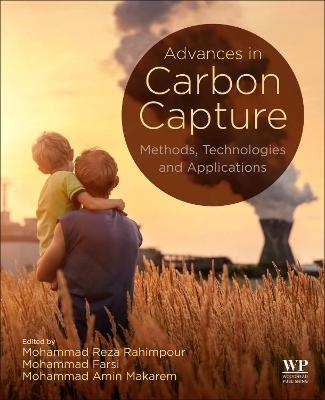
Advances in Carbon Capture
Woodhead Publishing (Verlag)
978-0-12-819657-1 (ISBN)
Prof. Mohammad Reza Rahimpour is a professor in Chemical Engineering at Shiraz University, Iran. He received his Ph.D. in Chemical Engineering from Shiraz University joint with University of Sydney, Australia 1988. He started his independent career as Assistant Professor in September 1998 at Shiraz University. Prof. M.R. Rahimpour, was a Research Associate at University of California, Davis from 2012 till 2017. During his stay in University of California, he developed different reaction networks and catalytic processes such as thermal and plasma reactors for upgrading of lignin bio-oil to biofuel with collaboration of UCDAVIS. He has been a Chair of Department of Chemical Engineering at Shiraz University from 2005 till 2009 and from 2015 till 2020. Prof. M.R. Rahimpour leads a research group in fuel processing technology focused on the catalytic conversion of fossil fuels such as natural gas, and renewable fuels such as bio-oils derived from lignin to valuable energy sources. He provides young distinguished scholars with perfect educational opportunities in both experimental methods and theoretical tools in developing countries to investigate in-depth research in the various field of chemical engineering including carbon capture, chemical looping, membrane separation, storage and utilization technologies, novel technologies for natural gas conversion and improving the energy efficiency in the production and use of natural gas industries. Dr. Mohammad Farsi is an associate professor in Chemical and Petroleum Engineering at Shiraz University from 2012. He received his PhD in Chemical Engineering in 2012 from Shiraz University as one of the most prestigious universities in Iran. His theoretical and experimental research interests are process design, CO2 capturing and crude oil desalting areas. In the process design field, he has focused on the modeling, simulation, optimization and control of chemical processes, and modification of conventional process to improve plant efficiency. His main activities in the CO2 capturing field are the development of green processes for CO2 conversion to chemicals, and CO2 capturing by novel solvents and adsorbents. Currently, he has collaborated actively with researchers in several other disciplines of chemical engineering, particularly bio processing. Dr. Mohammad Amin Makarem is a research associate at Taylor's University, Malaysia. He former worked at Shiraz University. His research interests are gas separation and purification, nanofluids, microfluidics, catalyst synthesis, reactor design and green energy. In gas separation, his focus is on experimental and theoretical investigation and optimization of pressure swing adsorption process, and in the gas purification field, he is working on novel technologies such as microchannels. Recently, he has investigated methods of synthesizing bio-template nanomaterials and catalysts. Besides, he has collaborated in writing and editing various books and book-chapters for famous publishers such as Elsevier, Springer and Wiley, as well as guest editing journals special issues.
Section I: Introduction to CO2 Capture
1. CO2 emission sources, greenhouse gases and global warming effect
2. Challenges on CO2 capture, reuse and conversion
Section II: Absorption Techniques and Methods for CO2 Capture
3. CO2 absorption by common solvents
4. CO2 absorption by ionic liquids and deep eutectic solvents
5. CO2 capture by solvents modified with nanoparticles
6. Encapsulated liquid sorbents for CO2 Capture
7. CO2 capture by Lewis acids and amino acid salts
8. Advances in gas-liquid contactors for carbon capture and challenges in industrialization: packed bed, rotating packed bed, mini and microchannels
Section III: Adsorption Techniques for CO2 Capture
9. CO2 adsorption by carbonaceous materials and nanomaterials
10. CO2 adsorption by conventional and nano-sized zeolites
11. Application of metals, pseudo metals and metal-organic framework (MOF) for capturing CO2
12. CO2 adsorption by functionalized sorbents
13. Advances in CO2 adsorption in swing technologies and challenge on industrialization
14. Phase-change absorption and Processes for CO2 Capture
Section IV: CO2 Capture by Membrane Separation
15. CO2 separation with ionic liquid membranes
16. Zeolite and Alumina based membranes for CO2 capture
17. Polymeric membranes for CO2 separation
18. An Overview of Gas-Liquid Hollow Fiber Polymeric Membrane Contactor for CO2 Absorption-Stripping
19. MOF mixed matrix membranes for CO2 separation
20. Challenges on industrialization of CO2 Capture by Membrane
Section V: Biological techniques for CO2 capture
21. CO2 capture using microalgae
22. CO2 capture using enzymes
23. CO2 capture using bacteria
24. Challenges on industrialization of biotechnological CO2 capturing techniques
Section VI: Applications of CO2 Capture
25. CO2 removal from biogas and syngas
26. CO2 removal from natural gas
27. Integration of CO2 capture and conversion
28. CO2 removal from flue gas
29. CO2 removal from air
| Erscheinungsdatum | 14.08.2020 |
|---|---|
| Sprache | englisch |
| Maße | 191 x 235 mm |
| Gewicht | 1130 g |
| Themenwelt | Technik ► Elektrotechnik / Energietechnik |
| Technik ► Umwelttechnik / Biotechnologie | |
| ISBN-10 | 0-12-819657-2 / 0128196572 |
| ISBN-13 | 978-0-12-819657-1 / 9780128196571 |
| Zustand | Neuware |
| Informationen gemäß Produktsicherheitsverordnung (GPSR) | |
| Haben Sie eine Frage zum Produkt? |
aus dem Bereich