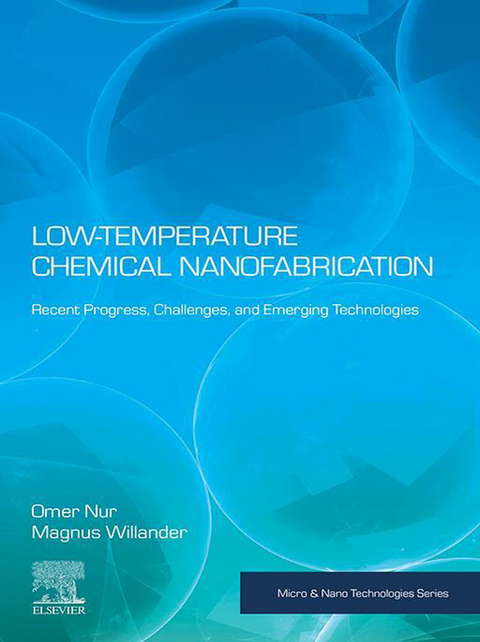
Low Temperature Chemical Nanofabrication (eBook)
252 Seiten
Elsevier Science (Verlag)
978-0-12-813346-0 (ISBN)
Omer Nur acquired his B. Sc. Honors degree in Physics from the University of Khartoum in 1986. He was then awarded a the Ph. D. Degree in Device Physics from the University of Link”ping in 1996. During the years 1996 and 2004 he worked as a researcher at Chalmers University of Technology and also at Gothenburg University. In 2002, he was made Associate professor (Docent in Physics) at Chalmers University of Technology. In the year 2007, he been appointed as Senior Lecturer at the Department of Science and Technology (ITN) Campus Norrk”ping, Link”ping University.
Low Temperature Chemical Nanofabrication: Recent Progress, Challenges and Emerging Technologies offers a thorough and theoretical background to nanoscale fabrication phenomena, also covering important practical applications. It covers the conventional top down and the newly emerging bottom up processing methods. The latter has proven to be feasible for obtaining device quality material and can either be performed using high or low temperature processing. Low temperature (?100 oC), in particular, is becoming increasingly used due to its simplicity and varied applications, with huge benefits for developing new devices and flexible non-conventional substrates. This important resource is ideal for researchers seeking to learn more about the fundamental theories related to nanoscale phenomena and nanofabrication. - Provides extensive coverage of nanofabrication techniques, allowing researchers to learn different nanofabrication techniques- Explores different applications for low-temperature chemical nanofabrication- Cogently explains how low-temperature chemical nanofabrication differs from other nanofabrication techniques, assessing the pros and cons of each
| Erscheint lt. Verlag | 18.1.2020 |
|---|---|
| Sprache | englisch |
| Themenwelt | Technik ► Maschinenbau |
| ISBN-10 | 0-12-813346-5 / 0128133465 |
| ISBN-13 | 978-0-12-813346-0 / 9780128133460 |
| Informationen gemäß Produktsicherheitsverordnung (GPSR) | |
| Haben Sie eine Frage zum Produkt? |
 EPUB (Adobe DRM)
Kopierschutz: Adobe-DRM
Adobe-DRM ist ein Kopierschutz, der das eBook vor Mißbrauch schützen soll. Dabei wird das eBook bereits beim Download auf Ihre persönliche Adobe-ID autorisiert. Lesen können Sie das eBook dann nur auf den Geräten, welche ebenfalls auf Ihre Adobe-ID registriert sind.
Details zum Adobe-DRM
Dateiformat: EPUB (Electronic Publication)
EPUB ist ein offener Standard für eBooks und eignet sich besonders zur Darstellung von Belletristik und Sachbüchern. Der Fließtext wird dynamisch an die Display- und Schriftgröße angepasst. Auch für mobile Lesegeräte ist EPUB daher gut geeignet.
Systemvoraussetzungen:
PC/Mac: Mit einem PC oder Mac können Sie dieses eBook lesen. Sie benötigen eine
eReader: Dieses eBook kann mit (fast) allen eBook-Readern gelesen werden. Mit dem amazon-Kindle ist es aber nicht kompatibel.
Smartphone/Tablet: Egal ob Apple oder Android, dieses eBook können Sie lesen. Sie benötigen eine
Geräteliste und zusätzliche Hinweise
Buying eBooks from abroad
For tax law reasons we can sell eBooks just within Germany and Switzerland. Regrettably we cannot fulfill eBook-orders from other countries.
aus dem Bereich