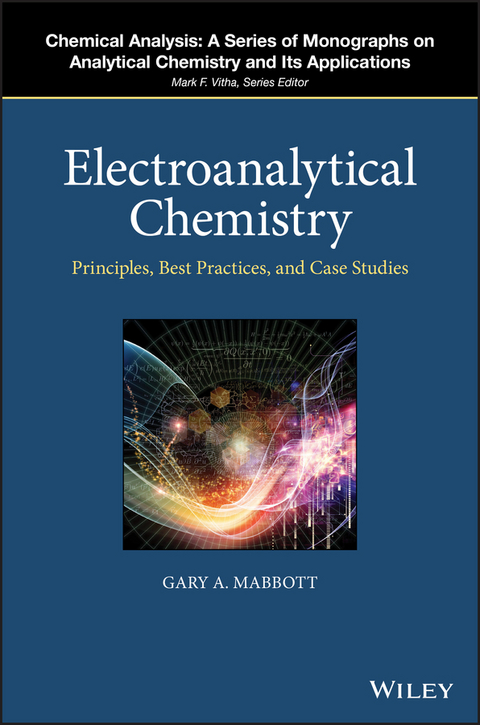
Electroanalytical Chemistry (eBook)
352 Seiten
John Wiley & Sons (Verlag)
978-1-119-53860-8 (ISBN)
Written for undergraduate majors in chemistry and chemical engineering, this book teaches the basic principles of electroanalytical chemistry and illustrates best practices through the use of case studies of organic reactions and catalysis using voltammetric methods and of the measurement of clinical and environmental analytes by potentiometric techniques. It provides insight beyond the field of analysis as students address problems arising in many areas of science and technology. The book also emphasizes electrochemical phenomena and conceptual models to help readers understand the influence of experimental conditions and the interpretation of results for common potentiometric and voltammetric methods.
Electroanalytical Chemistry: Principles, Best Practices, and Case Studies begins by introducing some basic concepts in electrical phenomena. It then moves on to a chapter that examines the potentiometry of oxidation-reduction processes, followed by another on the potentiometry of ion selective electrodes. Other sections look at: applications of ion selective electrodes; controlled potential methods; case studies in controlled potential methods; and instrumentation. The book also features several appendixes covering: Ionic Strength, Activity and Activity Coefficients; The Nicolsky-Eisenman Equation; The Henderson Equation for Liquid Junction Potentials; Selected Standard Electrode Potentials; and The Nernst Equation Derivation.
* Introduces the principles of modern electrochemical sensors and instrumental chemical analysis using potentiometric and voltammetric methods
* Develops conceptual models underlying electrochemical phenomena and useful equations
* Illustrates best practice with short case studies of organic reaction mechanisms using voltammetry and quantitative analysis with ion selective electrodes
* Offers instructors the opportunity to select focus areas and tailor the book to their course by providing a collection of shorter texts, each dedicated to a single field
* Intended as one of a series of modules for teaching undergraduate courses in instrumental chemical analysis
Electroanalytical Chemistry: Principles, Best Practices, and Case Studies is an ideal textbook for undergraduate majors in chemistry and chemical engineering taking instrumental analysis courses. It would also benefit professional chemists who need an introduction to potentiometry or voltammetry.
Gary A. Mabbott, PhD, has taught analytical chemistry courses for 38 years, and he currently holds the rank of professor emeritus at the University of St. Thomas in St. Paul, Minnesota. He developed voltammetric and coulometric methods for studying electroactive species confined to solid electrode surfaces during his doctoral work with Walter Blaedel. He has published 17 articles in peer-reviewed journals and posted 70 instructional videos on various analytical topics for public use.
| Erscheint lt. Verlag | 27.1.2020 |
|---|---|
| Reihe/Serie | Chemical Analysis: A Series of Monographs on Analytical Chemistry and Its Applications | Chemical Analysis: A Series of Monographs on Analytical Chemistry and Its Applications |
| Sprache | englisch |
| Themenwelt | Naturwissenschaften ► Chemie ► Technische Chemie |
| Technik ► Elektrotechnik / Energietechnik | |
| Schlagworte | Analytical Chemistry • Analytische Chemie • chemical engineering • Chemie • Chemische Verfahrenstechnik • Chemistry • Electrochemistry • Elektrochemie |
| ISBN-10 | 1-119-53860-2 / 1119538602 |
| ISBN-13 | 978-1-119-53860-8 / 9781119538608 |
| Informationen gemäß Produktsicherheitsverordnung (GPSR) | |
| Haben Sie eine Frage zum Produkt? |
 PDF (Adobe DRM)
Kopierschutz: Adobe-DRM
Adobe-DRM ist ein Kopierschutz, der das eBook vor Mißbrauch schützen soll. Dabei wird das eBook bereits beim Download auf Ihre persönliche Adobe-ID autorisiert. Lesen können Sie das eBook dann nur auf den Geräten, welche ebenfalls auf Ihre Adobe-ID registriert sind.
Details zum Adobe-DRM
Dateiformat: PDF (Portable Document Format)
Mit einem festen Seitenlayout eignet sich die PDF besonders für Fachbücher mit Spalten, Tabellen und Abbildungen. Eine PDF kann auf fast allen Geräten angezeigt werden, ist aber für kleine Displays (Smartphone, eReader) nur eingeschränkt geeignet.
Systemvoraussetzungen:
PC/Mac: Mit einem PC oder Mac können Sie dieses eBook lesen. Sie benötigen eine
eReader: Dieses eBook kann mit (fast) allen eBook-Readern gelesen werden. Mit dem amazon-Kindle ist es aber nicht kompatibel.
Smartphone/Tablet: Egal ob Apple oder Android, dieses eBook können Sie lesen. Sie benötigen eine
Geräteliste und zusätzliche Hinweise
Buying eBooks from abroad
For tax law reasons we can sell eBooks just within Germany and Switzerland. Regrettably we cannot fulfill eBook-orders from other countries.
aus dem Bereich