


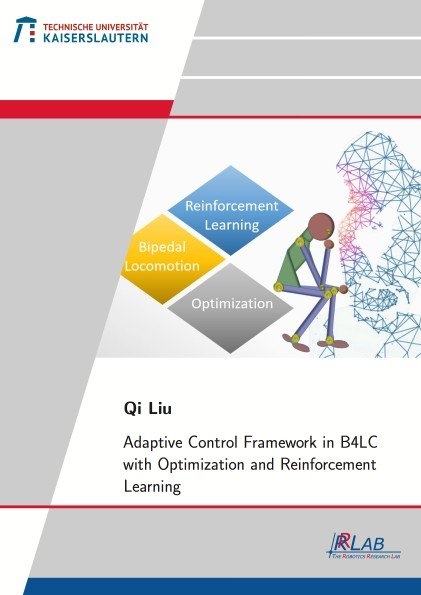
Adaptive Control Framework in B4LC with Optimization and Reinforcement Learning
Seiten
2019
Dr. Hut (Verlag)
978-3-8439-4219-5 (ISBN)
Dr. Hut (Verlag)
978-3-8439-4219-5 (ISBN)
- Keine Verlagsinformationen verfügbar
- Artikel merken
B4LC (Bio-inspired Behavior-based Bipedal Locomotion Control) has been developed by transferring some of the key findings in biomechanics to bipedal locomotion control. The system shows advantages over classical control approaches in achieving human-like locomotion behaviors, however, it suffers from several inherent problems.
In the local joints level, the control parameters were initially defined manually by comparing the experimental results to human kinematic and dynamic data.
In the higher control level, the postural reflexes and CPGs were developed considering limited external disturbances.
Therefore, a generic framework with the coordination of optimization and learning is proposed in this thesis.
The optimization modules based on the Particle Swarm Optimization are designed to search for the parameter sets of the dominant control units at the local joints.
The learning modules based on the Expectation-maximization Reinforcement Learning are implemented to define the activations of the corresponding CPGs and postural reflexes. The framework is further applied to refine the existing locomotion modes and to develop new walking skills.
To the end, the system is validated on a dynamic simulation platform for the walking phase transition of different scenarios, e.g., energy-efficient walking, uneven ground locomotion, obstacle avoidance, and various speeds walking.
In the local joints level, the control parameters were initially defined manually by comparing the experimental results to human kinematic and dynamic data.
In the higher control level, the postural reflexes and CPGs were developed considering limited external disturbances.
Therefore, a generic framework with the coordination of optimization and learning is proposed in this thesis.
The optimization modules based on the Particle Swarm Optimization are designed to search for the parameter sets of the dominant control units at the local joints.
The learning modules based on the Expectation-maximization Reinforcement Learning are implemented to define the activations of the corresponding CPGs and postural reflexes. The framework is further applied to refine the existing locomotion modes and to develop new walking skills.
To the end, the system is validated on a dynamic simulation platform for the walking phase transition of different scenarios, e.g., energy-efficient walking, uneven ground locomotion, obstacle avoidance, and various speeds walking.
| Erscheinungsdatum | 24.01.2020 |
|---|---|
| Reihe/Serie | Robotik und Automation |
| Verlagsort | München |
| Sprache | englisch |
| Maße | 148 x 210 mm |
| Gewicht | 332 g |
| Themenwelt | Technik ► Elektrotechnik / Energietechnik |
| Schlagworte | bipedal locomotion • Optimization • Reinforcement Learning |
| ISBN-10 | 3-8439-4219-6 / 3843942196 |
| ISBN-13 | 978-3-8439-4219-5 / 9783843942195 |
| Zustand | Neuware |
| Informationen gemäß Produktsicherheitsverordnung (GPSR) | |
| Haben Sie eine Frage zum Produkt? |
Mehr entdecken
aus dem Bereich


aus dem Bereich
Grundlagen, Systemtechnik und Analysen ausgeführter Beispiele …
Buch | Softcover (2025)
Springer Vieweg (Verlag)
CHF 55,95
Wegweiser für Elektrofachkräfte
Buch | Hardcover (2024)
VDE VERLAG
CHF 67,20


