


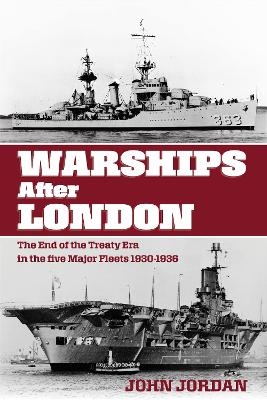
Warships After London
The End of the Treaty Era in the Five Major Fleets, 1930-1936
Seiten
2020
Seaforth Publishing (Verlag)
978-1-5267-7749-2 (ISBN)
Seaforth Publishing (Verlag)
978-1-5267-7749-2 (ISBN)
A sequel to the highly successful Warships after Washington. Essential background to the warships that fought the Second World War.
The Washington Treaty of February 1922 put a cap on the construction of capital ships and aircraft carriers while failing to impose similar restraints on auxiliary' vessels or submarines. This led to a competition in treaty cruisers' - ships of the maximum 10,000-ton displacement allowed, armed with multiple 8in guns - and in submarines, many of which were designed for long range and high speed on the surface. During the 1920s the French and the Japanese took particular advantage of the absence of quantitative or qualitative limits for these vessels to compensate for their inferiority in capital ships. Thus, as the ten-year review of Washington approached, Britain and the United States attempted to extend the ratios agreed in 1922 to the newly-defined categories of cruisers, destroyers and submarines. The negotiations which resulted in the Treaty of London of April 1930 were fraught, and the agreement proved controversial, particularly in Japan.
_Warships After London_ examines warship developments in the five major navies during the period 1930-1936/. Long-term plans were disrupted, and new construction had to be reviewed in the light of the new treaty regulations. The imposition of new quantitative limits for cruisers, destroyers and submarines led to new, often smaller designs, and a need to balance unit size against overall numbers within each of the categories.
As ships produced under these restrictions were the newest available when war broke out in 1939, this book is a major contribution to understanding the nature of the navies involved. Its value is enhanced by well-chosen photographs and by the author's specially-prepared line drawings showing the overall layout, armament, protection and propulsion of the ships laid down during the period.
_Warships After London_ is a fitting sequel to the author's acclaimed _Warships After Washington_, first published by Seaforth in 2011.
The Washington Treaty of February 1922 put a cap on the construction of capital ships and aircraft carriers while failing to impose similar restraints on auxiliary' vessels or submarines. This led to a competition in treaty cruisers' - ships of the maximum 10,000-ton displacement allowed, armed with multiple 8in guns - and in submarines, many of which were designed for long range and high speed on the surface. During the 1920s the French and the Japanese took particular advantage of the absence of quantitative or qualitative limits for these vessels to compensate for their inferiority in capital ships. Thus, as the ten-year review of Washington approached, Britain and the United States attempted to extend the ratios agreed in 1922 to the newly-defined categories of cruisers, destroyers and submarines. The negotiations which resulted in the Treaty of London of April 1930 were fraught, and the agreement proved controversial, particularly in Japan.
_Warships After London_ examines warship developments in the five major navies during the period 1930-1936/. Long-term plans were disrupted, and new construction had to be reviewed in the light of the new treaty regulations. The imposition of new quantitative limits for cruisers, destroyers and submarines led to new, often smaller designs, and a need to balance unit size against overall numbers within each of the categories.
As ships produced under these restrictions were the newest available when war broke out in 1939, this book is a major contribution to understanding the nature of the navies involved. Its value is enhanced by well-chosen photographs and by the author's specially-prepared line drawings showing the overall layout, armament, protection and propulsion of the ships laid down during the period.
_Warships After London_ is a fitting sequel to the author's acclaimed _Warships After Washington_, first published by Seaforth in 2011.
JOHN JORDAN is the editor of the annual Warship and is best known for a series of technical histories of French warships published by Seaforth. He has also made a particular study of the workings of naval treaties, this book being a sequel to his very popular _Warships after Washington._
| Erscheinungsdatum | 01.10.2020 |
|---|---|
| Zusatzinfo | 120 black and white illustrations |
| Verlagsort | Barnsley |
| Sprache | englisch |
| Maße | 156 x 234 mm |
| Themenwelt | Geschichte ► Teilgebiete der Geschichte ► Militärgeschichte |
| Sozialwissenschaften ► Politik / Verwaltung | |
| Technik | |
| ISBN-10 | 1-5267-7749-5 / 1526777495 |
| ISBN-13 | 978-1-5267-7749-2 / 9781526777492 |
| Zustand | Neuware |
| Informationen gemäß Produktsicherheitsverordnung (GPSR) | |
| Haben Sie eine Frage zum Produkt? |
Mehr entdecken
aus dem Bereich

aus dem Bereich
von der Wiederbewaffnung bis zur Zeitenwende
Buch | Softcover (2025)
C.H.Beck (Verlag)
CHF 16,80
Deutschlands großer Volksaufstand
Buch | Softcover (2024)
Propyläen Verlag
CHF 30,80


