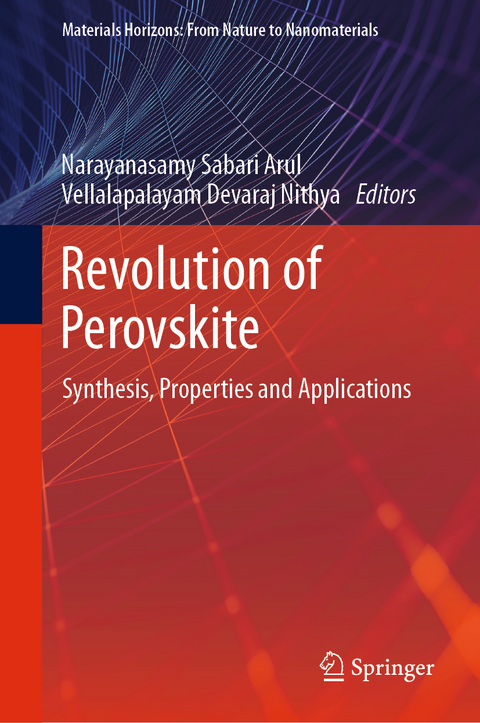
Revolution of Perovskite (eBook)
IX, 320 Seiten
Springer Singapore (Verlag)
978-981-15-1267-4 (ISBN)
This volume presents advanced synthesis techniques for fabricating Perovskite materials with enhanced properties for applications such as energy storage devices, photovoltaics, electrocatalysis, electronic devices, photocatalysts, sensing, and biomedical instruments. The book attempts to fill a gap in the published literature and provide a detailed reference on Perovskite materials. This book will be of use to graduate students and academic and industrial researchers in the fields of solid-state chemistry, physics, materials science, and chemical engineering.
Narayanasamy Sabari Arul received his Ph.D. in Nanoscience and Technology from Bharathiar University, Tamil Nadu, India. His research position includes visiting PhD research fellow at Lunghwa University of Science and Technology, Taiwan and Brain-Korea (BK21) Postdoctoral Fellow at Hanyang University, Seoul, South Korea and Assistant Professor in Dongguk University-Seoul, South Korea. His research interests include synthesis of metal oxide nanocomposites and thin films, nanomaterials, quantum dots, two-dimensional dichalcogenides and perovskites for photocatalysts, photovoltaic cells, memory devices, supercapacitors, and electrochemical sensors. He has published more than 45 SCI journal articles in the field of Materials science multidisciplinary and Nanotechnology along with 20 papers in proceedings of international conferences and holds one US and Korean Patent. Dr. Arul also serves as a referee for various journals in Springer, Elsevier, Royal Society of Chemistry and Institute of Physics.
V.D. Nithya received her Ph.D. in Physics from Bharathiar University, Tamil Nadu, India. She was awarded University gold medal in Bharathiar University for her excellence in M.Sc Physics motivated her to receive INSPIRE junior research fellowship (2010-2012) and INSPIRE senior research fellowship (2012-2014) from the Department of Science and Technology (DST), India. Her research interests mainly focus on metal oxide nanostructures and their applications for energy storage devices with special emphasis on supercapacitors and Li-ion batteries. In her academic carrier, she has published more than 20 peer-reviewed international research articles and also participated and published few national/international conferences proceedings in the field of Materials science, Physics/Chemistry Multidisciplinary.
This volume presents advanced synthesis techniques for fabricating Perovskite materials with enhanced properties for applications such as energy storage devices, photovoltaics, electrocatalysis, electronic devices, photocatalysts, sensing, and biomedical instruments. The book attempts to fill a gap in the published literature and provide a detailed reference on Perovskite materials. This book will be of use to graduate students and academic and industrial researchers in the fields of solid-state chemistry, physics, materials science, and chemical engineering.
Preface 6
Contents 7
About the Editors 9
1 Introduction to Perovskites: A Historical Perspective 10
1 Introduction 10
2 Working Nearly Blind: Discovery and Problems Establishing Perovskite Mineral’s Crystal System (1839–1925) 12
3 Let There Be Light: The X-Ray Time and the Proposition of a Structure for the Mineral Perovskite. (1925–1950s) 14
4 Perovskite Structure Enters in the Field of Materials Chemistry (1930–1950s) 20
5 The Ferroelectric Breakthrough: Perovskites Become “Trending Topic” (1940–1950s) 25
6 The Family Grows: From the Concept of “Sister Structures” to the Actual Meaning of “Perovskite-Type Structure” (the 1940s—Today) 27
7 Golden Decades: Studies Diversify and New Properties and Many Potential Applications Are Discovered (the 1970s—Today) 39
8 Conclusions 42
Acknowledgements 43
References 43
2 Magnetic, Electronic, and Optical Properties of Perovskite Materials 51
1 Introduction 51
2 Magnetic Properties 52
3 Electronic Properties 56
4 Optical Properties 60
References 64
3 Preparation Methods of Perovskite-Type Oxide Materials 68
1 Introduction 68
2 Preparation of Bulk Perovskite-Type Oxides 70
3 Synthesis of Perovskite-Type Oxide Nanopowders 70
3.1 Solid-State Reaction Route 70
3.2 Molten Salt Synthesis (MSS) 72
3.3 Mechanical Milling Method 72
3.4 Wet Chemical Routes 73
3.4.1 Sol–Gel Processing 73
3.4.2 Alkoxide-Hydroxide Sol–Precipitation Synthesis 74
3.4.3 Hydrothermal Routes 75
Hydrothermal Process 75
Solvothermal Process 76
Microwave-Hydrothermal Process 77
3.5 Chemical or Physical Vapor Deposition 78
4 Preparation Methods of 1D Perovskite-Type Oxide Nanostructures 79
4.1 Template-Free Synthesis 79
4.2 Template-Assisted Methods 80
5 Preparation Methods of 2D Perovskite-Type Oxide Nanostructures 85
5.1 Perovskite Oxide Thin Films or Multilayers 85
5.2 Pulsed Laser Deposition (PLD) 85
5.2.1 Chemical Solution Deposition (CSD) 85
5.2.2 CVD and MOCVD 86
5.2.3 Molecular Beam Epitaxy (MBE) 87
5.3 2D Perovskite Oxide Nanostructures Based on Planar Structures 87
5.3.1 Top-Down Methods 87
5.3.2 Bottom-up Methods 87
5.4 Perovskite Oxide Nanosheets 88
6 Preparation Methods of 3D Perovskite-Type Oxide Nanostructures 88
7 Conclusions and Outlook 91
Acknowledgements 92
References 92
4 Perovskite Materials in Biomedical Applications 101
1 Introduction 101
2 Organic–Inorganic Hybrid Perovskites for X-Ray Detection and Imaging 102
2.1 CH3NH3PbI3 (MAPbI3) Photodiode for Sensitive X-Ray Detection 102
2.2 MAPbI3 Photoconductor for X-Ray Imaging with High Responsivity 103
2.3 CH3NH3PbBr3 (MAPbBr3) Single Crystal for Low-Dose X-Ray Imaging with High Sensitivity 105
2.4 Polycrystalline MAPbI3 Photoconductor with Polymer–Perovskite Interlayers for Large-Area and Low-Dose X-Ray Imaging 106
3 Magnetic Perovskite Nanoparticles for In Vitro Applications 110
3.1 La0.7Sr0.3Mn0.98Ti0.02O3 Perovskite Nanoparticles with Magneto-Temperature Properties 110
3.2 Perovskite La2NiMnO6 Nanoparticles for Adsorption of Bovine Serum Albumin (BSA) 112
4 In Vitro Biocompatibility of (Ca10(PO4)6(OH)2–CaTiO3) Composites in Cellular Cultures 114
5 Concluding Remarks 116
References 117
5 Ion Transport and Stability Issues in Organic–Inorganic Perovskite Materials 123
1 Introduction 123
2 Vacancy-Mediated Ion Transport (Microscopic Transport Mechanism of Ion Migration) 124
2.1 Vacancy-Mediated Ion Transport Mechanism 125
2.2 Paths of Vacancy Migration 127
3 Experimental Evidences of Ionic Transport 129
3.1 Charge Transport Dynamics in Organolead Halide Perovskite Materials (Metal/Perovskite/Metal Geometry) 129
3.1.1 Mechanism 131
3.1.2 Quantification 133
3.2 Bias Dependent 134
3.3 Illumination Dependent 136
3.3.1 Quantification 136
3.4 Temperature Dependent 140
3.5 Morphology Dependent 141
3.6 Electronic and Ionic Transport Dynamics in Organolead Halide Perovskites 144
4 Charge Transport Dynamics in Organolead Halide Perovskite Solar Cell (Device Geometry) 144
4.1 Bias Dependent 147
4.2 Illumination Dependent 151
4.3 Temperature Dependent 152
4.4 Size of Alkyl Ammonium Ion Dependent 154
5 Stability Issues 154
5.1 Role of Organic Cation 155
5.2 Role of Halide Ion 155
5.3 Role of Crystal Size and Purity 156
6 Conclusion 157
References 157
6 Perovskite Materials in Batteries 159
1 Introduction to Perovskite Materials 159
1.1 Perovskite Structure 160
1.2 Preparation Methods 161
2 Perovskite Materials in Batteries 165
3 Layered Perovskites as New Electrode Materials in Ni–Oxide Batteries 170
3.1 Nd2Ti2O5 Electrode Preparation and Electrochemical Setup 171
3.2 Nd2Ti2O5 Electrochemical Performance 171
4 Perspectives and Suggestions Regarding the Selection of Perovskite Materials for Ni–Oxide and Metal–Air Batteries 175
5 Concluding Remarks 176
Acknowledgements 176
References 177
7 Perovskite Materials in Photovoltaics 180
1 Introduction 180
2 Organic–Inorganic Solar Cells 181
2.1 A Brief Introduction of PSCs 181
2.2 Light Absorbers 182
2.2.1 Processing of Perovskite Films 182
2.2.2 Compositional Engineering 184
2.2.3 Device Operational Stability 188
2.3 Electron Transportation Materials 189
3 Dye-Sensitized Solar Cells 193
3.1 A Brief Introduction of DSSCs 193
3.2 Photoanodes 194
3.3 Photocathodes 198
Acknowledgements 201
References 202
8 Perovskite Materials in Electrocatalysis 213
1 Introduction 213
2 Mechanisms in Electrocatalysis on Perovskite Materials 215
2.1 Oxygen Electrocatalysis 215
2.2 Hydrogen Electrocatalysis 217
3 Rational Design of Perovskite Materials Toward Efficient Electrocatalysis 218
3.1 Activity Descriptors 219
3.1.1 Activity Descriptors from Molecular Orbital Theory 219
3.1.2 Activity Descriptors from Band Theory 221
3.2 Design Strategies 222
3.2.1 Composition 223
3.2.2 Oxygen Vacancy 225
3.2.3 Crystal Structure 226
3.2.4 Nanostructure 228
3.2.5 Composite 230
3.3 Stability Concerns 233
4 Perovskite Materials for Electrocatalysis-Related Applications 235
4.1 Metal–Air Batteries 236
4.2 Water Electrolyzers 240
References 243
9 Perovskite Material-Based Photocatalysts 255
1 Introduction 255
1.1 Heterogeneous Photocatalysis—Semiconductor Oxides as Photocatalysts 256
1.2 Mechanism of Semiconductor Photocatalysis 257
2 Methods to Tailor the Photocatalytic Properties of Semiconductor Photocatalysts 259
3 A Short Overview of Perovskite Oxides as Photocatalysts 261
4 Recent Developments in Enhancing the Photocatalytic Activity of Perovskite Materials 263
5 Conclusions and Insights 283
Acknowledgements 283
References 283
10 LEDs and Other Electronic Devices Based on Perovskite Materials 292
1 Introduction 292
2 Low-Dimensional Hybrid Organic–Inorganic Semiconductors in Light–Emitting Diodes—LEDs 298
3 Low-Dimensional Hybrid Organic–Inorganic Semiconductors in Lasers 305
4 Low-Dimensional Hybrid Organic–Inorganic Semiconductors in Sensors 307
5 Low-Dimensional Hybrid Organic–Inorganic Semiconductors in Transistors 309
6 Low-Dimensional Hybrid Organic–Inorganic Semiconductors in Lithium–Ion Batteries 311
7 Conclusions 312
References 312
11 Future Challenges of the Perovskite Materials 318
1 Lifetime and Stability 318
2 Lead Toxicity 319
3 Hysteresis and Measurement Standards 320
4 Large-Area and Flexible Devices 321
References 321
12 Correction to: Introduction to Perovskites: A Historical Perspective 324
Correction to: Chapter 1 in: N. S. Arul and V. D. Nithya (eds.), Revolution of Perovskite, Materials Horizons: From Nature to Nanomaterials, https://doi.org/10.1007/978-981-15-1267-4_1 324
| Erscheint lt. Verlag | 3.1.2020 |
|---|---|
| Reihe/Serie | Materials Horizons: From Nature to Nanomaterials | Materials Horizons: From Nature to Nanomaterials |
| Zusatzinfo | IX, 320 p. 129 illus., 85 illus. in color. |
| Sprache | englisch |
| Themenwelt | Technik ► Maschinenbau |
| Schlagworte | Applications of Perovskite materials • Perovskite materials • Properties of Perovskite materials • Simulation of Perovskite materials • Synthesis of Perovskite materials |
| ISBN-10 | 981-15-1267-1 / 9811512671 |
| ISBN-13 | 978-981-15-1267-4 / 9789811512674 |
| Informationen gemäß Produktsicherheitsverordnung (GPSR) | |
| Haben Sie eine Frage zum Produkt? |
 PDF (Wasserzeichen)
DRM: Digitales Wasserzeichen
Dieses eBook enthält ein digitales Wasserzeichen und ist damit für Sie personalisiert. Bei einer missbräuchlichen Weitergabe des eBooks an Dritte ist eine Rückverfolgung an die Quelle möglich.
Dateiformat: PDF (Portable Document Format)
Mit einem festen Seitenlayout eignet sich die PDF besonders für Fachbücher mit Spalten, Tabellen und Abbildungen. Eine PDF kann auf fast allen Geräten angezeigt werden, ist aber für kleine Displays (Smartphone, eReader) nur eingeschränkt geeignet.
Systemvoraussetzungen:
PC/Mac: Mit einem PC oder Mac können Sie dieses eBook lesen. Sie benötigen dafür einen PDF-Viewer - z.B. den Adobe Reader oder Adobe Digital Editions.
eReader: Dieses eBook kann mit (fast) allen eBook-Readern gelesen werden. Mit dem amazon-Kindle ist es aber nicht kompatibel.
Smartphone/Tablet: Egal ob Apple oder Android, dieses eBook können Sie lesen. Sie benötigen dafür einen PDF-Viewer - z.B. die kostenlose Adobe Digital Editions-App.
Buying eBooks from abroad
For tax law reasons we can sell eBooks just within Germany and Switzerland. Regrettably we cannot fulfill eBook-orders from other countries.
aus dem Bereich