Petrochemistry (eBook)
John Wiley & Sons (Verlag)
978-1-119-64783-6 (ISBN)
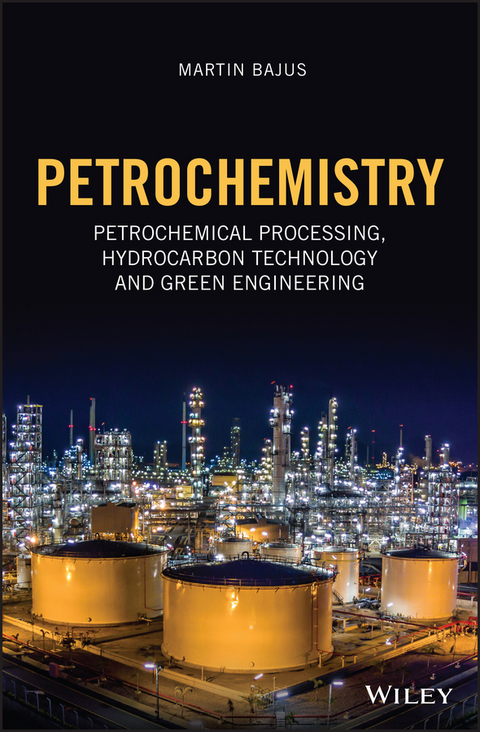
A comprehensive textbook on petrochemical conversion processes for petroleum and natural gas fractions as produced by refinery operations
This innovative textbook provides essential links between the chemical sciences and chemical technology, between petrochemistry and hydrocarbon technology. The book brings alive key concepts forming the basis of chemical technology and presents a solid background for innovative process development. In all chapters, the processes described are accompanied by simplified flow schemes, encouraging students to think in terms of conceptual process designs.
Petrochemistry: Petrochemical Processing, Hydrocarbon Technology and Green Engineering introduces students to a variety of topics related to the petrochemical industry, hydrocarbon processing, fossil fuel resources, as well as fuels and chemicals conversion. The first chapter covers the fundamentals and principals for designing several of the processes in the book, including discussions on thermodynamics, chemical kinetics, reactor calculations, and industrial catalysts. The following chapters address recent advances in hydrocarbon technology, energy technology, and sources of hydrocarbons. The book then goes on to discuss the petrochemical industry based on four basic pillars, all derived from petroleum and natural gas:
- Production of lower alkenes; other sources of lower alkenes; petrochemicals from C2-C3 alkenes
- Production of BTX aromatics; chemicals from BTX aromatics
- C1 technology
- Diversification of petrochemicals
The growing importance of sustainable technology, process intensification and addressing greenhouse gas emissions is reflected throughout the book.
Written for advanced students working in the areas of petrochemistry, hydrocarbon technology, natural gas, energy materials and technologies, alternative fuels, and recycling technologies the book is also a valuable reference for industrial practitioners in the oil and gas industry.
MARTIN BAJUS, Professor of Chemical Technology at Slovak University of Technology, Institute of Organic Chemistry, Catalysis and Petrochemistry, Bratislava, Slovak Republic. Prof. Bajus is a leading expert in refinery, petrochemical, energy and recycling technologies, and founder of the Bratislava School of Pyrolysis at the Slovak University of Technology.
A comprehensive textbook on petrochemical conversion processes for petroleum and natural gas fractions as produced by refinery operations This innovative textbook provides essential links between the chemical sciences and chemical technology, between petrochemistry and hydrocarbon technology. The book brings alive key concepts forming the basis of chemical technology and presents a solid background for innovative process development. In all chapters, the processes described are accompanied by simplified flow schemes, encouraging students to think in terms of conceptual process designs. Petrochemistry: Petrochemical Processing, Hydrocarbon Technology and Green Engineering introduces students to a variety of topics related to the petrochemical industry, hydrocarbon processing, fossil fuel resources, as well as fuels and chemicals conversion. The first chapter covers the fundamentals and principals for designing several of the processes in the book, including discussions on thermodynamics, chemical kinetics, reactor calculations, and industrial catalysts. The following chapters address recent advances in hydrocarbon technology, energy technology, and sources of hydrocarbons. The book then goes on to discuss the petrochemical industry based on four basic pillars, all derived from petroleum and natural gas: Production of lower alkenes; other sources of lower alkenes; petrochemicals from C2-C3 alkenes Production of BTX aromatics; chemicals from BTX aromatics C1 technology Diversification of petrochemicals The growing importance of sustainable technology, process intensification and addressing greenhouse gas emissions is reflected throughout the book. Written for advanced students working in the areas of petrochemistry, hydrocarbon technology, natural gas, energy materials and technologies, alternative fuels, and recycling technologies the book is also a valuable reference for industrial practitioners in the oil and gas industry.
MARTIN BAJUS, Professor of Chemical Technology at Slovak University of Technology, Institute of Organic Chemistry, Catalysis and Petrochemistry, Bratislava, Slovak Republic. Prof. Bajus is a leading expert in refinery, petrochemical, energy and recycling technologies, and founder of the Bratislava School of Pyrolysis at the Slovak University of Technology.
General Literature
- Aguado, J. and Serrano, D. (1999). Feedstock Recycling of Plastic Wastes., RSC Clean Technology Monographs (ed. J.H. Clark). Cambridge: Royal Society of Chemistry.
- Albright, L.F., Crynes, B.L., and Corcoran, W.H. (1983). Pyrolysis: Theory and Industrial Practice, 266. New York: Academic Press; p. 233.
- Arpe, H. (2010). Industrial Organic Chemicals, 5e. New York: Wiley.
- Arpentinier, P., Cavani, F., and Trifiro, F. (2001). Chemical, Catalytic & Engineering Aspects, The Technology of Catalytic Oxidation. Paris: Editions Technip.
- Arpentinier, P., Cavani, F., and Trifiro, F. (2001). The Technology of Catalytic Oxidation, 2. Safety Aspects. Paris: Editions Technip.
- Austin, G.T. (1984). Shreve's Chemical Process Industries. New York: McGraw Hill Book Company, Finfth Edition.
- Bajus, M. (1987). Thermal conversion of petroleum hydrocarbons into petrochemicals. D.Sc thesis. Slovak University of Technology, Bratislava, Slovak Republic.
- Bajus, M. (1989). Sulfur compounds in hydrocarbon pyrolysis. Sulfur Reports 9 (1): 25–71.
- Bajus, M. (2002). Organická technológia a petrochémia, Uhľovodíkové technológie. Bratislava: Vydavateľstvo STU.
- Bajus, M. (2019). Chemické procesy v organickej technológii a petrochémii (Chemical Process in Organic Technology and Petrochemistry). e‐Book. Bratislava: Vydavateľstvo Spektrum STU.
- Bajus, M., Lederer, J., and Bělohlav, Z. (2016). Hydrocarbon technology, trends and outlook in petrochemistry. Plenary lecture at the 4th International Conference on Chemical Technology.
- Bajus, M., Malatinský, T., Buláková, Ľ. et al. (2006). 150 rokov plynárenstva na Slovensku. Bratislava: Vydal Slovenský plynárenský a naftový zväz.
- Bisio, A. and Boots, S. (1995). Encyclopedia of Energy Technology and the Environment, vol. 1–4. Wiley.
- BP. (2019). BP statistical review of world energy (1995–2018). http://bp.com/statisticalreview.
- Brown, R.C. (ed.) (2011). Thermochemical Processing of Biomass, Conversion into Fuels, Chemicals and Power. Wiley.
- Burnham, A.K. (2017). Global Chemical Kinetics of Fossil Fuels. Springer.
- van Santen, R.A., van Leeuwen, P.W.N.M., Moulijn, J.A., and Averill, B.A. (eds.) (1999). Catalysis: An Integrated Approach, second, revised and enlargede, vol. 123. Elsevier.
- Cenka, M. (2001). Obnovitelné zdroje energie. Praha: FCC Public.
- Centi, G., Cavani, F., and Trifiró, F. (2001). Selective Oxidation by Heterogeneous Catalysis. New York: Kluwer Academic/Plenum Publishers.
- Comyns, A.E. (1999). Encyclopedic Dictionary of Named Processes in Chemical Technology, 2e. Boca Raton London: CRC Press.
- Corma, A. and Martinez, A. (2002). Handbook of Porous Solids (eds. F. Schutz, K.S.W. Sing and J. Wetkamp), 2825. Weinheim: Wiley‐VCH.
- Coutler, J.C. (2004). Encyclopedia of Energy, vol. 1–6. San Diego, California: Elsevier Inc., Academic Press.
- Ehrfeld, W., Hessel, V., and Loewe, H. (2000). Microreactors‐New Technology for Modern Chemistry, 9. Weinheim: Wiley‐VCH.
- El‐Gendy, L.S. (2018). Biodesulfurization in Petroleum Refining. Scrivener Publishing: Wiley, 1200 pages.
- Germain, J.E. (1969). Catalytic Conversion of Hydrocarbons. London and New York: Academic Press.
- Harker, J.H. and Backhurst, J.R. (1981). Fuel and Energy. London: Academic Press.
- Holt, K., Jewell, L., Niemantsverdriet, H. et al. (2017). Designing new catalysts for synthetic fuels. Faraday Discussions 197: 353–388.
- Hougen, O.A. and Watson, K.M. (1947). Chemical Process Principles, vol. 3, 887–886. New York: Wiley.
- Hsu, C.S. (2019). Petroleum Science and Technology. Springer International Publishing, 487 pages.
- Hsu, C. and Robinson, P.R. (eds.) (2017). Springer Handbook of Petroleum Technology. Springer International Publishing AG.
- Humphrey, J.L. and Keller, G.L. (1997). Separation Process Technology. New York: McGraw‐Hill.
- Hussein, K.A. and Alsahlavi, M. (2013). Petroleum Economics and Engineering, 3e. CRC Press.
- Jones, D.S.J. and Pujado, P. (eds.) (2006). Handbook of Chemical Processing. Springer.
- Ke, L., Chunshan, S., and Velu, S. (2010). Hydrogen and Syngas Production and Purification Technologies, AIChe. Hoboken: Wiley.
- Kelland, M.A. (2014). Production Chemicals from the Oil and Gas Industry. CRC Press.
- Kizlink, J. (2011). Technologie chemických látek a jejich použití (Technology of Chemical Compounds), 4ee. VUTIUM.
- Lee, S. (2012). Biofuels and Bioenergy. CRC Press.
- Luque, R. (2013). Producing Fuels and Fine Chemicals from Biomass Using Na. CRC Press.
- Luque, R. and Leung‐Yuk Lam, F. (2018). Substainable Catalysis: Energy‐Efficient Reactions and Applications. Wiley‐VHC, Verlag GmbH and CoKGaA.
- Malwell, I.E. and Stork, W.H.J. (2001). Introduction to zeolite science and practise. In: Studies Science and Catalysis, 2e, vol. 137 (eds. H. van Bekkum, E.M. Flamigen, P.A. Jacobs and J.C. Jansen), 747. Amsterdam: Elsevier.
- Meyers, R.A. (2005). Handbook of Petrochemicals Production Processes. Inc., New York: The McGraw‐Hill Companies.
- Minteer, S. (2006). Alcoholic Fuels. Boca Raton: CRC, Taylor and Francis.
- Dawe, R.A. (ed.) (2000). Modern Petroleum Technology, 6e, vol. 1, Upstream. Chichester: Wiley.
- Lucas, A.G. (2000). Modern Petroleum Technology, 6e, vol. 2, Downstream. Chichester: Wiley.
- Moulijn, J.A., Makkee, M., and Van Diepen, A. (2005). Chemical Process Technology. Wiley.
- Parmaliana, A., Sanfilippo, D., Frusteri, F. et al. (eds.) (1998). Natural Gas Conversion V, vol. 119. Elsevier.
- Iglesia, E., Spivey, J.J., and Fleisch, T.H. (eds.) (2001). Natural Gas Conversion VI, vol. 136. Elsevier.
- Noronha, F.B., Schmal, M., and Sousa‐Aguiar, E.F. (eds.) (2007). Natural Gas Conversion VIII, vol. 167. Elsevier.
- Olah, G.A. and Molnar, A. (1995). Hydrocarbons Chemistry, 632. New York: Wiley.
- Olivé, G.H. and Olivé, S. (1984). The Chemistry of the Catalyzed Hydrogenation of Carbon Monoxide. Berlin, Heidelberg: Springer – Verlag.
- Pastorek, Z., Kára, J., and Jevič, P. (2004). Biomasa obnovitelný zdroj energie. Praha: FCC Public.
- Wauquier, J.‐P. (ed.) (1995). Petroleum Refining, 1. Crude Oil, Petroleum Process Flowsheets. Editions Technip.
- Wauquier, J.‐P. (ed.) (2000). Petroleum Refining, 2. Separation Processes. Editions Technip.
- Leprince, P. (ed.) (1995). Petroleum Refining, 3. Conversion Process. Editions Technip.
- Trambouze, P. (ed.) (2000). Petroleum Refining, 4. Materials and Equipment. Editions Technip.
- Favennec, J.P. (ed.) (2001). Petroleum Refining, 5. Refinery Operation and Management. Editions Technip.
- Pines, H. (1981). The Chemistry of Catalytic Hydrocarbon Reactions. Academic Press.
- Rojey, A., Jaffret, C., Cornot‐Gandolphe, S., and Durand, B. (1997). Natural Gas Production Processing Transport, 429. Editions Technip.
- Rossillo‐Calle, F., de Groot, P., and Hemstock, S.L. (eds.) (2007). The Biomass Assessment Handbook, Bioenergy for a Sustainable Environment. London: Earthscan.
- Sabu, T. (2014). Biomaterial Applications: Micro to Nanoscales. CRC Press.
- Shah, Y.T. (2014). Water for Energy and Fuel Production. CRC Press.
- Sheldon, R.A. (1982). Chemicals from Synthesis Gas, D. Dordrecht, Holland: Reidel Publishing Company.
- Skrzypek, J., Sloczynski, J., and Ledakowicz, S. (1994). Methanol Synthesis. Sp. Z o.o, Warszawa: Polish Scientific Publishers PWN.
- Sorensen, B. (2005). Hydrogen and Fuel Cells, Emerging Technologies and Applications. Amsterdam: Elsevier, Academic Press.
- Spath, P.L. and Dayton, D.C. (2003). Preliminary screening – technical and economic assessment of synthesis gas to fuels and chemicals with emphasis on the potential for biomass‐derived syngas. National Renewable Energy Laboratory.
- Speight, J.G. (2011). Handbook of Industrial Hydrocarbon Processes, 1e. Burlington, MA: Elsevier Inc.
- Speight, J.G. (2014). The Chemistry and Technology of Petroleum, 5e. CRC Press.
- Spitz, H.P. (1988). Petrochemicals, the Rise of an Industry. Wiley.
- Stocchi, E. (1999). Industrial Chemistry, vol. 1. New York: Ellis Horwood Limited.
- Sylvester, E. (2010). Course: chemical technology (organic), lecture 7, aromatic production. https://www.academia.edu/33302746/Course_Chemical_Technology_Organic_Module_VII_Lecture_7_Aromatic_Production.
- Uner, D. (2017). Advances in Refining Catalysis, Chemical Industries, 1e. CRC Press, 422 pp.
- Varfolomeev, S.D. (2014). Chemical and Biochemical Technology: Material and Processing. CRC Press.
- Vertes, A.A., Qureshi, N., Blaschek, H.P., and Yukawa, H. (eds.) (2010). Biomass to Biofuels, Strategies for Global Industries. Wiley.
- Veselý, V., Mostecký, J., Bajus, M. et al. (1989). Petrochémia (Petrochemistry). Alfa Bratislava.
- Wikipedia. (2019). Petrochemical. https//en.wikipedia.org/wiki/Petrochemical.
- Wittcoff, H.A. and Reuben, B.G. (1980). Industrial Organic Chemicals in Perspective, Part One: Raw Materials and Manufacture. New York: Wiley.
- Wittcoff, H.A. and Reuben, B.G. (1996). Industrial Organic Chemicals. New York: Wiley.
- Wittcoff, H.A., Reuben, B.G., and Plotkin, J.S....
| Erscheint lt. Verlag | 3.1.2020 |
|---|---|
| Sprache | englisch |
| Themenwelt | Naturwissenschaften ► Chemie ► Technische Chemie |
| Technik | |
| Schlagworte | Alkenes • BTX aromatics • C1 technology • catalysis • chemical conversion</p> • chemical engineering • chemical science • Chemie • Chemische Verfahrenstechnik • Chemistry • Energie • Energy • Erdgas • Erdgas u. Erdöl • Green Engineering • hydrocarbon technology • <p>petrochemistry: petrochemical processing • Natural gas • Natural Gas & Petroleum Products • organic technology • petrochemicals • Petrochemie • Petrochemie / Brennstoffindustrie • Petrochemistry / Fuel • Petroleum |
| ISBN-10 | 1-119-64783-5 / 1119647835 |
| ISBN-13 | 978-1-119-64783-6 / 9781119647836 |
| Informationen gemäß Produktsicherheitsverordnung (GPSR) | |
| Haben Sie eine Frage zum Produkt? |
 EPUB (Adobe DRM)
Kopierschutz: Adobe-DRM
Adobe-DRM ist ein Kopierschutz, der das eBook vor Mißbrauch schützen soll. Dabei wird das eBook bereits beim Download auf Ihre persönliche Adobe-ID autorisiert. Lesen können Sie das eBook dann nur auf den Geräten, welche ebenfalls auf Ihre Adobe-ID registriert sind.
Details zum Adobe-DRM
Dateiformat: EPUB (Electronic Publication)
EPUB ist ein offener Standard für eBooks und eignet sich besonders zur Darstellung von Belletristik und Sachbüchern. Der Fließtext wird dynamisch an die Display- und Schriftgröße angepasst. Auch für mobile Lesegeräte ist EPUB daher gut geeignet.
Systemvoraussetzungen:
PC/Mac: Mit einem PC oder Mac können Sie dieses eBook lesen. Sie benötigen eine
eReader: Dieses eBook kann mit (fast) allen eBook-Readern gelesen werden. Mit dem amazon-Kindle ist es aber nicht kompatibel.
Smartphone/Tablet: Egal ob Apple oder Android, dieses eBook können Sie lesen. Sie benötigen eine
Geräteliste und zusätzliche Hinweise
Buying eBooks from abroad
For tax law reasons we can sell eBooks just within Germany and Switzerland. Regrettably we cannot fulfill eBook-orders from other countries.
aus dem Bereich