


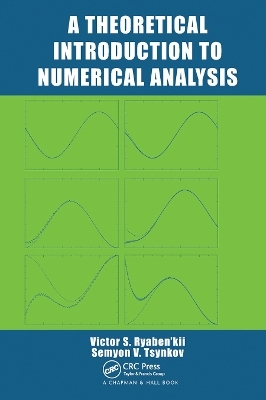
A Theoretical Introduction to Numerical Analysis
Seiten
2019
Chapman & Hall/CRC (Verlag)
9780367453398 (ISBN)
Chapman & Hall/CRC (Verlag)
9780367453398 (ISBN)
A Theoretical Introduction to Numerical Analysis presents the general methodology and principles of numerical analysis, illustrating these concepts using numerical methods from real analysis, linear algebra, and differential equations. The book focuses on how to efficiently represent mathematical models for computer-based study.
An accessible yet rigorous mathematical introduction, this book provides a pedagogical account of the fundamentals of numerical analysis. The authors thoroughly explain basic concepts, such as discretization, error, efficiency, complexity, numerical stability, consistency, and convergence. The text also addresses more complex topics like intrinsic error limits and the effect of smoothness on the accuracy of approximation in the context of Chebyshev interpolation, Gaussian quadratures, and spectral methods for differential equations. Another advanced subject discussed, the method of difference potentials, employs discrete analogues of Calderon’s potentials and boundary projection operators. The authors often delineate various techniques through exercises that require further theoretical study or computer implementation.
By lucidly presenting the central mathematical concepts of numerical methods, A Theoretical Introduction to Numerical Analysis provides a foundational link to more specialized computational work in fluid dynamics, acoustics, and electromagnetism.
An accessible yet rigorous mathematical introduction, this book provides a pedagogical account of the fundamentals of numerical analysis. The authors thoroughly explain basic concepts, such as discretization, error, efficiency, complexity, numerical stability, consistency, and convergence. The text also addresses more complex topics like intrinsic error limits and the effect of smoothness on the accuracy of approximation in the context of Chebyshev interpolation, Gaussian quadratures, and spectral methods for differential equations. Another advanced subject discussed, the method of difference potentials, employs discrete analogues of Calderon’s potentials and boundary projection operators. The authors often delineate various techniques through exercises that require further theoretical study or computer implementation.
By lucidly presenting the central mathematical concepts of numerical methods, A Theoretical Introduction to Numerical Analysis provides a foundational link to more specialized computational work in fluid dynamics, acoustics, and electromagnetism.
Victor S. Ryaben'kii, Semyon V Tsynkov
Introduction. Interpolation of Functions. Quadratures. Systems of Scalar Equations. The Method of Finite Differences for the Numerical Solution of Differential Equations. The Methods of Boundary Equations for the Numerical Solution of Boundary Value Problems. References. Index.
| Erscheinungsdatum | 16.12.2019 |
|---|---|
| Zusatzinfo | 50 Illustrations, black and white |
| Sprache | englisch |
| Maße | 156 x 234 mm |
| Gewicht | 453 g |
| Themenwelt | Mathematik / Informatik ► Informatik ► Theorie / Studium |
| Mathematik / Informatik ► Mathematik ► Analysis | |
| Technik ► Maschinenbau | |
| Technik ► Umwelttechnik / Biotechnologie | |
| ISBN-13 | 9780367453398 / 9780367453398 |
| Zustand | Neuware |
| Informationen gemäß Produktsicherheitsverordnung (GPSR) | |
| Haben Sie eine Frage zum Produkt? |
Mehr entdecken
aus dem Bereich


aus dem Bereich
was jeder über Informatik wissen sollte
Buch | Softcover (2024)
Springer Vieweg (Verlag)
CHF 53,15
Grundlagen – Anwendungen – Perspektiven
Buch | Softcover (2022)
Springer Vieweg (Verlag)
CHF 53,15
Teil 2 der gestreckten Abschlussprüfung Fachinformatiker/-in …
Buch | Softcover (2025)
Europa-Lehrmittel (Verlag)
CHF 37,90


