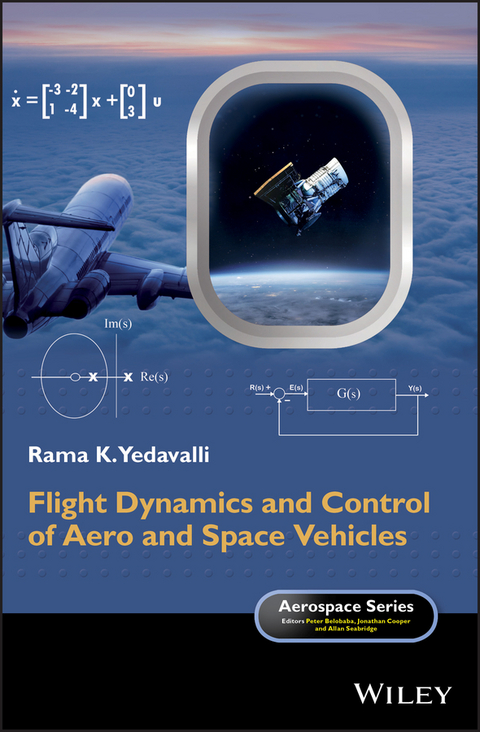
Flight Dynamics and Control of Aero and Space Vehicles (eBook)
John Wiley & Sons (Verlag)
978-1-118-93443-2 (ISBN)
Flight Vehicle Dynamics and Control
Rama K. Yedavalli, The Ohio State University, USA
A comprehensive textbook which presents flight vehicle dynamics and control in a unified framework
Flight Vehicle Dynamics and Control presents the dynamics and control of various flight vehicles, including aircraft, spacecraft, helicopter, missiles, etc, in a unified framework. It covers the fundamental topics in the dynamics and control of these flight vehicles, highlighting shared points as well as differences in dynamics and control issues, making use of the 'systems level' viewpoint.
The book begins with the derivation of the equations of motion for a general rigid body and then delineates the differences between the dynamics of various flight vehicles in a fundamental way. It then focuses on the dynamic equations with application to these various flight vehicles, concentrating more on aircraft and spacecraft cases. Then the control systems analysis and design is carried out both from transfer function, classical control, as well as modern, state space control points of view. Illustrative examples of application to atmospheric and space vehicles are presented, emphasizing the 'systems level' viewpoint of control design.
Key features:
- Provides a comprehensive treatment of dynamics and control of various flight vehicles in a single volume.
- Contains worked out examples (including MATLAB examples) and end of chapter homework problems.
- Suitable as a single textbook for a sequence of undergraduate courses on flight vehicle dynamics and control.
- Accompanied by a website that includes additional problems and a solutions manual.
The book is essential reading for undergraduate students in mechanical and aerospace engineering, engineers working on flight vehicle control, and researchers from other engineering backgrounds working on related topics.
Rama K. Yedavalli is a Professor in the Department of Mechanical and Aerospace Engineering at Ohio State University. His research interests include systems level robust stability analysis and control design for uncertain dynamical systems with applications to mechanical and aerospace systems. He also works on robust control, distributed control, adaptive control, hybrid systems control and control of time delay systems with applications to mechanical and aerospace systems.
Rama K. Yedavalli is a Professor in the Department of Mechanical and Aerospace Engineering at Ohio State University. His research interests include systems level robust stability analysis and control design for uncertain dynamical systems with applications to mechanical and aerospace systems. He also works on robust control, distributed control, adaptive control, hybrid systems control and control of time delay systems with applications to mechanical and aerospace systems.
"Different from the most existing books on the subject, this book covers not only aircraft but also spacecraft via the frequency-domain transfer function based control theory as well as the time-domain state space based control theory, thereby providing important concepts of flight dynamics and control in an integral way, which is crucial for students in aerospace engineering who want to know how flight vehicles fly as intended."
Inseok Hwang, PhD, Professor, Aeronautics and Astronautics
School of Aeronautics and Astronautics, Purdue University
"The book is a "must have" for students as well as practicing engineers. I think that the book is unique and it is a complete guideline for two undergraduate courses. It is extremely well written, and it shows the high level scientific background of its author."
Mario Innocenti, PhD, Full Professor of Aerospace Dynamics and Control
Department of Information Engineering, University of Pisa
Preface
The subject of flight dynamics and control is an important and integral part of any quality aerospace education curriculum. With the affinity and bias I have for this subject, I even go to the extent of saying that this discipline is an essential part of aerospace education. If we make the analogy of a flight vehicle to a human body, I liken this subject as the “brain” of the human body. After all, a flight vehicle on its own is of no use (or lifeless) without its ability to maneuver from one point to another point. In the first half of the 20th century, flight essentially meant atmospheric flight, while the second half of the 20th century expanded that notion to space vehicles as well. Thus, it is only fitting that the students of the 21st century be conversant with both aero and space flight vehicle dynamics and control. It is indeed accepted that there are plenty of excellent textbooks available on this general subject area. However, a close examination of the contents of the currently available textbooks reveals that the majority of those textbooks are exclusively aimed at either aircraft flight dynamics and control or at spacecraft flight dynamics and control, as can be seen from the references given at the end of this preface.
While universities and academic institutions with large and separate aerospace engineering departments can afford the luxury of teaching flight vehicle dynamics and control at the undergraduate level separately for air vehicles and space vehicles, in general, the most likely scenario in majority of the undergraduate curricula across major higher education institutions across the globe is that this type of separate, exclusive treatment for both of these types of vehicles within the available undergraduate curriculum became constrained by faculty/staff resources, the academic institution's mission as well as student body interests and the local job market. Hence, of late, it is felt that the undergraduate student body is better served if it is introduced to few basics of both aircraft flight vehicle dynamics and of spacecraft (satellite) dynamics and control to conform to the ABET guidelines of a satisfactory and adequate dynamics and control discipline coverage in a typical aerospace engineering department. Our then aerospace engineering department at the Ohio State University embraced this viewpoint. Within this viewpoint, it became increasingly clear that there is a need for an undergraduate level textbook that provides the needed exposure to the fundamentals of both air vehicles as well as space vehicles, adjacent to one another, so that the undergraduate student has the option to specialize in either of those two application areas for their advanced learning. For a long period of time, two separate textbooks (expensive) were prescribed; one catering to aircraft dynamics and control and another catering to spacecraft dynamics and control. The practicality of the coverage of the subject in a limited time (of either in a semester or in a quarter, depending on the academic institution's calendar) dictated that only a very minor part of each of those books was used in the entire course, leaving the students somewhat dissatisfied with a feeling that they did not get “value” for the money they spent on the dual set of textbooks. This observation solidified my desire to author a textbook that covers both topics in a single volume, which in turn would serve as a single textbook for the entire core/elective sequence of courses in the undergraduate curriculum. Hence the resulting title of this book, namely “Flight Dynamics and Control of Aero and Space Vehicles”. Even though there are few books that treat both of these vehicles together, the covered material is too advanced and not suitable for the standard undergraduate population.
Typically, in a semester system, the Fall semester of the junior year starts with a flight vehicle dynamics (AAE 3520, at OSU) core course, then the Spring semester has a core course on the fundamentals of flight vehicle control (AAE 3521, at OSU), which deals with basic transfer function based linear control systems theory with applications to flight vehicles. A more advanced state space based time domain modern control theory based course with flight vehicle applications is offered as an elective at the senior level. Thus the entire flight vehicle dynamics and control at the undergraduate level consists of a year long sequence of three courses. This scenario at OSU, that existed for a long time and continues to exist even now, provided this author the needed incentive to serve the undergraduate student body at a place like OSU by offering them a single textbook that they can use throughout their undergraduate days at OSU. This type of textbook has to have contents such that it provides sufficiently strong coverage of both aircraft and spacecraft dynamics and control areas simultaneously, thereby preparing them to embark on pursuing higher learning in either of those two areas of their choice and passion. It turns out that while writing this book with this viewpoint, many intellectually stimulating and rewarding insights surfaced that clearly highlighted the similarities as well as the differences in the subject matter between these two types of flight vehicles. As an educator, this author believes that this type of overview on the treatment of the subject between these two types of vehicles is much more valuable than mastering the subject matter related to either of those two types of vehicles individually. This in itself provided sufficient impetus for the author to complete this textbook with a unified and integrated treatment given to these types of highly important flight vehicles that form the backbone of the aerospace education and practice.
As such, by its scope and intent, this book does not promise elaborate discussion and exposure to a variety of topics within each of these two types of vehicles, namely aircraft and spacecraft. Instead, it offers the minimum needed, yet sufficiently strong exposure, to the basic topics in dynamics and control of each of these two types of vehicles. Thus, it is hoped that the content of this book is evaluated and appreciated more from the appropriate balance between breadth and depth in the coverage on each of these flight vehicles. The overall objective of the book is to achieve a reasonably satisfactory balance between the coverage on each of these two types of vehicles. In that sense, this book does not conflict or replace the contributions of the many excellent textbooks available on each of these individual types of vehicles, but instead gets inspired by them and makes that type of subject matter available to the student in a single volume, but with only the needed degree of emphasis each type of vehicle warrants, in an undergraduate curriculum. Thus the interested student is left with the option of learning additional advanced material in any single discipline from those textbooks specialized in either aircraft or spacecraft.
The material covered in this book is essentially divided into four parts; Parts I (flight vehicle dynamics), II (flight vehicle control via classical transfer function based methods), III (flight vehicle control via modern, state space based methods), and IV (other related flight vehicles). It also contains four Appendices (A,B,C, and D), where Appendix A presents useful data related to aircraft and satellites (needed for Part I), Appendix B summarizes a brief review of Laplace transform theory (needed for Part II), Appendix C summarizes a brief review of matrix theory and linear algebra (needed for Part III), and finally Appendix D, which summarizes all the MATLAB commands used or needed along with author supplied MATLAB subroutines (for forming the Fuller matrices). The suggested options for use of the entire material in the book are as follows.
| Courses | Suggested parts in textbook |
| Flight vehicle dynamics | Part I + Appendices A, C, and D |
| Flight vehicle control using transfer function based control theory | Part II + Part IV + Appendices A, B, C, and D |
| Flight vehicle control using time domain state space based control theory | Part III + Part IV + Appendices A, B, C, and D |
Each of the above suggested courses is suitable for a complete semester long course on the said subject matter in the undergraduate curriculum at a standard American (possibly worldwide) university. For example, at OSU, the first course content is taught as a core course AAE3520 in the Fall semester of the junior year, the second course content is taught as as a core course AAE3521 in the Spring semester of the junior year and finally the third course content is taught as a technical elective at the senior year. Thus this book is intended to serve as a single textbook for the undergraduate to cover entire the flight dynamics and control course sequence at OSU, covering the needed material in both the aeronautical as well as space vehicles in a single volume for each of the courses mentioned above. It is believed that this feature is indeed the strength of this book that would serve the undergraduate education in a standard aerospace engineering department at any university.
While the above arrangement of the usage of the book in its entirety portrays the situation at The Ohio State University, it is possible that the contents of the book can also be used in various different combinations, tailored to the situation of any specific dynamics and control sequence of courses at a given academic institution. For...
| Erscheint lt. Verlag | 10.12.2019 |
|---|---|
| Reihe/Serie | Aerospace Series |
| Aerospace Series (PEP) | Aerospace Series (PEP) |
| Mitarbeit |
Herausgeber (Serie): Peter Belobaba, Jonathan Cooper, Allan Seabridge |
| Sprache | englisch |
| Themenwelt | Technik ► Elektrotechnik / Energietechnik |
| Technik ► Maschinenbau | |
| Schlagworte | Aeronautic & Aerospace Engineering • Aerospace Engineering • Aircraft • Applied Mathematics in Engineering • atmospheric vehicles • Classical control • Control Systems Analysis • Control Systems Design • Control Systems Technology • Electrical & Electronics Engineering • Elektrotechnik u. Elektronik • Equations of motion • flight vehicle control • flight vehicle dynamics • Flight Vehicles • Helicopter • Luft- u. Raumfahrttechnik • Maschinenbau • Mathematics • Mathematik • Mathematik in den Ingenieurwissenschaften • MATLAB • mechanical engineering • Missiles • Regelungstechnik • spacecraft • Space vehicles • State Space Control • Transfer Function |
| ISBN-10 | 1-118-93443-1 / 1118934431 |
| ISBN-13 | 978-1-118-93443-2 / 9781118934432 |
| Informationen gemäß Produktsicherheitsverordnung (GPSR) | |
| Haben Sie eine Frage zum Produkt? |
 EPUB (Adobe DRM)
Kopierschutz: Adobe-DRM
Adobe-DRM ist ein Kopierschutz, der das eBook vor Mißbrauch schützen soll. Dabei wird das eBook bereits beim Download auf Ihre persönliche Adobe-ID autorisiert. Lesen können Sie das eBook dann nur auf den Geräten, welche ebenfalls auf Ihre Adobe-ID registriert sind.
Details zum Adobe-DRM
Dateiformat: EPUB (Electronic Publication)
EPUB ist ein offener Standard für eBooks und eignet sich besonders zur Darstellung von Belletristik und Sachbüchern. Der Fließtext wird dynamisch an die Display- und Schriftgröße angepasst. Auch für mobile Lesegeräte ist EPUB daher gut geeignet.
Systemvoraussetzungen:
PC/Mac: Mit einem PC oder Mac können Sie dieses eBook lesen. Sie benötigen eine
eReader: Dieses eBook kann mit (fast) allen eBook-Readern gelesen werden. Mit dem amazon-Kindle ist es aber nicht kompatibel.
Smartphone/Tablet: Egal ob Apple oder Android, dieses eBook können Sie lesen. Sie benötigen eine
Geräteliste und zusätzliche Hinweise
Buying eBooks from abroad
For tax law reasons we can sell eBooks just within Germany and Switzerland. Regrettably we cannot fulfill eBook-orders from other countries.
aus dem Bereich