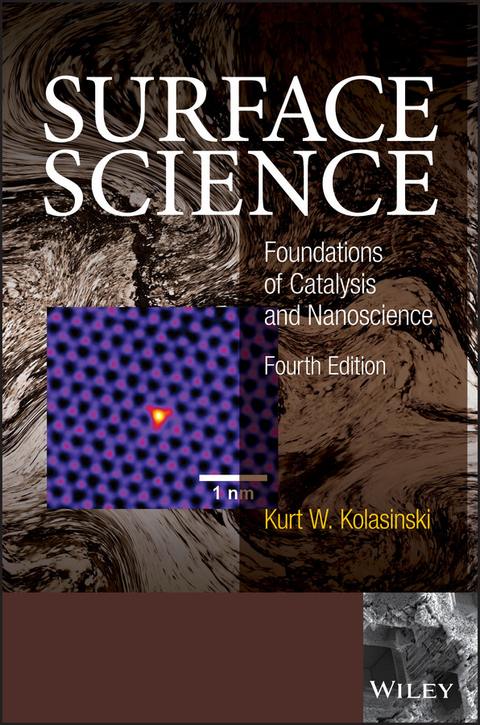
Surface Science (eBook)
John Wiley & Sons (Verlag)
978-1-119-54661-0 (ISBN)
An updated fourth edition of the text that provides an understanding of chemical transformations and the formation of structures at surfaces
The revised and enhanced fourth edition of Surface Science covers all the essential techniques and phenomena that are relevant to the field. The text elucidates the structural, dynamical, thermodynamic and kinetic principles concentrating on gas/solid and liquid/solid interfaces. These principles allow for an understanding of how and why chemical transformations occur at surfaces. The author (a noted expert on in the field) combines the required chemistry, physics and mathematics to create a text that is accessible and comprehensive.
The fourth edition incorporates new end-of-chapter exercises, the solutions to which are available on-line to demonstrate how problem solving that is relevant to surface science should be performed. Each chapter begins with simple principles and builds to more advanced ones. The advanced topics provide material beyond the introductory level and highlight some frontier areas of study. This updated new edition:
- Contains an expanded treatment of STM and AFM as well as super-resolution microscopy
- Reviews advances in the theoretical basis of catalysis and the use of activity descriptors for rational catalyst design
- Extends the discussion of two-dimensional solids to reflect remarkable advances in their growth and characterization
- Delves deeper into the surface science of electrochemistry and charge transfer reactions
- Updates the 'Frontiers and Challenges' sections at the end of each chapter as well as the list of references
Written for students, researchers and professionals, the fourth edition of Surface Science offers a revitalized text that contains the tools and a set of principles for understanding the field.
Instructor support material, solutions and PPTs of figures, are available at http://booksupport.wiley.com
Kurt W. Kolasinski, PhD, is Professor of Physical Chemistry at West Chester University. His research concentrates on the study of dynamical processes at the surfaces of metals and semiconductors with a special emphasis on structure formation and laser-surface interactions. He is responsible for teaching Theoretical and Experimental Physical Chemistry as well as Surface Science.
Kurt W. Kolasinski, PhD, is Professor of Physical Chemistry at West Chester University. His research concentrates on the study of dynamical processes at the surfaces of metals and semiconductors with a special emphasis on structure formation and laser-surface interactions. He is responsible for teaching Theoretical and Experimental Physical Chemistry as well as Surface Science.
Introduction
Surface Science is dead. Long live Surface Science! Having learned the fundamentals of the chemistry and physics of surfaces, we are no longer in a simple search and discover mode of scientific investigation. Now, we seek increasingly sophisticated control of the chemistry and physics of surfaces and nanostructures to generate not just new knowledge, but also new processes that can address the needs of society. Binnig and Rohrer [1,2] discovered the scanning tunnelling microscope (STM) in 1983 [2] and set off an avalanche in the atomistic understanding of surfaces and nanostructures. By 1986, they had been awarded the Nobel Prize in Physics and surface science was changed indelibly. Thereafter, it was possible to image, almost routinely, surfaces and surface‐bound species with atomic‐scale resolution. Not long afterward, Eigler and Schweizer [3] demonstrated that matter could be manipulated on an atom‐by‐atom basis. The tremendous infrastructure of instrumentation, ideas, and understanding that has been amassed in surface science is evident in the translation of the 2004 discovery of Novoselov et al. [4] of graphene into a body of influential work recognized by the 2010 Nobel Prize in Physics.
Surface science has allowed us to probe matter in intimate detail to reveal images of concepts that were once only Gedanken experiments. The STM has allowed us to visualize quantum mechanics as never before. As an example, two images of a Si(100) surface are shown in Figure I.1. In one case, Figure I.1a, a bonding state is imaged. In the other, Figure I.1b an antibonding state is shown. Just as expected, the antibonding state exhibits a node between the atoms whereas the bonding state exhibits enhanced electron density between the atoms.
Figure I.1 Bonding and antibonding electronic states on the Si(100) surface as imaged by STM.
Source: Reproduced with permission from R.J. Hamers, P. Avouris and F. Bozso, Phys. Rev. Lett. 59 (1987) 2071. © 1987 by the American Physical Society.
The STM ushered in the age of nanoscience; however, surface science has always been about nanoscience, even when it was not phrased that way. Catalysis has been the traditional realm of surface chemistry, and 2007 was a great year for surface science as celebrated by the awarding of the Nobel Prize in Chemistry to Gerhard Ertl ‘for his studies of chemical processes on solid surface’. While it was Irving Langmuir's work – Nobel Prize in Chemistry, 1932 – that established the basis for understanding surface reactivity, it was not until the work of Gerhard Ertl and colleagues that surface chemistry emerged from its black box, and that we were able to understand the dynamics of surface reactions on a truly molecular level.
With the inexorable march of smaller, faster, cheaper, and better in the semiconductor device industry, technology has now been marching on surfaces for decades and relies on functioning nanostructures. This is exemplified by the 2014 Nobel Prize in Physics, which was awarded to Isamu Akasaki, Hiroshi Amano and Shuji Nakamura for their development of blue light emitting diodes (LEDs). These devices were made possible by the understanding and control of crystal growth and etching on the nanoscale and the effects of thin films on the electronic structure of materials.
Of course, these are not the only scientists to have contributed to the growth of understanding in surface science, nor even the only Nobel Prize winners. In the pages that follow you will be introduced to many more scientists, and, hopefully, to many more insights developed by all of them. This book is an attempt, from the point of view of a dynamicist, to approach surface science as the underpinning science of both heterogeneous catalysis and nanotechnology.
I.1. Heterogeneous catalysis
One of the great motivations for studying chemical reactions on surfaces is the will to understand heterogeneous catalytic reactions. Heterogeneous catalysis is the basis of the chemical industry. Heterogeneous catalysis is involved in literally billions of dollars worth of economic activity. Neither the chemical industry nor civilization would exist as we know them today, if it were not for the successful implementation of heterogeneous catalysis. At the beginning of the twentieth Century, the human condition was fundamentally changed by the transformation of nitrogen on nanoscale, potassium promoted, iron catalysts to ammonia, and ultimately fertilizer. Undoubtedly, catalysts are the most successful implementation of nanotechnology, not only contributing towards roughly one‐third of the material gross domestic product (GDP) of the US economy [5], but also supporting an additional 4.4 billion people beyond what the Earth could otherwise sustain [6]. At the beginning of the twenty‐first Century, we understood that humans were changing the world around us. Catalysis and nanotechnology will undoubtedly play a role in helping us cope with, and ameliorate, our impact on climate and the Earth. This book aims to help you understand why catalytic activity occurs, how we can control it, and how we can use it to control and construct a world of functional nanoscale objects.
First, we should define what we mean by catalysis and a catalyst. The term catalysis (from the Greek λνσιζ and κατα, roughly ‘wholly loosening’) was coined by Berzelius in 1836 [7]. Armstrong proposed the word catalyst in 1885. A catalyst is an active chemical spectator. It takes part in a reaction but is not consumed. A catalyst produces its effect by changing activation barriers as shown in Figure I.2. As noted by Ostwald, who was awarded the Nobel Prize in chemistry in 1909 primarily for this contribution, a catalyst speeds up a reaction; however, it does not change the properties of the equilibrated state. It accelerates reactions by lowering the height of an activation barrier. Remember that whereas the kinetics of a reaction is determined by the relative height of activation barriers (in combination with Arrhenius pre‐exponential factors), the equilibrium constant is determined by the Gibbs energy of the initial state relative to the final state.
Figure I.2 Activation energies and their relationship to an active and selective catalyst, which transforms A + B, the reactants, into C, the desired product, rather than D, the undesired product. Ea, activation barrier for the homogeneous reaction; Ea, cat, activation barrier with use of a catalyst.
Nonetheless, the acceleration of reactions is not the only key factor in catalytic activity. If catalysts only accelerated reactions, they would not be nearly as important or as effective as they actually are. Catalysts can be designed not only to accelerate reactions: the best of them can also perform this task selectively. In other words, it is important for catalysts to speed up the right reactions, not simply every reaction. This is also illustrated in Figure I.2, wherein the activation barrier for the desired product B is decreased more than the barrier for the undesired product C.
I.2. Why surfaces?
Heterogeneous reactions occur in systems where two or more phases are present, for instance, solids and liquids, or gases and solids. The reactions occur at the interface between these phases. The interfaces are where the two phases and reactants meet, where charge exchange occurs. Liquid/solid and gas/solid interfaces are of particular interest because the surface of a solid gives us a place to deposit and immobilize a catalytic substance. By immobilizing the catalyst, we can ensure that it is not washed away and lost in the stream of products that are made. Very often catalysts take the form of nanoparticles (the active agent) attached to the surfaces of high‐surface area porous solids (the substrate).
Surfaces are of particular interest because that is where phases meet and because they give us a place to put catalysts. Moreover, the surface of a solid is inherently different than the rest of the solid (the bulk) because its bonding is different. We expect the chemistry of the surface to be unique. Surface atoms simply cannot satisfy their bonding requirements in the same way as bulk atoms. Therefore, surface atoms will always have a propensity to react in some way, either with each other or with foreign atoms, to satisfy their bonding requirements.
I.3. Where are surfaces, interfaces, and nanoscale objects important?
To illustrate a variety of topics in heterogeneous catalysis and the importance of surface science, I will make reference to a list of chemical challenges. These challenges are selected not only because they demonstrate a variety of important chemical concepts, but also because they have also been of particular importance both historically and politically. As you will also observe, they all reverberate with connections to one of the grandest challenges of society: the construction and maintenance of a sustainable energy system [8].
I.3.1 Making bread from air: ammonia synthesis
Nitrogen fertilizers underpin modern agriculture [6]. The inexpensive production of fertilizers would not be possible without the Haber‐Bosch process. Ammonia synthesis is almost exclusively performed over an alkali metal promoted Fe...
| Erscheint lt. Verlag | 26.11.2019 |
|---|---|
| Sprache | englisch |
| Themenwelt | Naturwissenschaften ► Chemie ► Physikalische Chemie |
| Technik ► Maschinenbau | |
| Schlagworte | catalysis and nanoscience • Chemie • Chemistry • electrochemistry and surface science • growth and epitaxy • Halbleiterphysik • heterogeneous catalysis</p> • interfacial materials chemistry • laser-surface interactions • <p>Guide to surface science • materials characterization • Materials Science • Materialwissenschaften • nanostructure formation • Physics • Physik • Semiconductor physics • spectroscopy • Spektroskopie • Surface Chemistry • Surface dynamics • surface photochemistry • Surface Physics • techniques of surface science • understanding surface science • Werkstoffprüfung |
| ISBN-10 | 1-119-54661-3 / 1119546613 |
| ISBN-13 | 978-1-119-54661-0 / 9781119546610 |
| Informationen gemäß Produktsicherheitsverordnung (GPSR) | |
| Haben Sie eine Frage zum Produkt? |
 EPUB (Adobe DRM)
Kopierschutz: Adobe-DRM
Adobe-DRM ist ein Kopierschutz, der das eBook vor Mißbrauch schützen soll. Dabei wird das eBook bereits beim Download auf Ihre persönliche Adobe-ID autorisiert. Lesen können Sie das eBook dann nur auf den Geräten, welche ebenfalls auf Ihre Adobe-ID registriert sind.
Details zum Adobe-DRM
Dateiformat: EPUB (Electronic Publication)
EPUB ist ein offener Standard für eBooks und eignet sich besonders zur Darstellung von Belletristik und Sachbüchern. Der Fließtext wird dynamisch an die Display- und Schriftgröße angepasst. Auch für mobile Lesegeräte ist EPUB daher gut geeignet.
Systemvoraussetzungen:
PC/Mac: Mit einem PC oder Mac können Sie dieses eBook lesen. Sie benötigen eine
eReader: Dieses eBook kann mit (fast) allen eBook-Readern gelesen werden. Mit dem amazon-Kindle ist es aber nicht kompatibel.
Smartphone/Tablet: Egal ob Apple oder Android, dieses eBook können Sie lesen. Sie benötigen eine
Geräteliste und zusätzliche Hinweise
Buying eBooks from abroad
For tax law reasons we can sell eBooks just within Germany and Switzerland. Regrettably we cannot fulfill eBook-orders from other countries.
aus dem Bereich