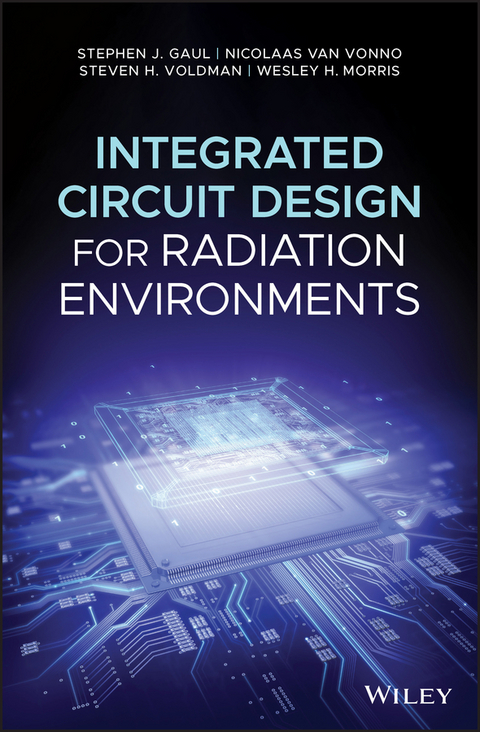
Integrated Circuit Design for Radiation Environments (eBook)
John Wiley & Sons (Verlag)
978-1-118-70185-0 (ISBN)
A practical guide to the effects of radiation on semiconductor components of electronic systems, and techniques for the designing, laying out, and testing of hardened integrated circuits
This book teaches the fundamentals of radiation environments and their effects on electronic components, as well as how to design, lay out, and test cost-effective hardened semiconductor chips not only for today's space systems but for commercial terrestrial applications as well. It provides a historical perspective, the fundamental science of radiation, and the basics of semiconductors, as well as radiation-induced failure mechanisms in semiconductor chips.
Integrated Circuits Design for Radiation Environments starts by introducing readers to semiconductors and radiation environments (including space, atmospheric, and terrestrial environments) followed by circuit design and layout. The book introduces radiation effects phenomena including single-event effects, total ionizing dose damage and displacement damage) and shows how technological solutions can address both phenomena.
- Describes the fundamentals of radiation environments and their effects on electronic components
- Teaches readers how to design, lay out and test cost-effective hardened semiconductor chips for space systems and commercial terrestrial applications
- Covers natural and man-made radiation environments, space systems and commercial terrestrial applications
- Provides up-to-date coverage of state-of-the-art of radiation hardening technology in one concise volume
- Includes questions and answers for the reader to test their knowledge
Integrated Circuits Design for Radiation Environments will appeal to researchers and product developers in the semiconductor, space, and defense industries, as well as electronic engineers in the medical field. The book is also helpful for system, layout, process, device, reliability, applications, ESD, latchup and circuit design semiconductor engineers, along with anyone involved in micro-electronics used in harsh environments.
STEPHEN J. GAUL is a Senior Principal Engineer at Renesas Electronics Americas, Inc., Florida, USA. He has worked in the semiconductor/integrated circuit field for over 35 years and has authored many papers and over 35 patents, many specific to radiation-hard/radiation-tolerant techniques.
NICOLAAS VAN VONNO is currently a Principal Engineer at Renesas Electronics Americas, Inc., Florida, USA, and has been an independent consultant in the radiation effects field. He has been Guest Editor, Session Chairman, and Short Course Chairman for the IEEE Nuclear and Space Radiation Effects Conference (NSREC).
STEVEN H. VOLDMAN, Ph.D., is a Consultant on ESD and latchup, as well as invention and patenting. He is a Fellow of the Electrical and Electronics Engineers (IEEE) and author of over 10 books and 262 patents.
WESLEY H. MORRIS is President of Silicon-X (Technology focus), hardening CMOS devices to radiation and extreme temperatures. His career experience includes development of RH CMOS devices with SOS (RCA) and SOI (Harris), the first to prove bulk CMOS devices can be made latchup immune to extreme SEE radiation and operate reliably at high temperatures (250C). Morris is an author/inventor with multiple papers and patents related to RH and HT topics.
A practical guide to the effects of radiation on semiconductor components of electronic systems, and techniques for the designing, laying out, and testing of hardened integrated circuits This book teaches the fundamentals of radiation environments and their effects on electronic components, as well as how to design, lay out, and test cost-effective hardened semiconductor chips not only for today s space systems but for commercial terrestrial applications as well. It provides a historical perspective, the fundamental science of radiation, and the basics of semiconductors, as well as radiation-induced failure mechanisms in semiconductor chips. Integrated Circuits Design for Radiation Environments starts by introducing readers to semiconductors and radiation environments (including space, atmospheric, and terrestrial environments) followed by circuit design and layout. The book introduces radiation effects phenomena including single-event effects, total ionizing dose damage and displacement damage) and shows how technological solutions can address both phenomena. Describes the fundamentals of radiation environments and their effects on electronic components Teaches readers how to design, lay out and test cost-effective hardened semiconductor chips for space systems and commercial terrestrial applications Covers natural and man-made radiation environments, space systems and commercial terrestrial applications Provides up-to-date coverage of state-of-the-art of radiation hardening technology in one concise volume Includes questions and answers for the reader to test their knowledge Integrated Circuits Design for Radiation Environments will appeal to researchers and product developers in the semiconductor, space, and defense industries, as well as electronic engineers in the medical field. The book is also helpful for system, layout, process, device, reliability, applications, ESD, latchup and circuit design semiconductor engineers, along with anyone involved in micro-electronics used in harsh environments.
STEPHEN J. GAUL is a Senior Principal Engineer at Renesas Electronics Americas, Inc., Florida, USA. He has worked in the semiconductor/integrated circuit field for over 35 years and has authored many papers and over 35 patents, many specific to radiation-hard/radiation-tolerant techniques. NICOLAAS VAN VONNO is currently a Principal Engineer at Renesas Electronics Americas, Inc., Florida, USA, and has been an independent consultant in the radiation effects field. He has been Guest Editor, Session Chairman, and Short Course Chairman for the IEEE Nuclear and Space Radiation Effects Conference (NSREC). STEVEN H. VOLDMAN, Ph.D., is a Consultant on ESD and latchup, as well as invention and patenting. He is a Fellow of the Electrical and Electronics Engineers (IEEE) and author of over 10 books and 262 patents. WESLEY H. MORRIS is President of Silicon-X (Technology focus), hardening CMOS devices to radiation and extreme temperatures. His career experience includes development of RH CMOS devices with SOS (RCA) and SOI (Harris), the first to prove bulk CMOS devices can be made latchup immune to extreme SEE radiation and operate reliably at high temperatures (250C). Morris is an author/inventor with multiple papers and patents related to RH and HT topics.
About the Authors
Stephen J. Gaul received his B.S. and M.S. in Electrical Engineering Science from Iowa State University in 1980 and 1982, respectively. His undergraduate study focused on fields and waves, analog circuit design, and physics. His research during graduate study was supported by a grant from 3M (Minneapolis, Minnesota).
In 1983 Gaul joined Harris Semiconductor in Palm Bay, Florida. Harris Semiconductor was part of Harris Corporation, with many divisions, and Steve worked sequentially through several. These included the CMOS division as a process engineer, Bipolar division developing device simulation models, and the Custom Integrated Circuit Division working as a device engineer on a variety of programs to develop radiation hardened and other analog solutions. Several of these programs included process as well as circuit developments.
In the late 1980s, Gaul was doing research on bonded‐wafer silicon on insulator (SOI) as a replacement for dielectric isolation (DI) wafer material processing. He fabricated the first bonded wafer bipolar devices at Harris Semiconductor in 1989 and also developed bonded‐wafer material process flows and trench isolation for the first such analog components fabricated at Harris Semiconductor in the early 1990s. By the mid 1990s, Gaul had worked on a number of projects, including improving defect density in bonded/trenched material processing and solving an electro‐chemical mismatch issue on circuits using thin film resistors. Additionally, he worked on yield enhancement and migration of DI telecom circuits to bonded wafer substrates.
Gaul joined Unitrode in Merrimack, NH, in 1995 to develop a bonded‐wafer trench isolation process as a cost improvement for existing bulk isolated processes. He improved the yield of this process from 0% to greater than 90% in less than six months. Gaul also investigated safe operating area (SOA) issues in output devices in a 20 V BiCMOS process fabricated at an external foundry.
In 1997 Gaul returned to Harris Semiconductor, working on yield and process enhancement on submicron BCDMOS processes. He completed in‐house college‐level classes in RF circuit design and DSP in 1998, and his work at this time increasingly brought him into contact with circuit design tools and systems. By 1999, Gaul had taken a position as a process design kit (PDK) developer with Harris's design automation team.
Harris Semiconductor became a standalone company in late 1999 called Intersil (based on the Santa‐Clara company that was part of the 1988 Harris Semiconductor acquisition of GE Solid State), and Gaul turned to managing PDK and Design Systems for all circuit design teams at Intersil. He pioneered the use and repurposing of design system code for devices (pcells) providing rapid development of PDKs to keep pace with the corresponding rapid development of newer submicron processes. His process and device background was leveraged to improve electrostatic discharge (ESD) performance in existing processes and to cost‐improve an in‐house 0.6‐μm semiconductor process using a software shrink of 10%; this shrink was instrumental in bridging the design community to a smaller geometry BCDMOS that was in development, with a large cost saving to Intersil.
Gaul currently manages the engineering design infrastructure at Renesas Electronics Americas Inc. (REA), which purchased Intersil in 2017. His interests include radiation effects, circuit hardening, IP security, export law, and small‐town government. Gaul has written and presented 17 papers at refereed conferences, including the SOI Technology Conference, RHET, IEEE Nuclear and Space Radiation Effects Conference (NSREC), and the Journal of Radiation Effects Research and Engineering. He holds 40 US issued patents in a variety of areas, from semiconductor process flows, device design, ESD devices, radiation hardened devices, methods of forming SOI materials, improvements in trench isolation, 3D circuits, silicon on diamond (SOD), engineering design automation (EDA) software, and circuit solutions.
Nicolaas van Vonno has a strong background in the design, development, and production of high‐performance semiconductor integrated circuits, predominantly for radiation‐hardened space and defense applications. Specific areas of expertise include analog and mixed‐signal technology, radiation effects and semiconductor device radiation hardening.
Van Vonno received his Bachelor of Science degree in electrical engineering from the University of Florida in 1966. He then joined Harris Semiconductor (then Radiation, Incorporated, which was subsequently acquired by Harris Corporation) as a reliability engineer, with an initial assignment in reliability assurance for the US Navy Polaris and Poseidon SLBM programs, gaining experience in radiation effects, hardening technology, packaging, device fabrication, and quality assurance. Later, he transferred to a device engineering group, where he was responsible for device design, process development, and design/layout support. During this assignment, he participated in a broad range of projects reflecting Harris's support of many diverse technologies, including early metal‐gate CMOS and silicon‐on‐sapphire (SOS) processes. As a device engineering supervisor, he led a group of device designers, with representative projects including MOS hardness issues and radiation testing in the total ionizing dose, neutron and transient gamma environments.
In 1982, Van Vonno was promoted to director, Analog Product Development, with responsibilities in the design, development, and transfer to production of analog circuits for tactical, strategic, and space applications. Projects included the development of a broad range of analog parts for the Trident II SLBM program and development of a series of hardened analog signal processing circuits for the MX (Peacekeeper) program, as well as the development of mixed‐signal chip sets for tactical applications and the development of mixed‐signal design and verification methodologies, with Cadence as a technical partner. Other projects included the development of a radiation‐hardened cryogenic analog CMOS process for hardened 77 K and 40 K applications and the design of hardened readout multiplexer chips for use in directly hybridized HgCdTe IR focal plane array imagers.
Van Vonno was promoted to senior scientist in 1994, with responsibilities in radiation effects in electronics, technology development, and advanced projects. He then led the development of an innovative integrated fingerprint sensor using RF field technology. This project culminated in the successful spinoff of Authentec, Incorporated from Harris Semiconductor, and the eventual sale of Authentec, Inc. to Apple. The RF fingerprint sensor is currently a key feature of the Apple iPhone.
Van Vonno is currently a principal engineer with Intersil, a Renesas Company, Palm Bay, Florida. In this capacity, he is responsible for customer support and radiation effects research for the space product line, with added assignments in product development, legal support, and export control issues. He is an active researcher in enhanced low‐dose rate ionizing radiation sensitivity (ELDRS) phenomena in complementary bipolar processes. He has been an active participant in the JEDEC community, including the JEDEC JC13.4 Radiation Effects Assurance committee. He is an active participant in business development and customer support activities in Europe and is fluent in several languages.
Currently, Van Vonno holds 16 US patents in the areas of silicon device processing, optics, packaging, and biometric sensing. He has over 60 refereed publications and conference presentations and is a Life Senior Member of IEEE. He has participated in a wide range of professional activities, including IEEE and international conference assignments. He has been an active participant in the IEEE Nuclear and Space Radiation Effects Conference (NSREC), with assignments including poster session chairman, guest editor, session chairman, awards committee chairman, short course instructor, and short course chairman. Other IEEE activities include two three‐year terms as a member at large of the IEEE Radiation Effects Steering Group (RESG) and three years as vice‐chairman, publications, of RESG. He served as chairman of the 2001 IEEE Radiation Effects Data Workshop and was chairman of the local arrangements of the 2006 Nuclear and Space Radiation Effects Conference. Van Vonno received the IEEE Radiation Effects Award in 2009.
Dr. Steven H. Voldman received his BS in Engineering Science from the University of Buffalo (1979); a first M.S. electrical engineering (EE) (1981) from Massachusetts Institute of Technology (MIT); a second M.S. EE degree from MIT; an MS in Engineering Physics (1986), and a PhD in EE (1991) from the University of Vermont under IBM's resident study fellow program.
In 1977 and 1978, Dr. Voldman interned at the Robert E. Ginna nuclear plant as support for the nuclear engineer. He was a member of the MIT Magnetic Mirror Fusion experimental research group with a specialization in plasma physics from 1979 to 1981. In 1982, he was the first person in the IBM corporation to address alpha particle effects in...
| Erscheint lt. Verlag | 3.12.2019 |
|---|---|
| Sprache | englisch |
| Themenwelt | Technik ► Elektrotechnik / Energietechnik |
| Schlagworte | Circuit Design • circuit design for radiation environments • Circuits • circuit semiconductors • Circuit Theory & Design • design for radiation environments • designing circuits for radiation protection • Electrical & Electronics Engineering • Elektrotechnik u. Elektronik • fundamentals of radiation environments • guide to circuit design • Halbleiter • Integrated Circuit Design • Integrated Circuits • integrated circuits design for radiation environments • Integrierte Schaltung • latchup circuits • Leistungselektronik • Medical & Health Physics • micro-electronic design • Physics • Physik • Physik in Medizin u. Gesundheitswesen • Power Electronics • Radiation • radiation effects • radiation effects on semiconductor electronics • radiation fundamentals • radiation-hard techniques • radiation physics • radiation-tolerant techniques • Schaltkreise - Theorie u. Entwurf • semiconductor design • Semiconductor physics • semiconductors • silicon-on-insulator (SOI) materials • Space radiation • Technology |
| ISBN-10 | 1-118-70185-2 / 1118701852 |
| ISBN-13 | 978-1-118-70185-0 / 9781118701850 |
| Informationen gemäß Produktsicherheitsverordnung (GPSR) | |
| Haben Sie eine Frage zum Produkt? |
 EPUB (Adobe DRM)
Kopierschutz: Adobe-DRM
Adobe-DRM ist ein Kopierschutz, der das eBook vor Mißbrauch schützen soll. Dabei wird das eBook bereits beim Download auf Ihre persönliche Adobe-ID autorisiert. Lesen können Sie das eBook dann nur auf den Geräten, welche ebenfalls auf Ihre Adobe-ID registriert sind.
Details zum Adobe-DRM
Dateiformat: EPUB (Electronic Publication)
EPUB ist ein offener Standard für eBooks und eignet sich besonders zur Darstellung von Belletristik und Sachbüchern. Der Fließtext wird dynamisch an die Display- und Schriftgröße angepasst. Auch für mobile Lesegeräte ist EPUB daher gut geeignet.
Systemvoraussetzungen:
PC/Mac: Mit einem PC oder Mac können Sie dieses eBook lesen. Sie benötigen eine
eReader: Dieses eBook kann mit (fast) allen eBook-Readern gelesen werden. Mit dem amazon-Kindle ist es aber nicht kompatibel.
Smartphone/Tablet: Egal ob Apple oder Android, dieses eBook können Sie lesen. Sie benötigen eine
Geräteliste und zusätzliche Hinweise
Buying eBooks from abroad
For tax law reasons we can sell eBooks just within Germany and Switzerland. Regrettably we cannot fulfill eBook-orders from other countries.
aus dem Bereich