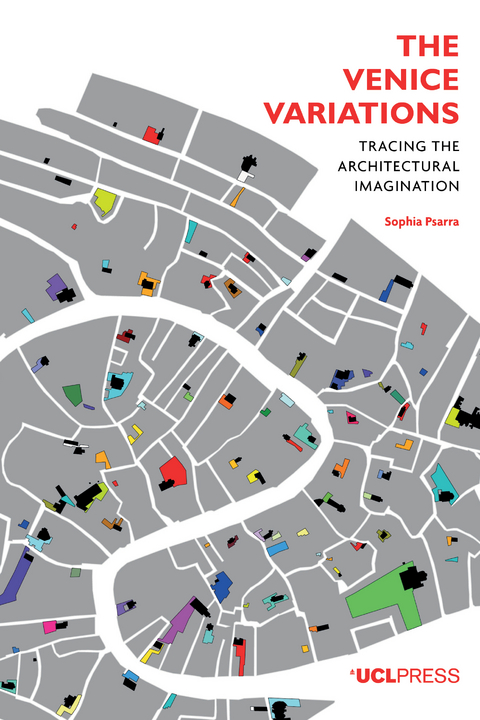
Venice Variations (eBook)
332 Seiten
UCL Press (Verlag)
978-1-78735-242-1 (ISBN)
While past utopias were conceived in terms of an ideal geometry, contemporary exemplary models of urban design seek technological solutions of optimal organisation. The Venice Variations explores Venice as a prototypical city that may hold unique answers to the ancient narrative of utopia.
From the myth of Arcadia through to the twenty-first century, ideas about sustainability - how we imagine better urban environments - remain persistently relevant, and raise recurring questions. How do cities evolve as complex spaces nurturing both urban creativity and the fortuitous art of discovery, and by which mechanisms do they foster imagination and innovation? While past utopias were conceived in terms of an ideal geometry, contemporary exemplary models of urban design seek technological solutions of optimal organisation. The Venice Variations explores Venice as a prototypical city that may hold unique answers to the ancient narrative of utopia. Venice was not the result of a preconceived ideal but the pragmatic outcome of social and economic networks of communication. Its urban creativity, though, came to represent the quintessential combination of place and institutions of its time.Through a discussion of Venice and two other works owing their inspiration to this city - Italo Calvino's Invisible Cities and Le Corbusier's Venice Hospital - Sophia Psarra describes Venice as a system that starts to resemble a highly probabilistic 'algorithm'. The rapidly escalating processes of urban development around our big cities share many of the motivations for survival, shelter and trade that brought Venice into existence. Rather than seeing these places as problems to be solved, we need to understand how urban complexity can evolve, as happened from its unprepossessing origins in the marshes of the Venetian lagoon to the 'model city' enduring a 1000 years. This book frees Venice from stereotypical representations, revealing its generative capacity to inform potential other 'Venices' for the future.Praise for The Venice Variations'An imaginative and ambitious account of urban development and the architect's means of engagement with it. The text is expansive, offering a virtuoso display of different modes of knowing. ... Both a history and a proposed methodology, a concatenation of erudition and imagination. ...What is the relevance of an architectural imagination that does not engage with such social and political concerns. The book certainly suggests why it would be important for it to do so.'Buildings & Cities'The beautifully designed book fulfils a dreamy mission of aggrandizing the titular city's history and beauty while recognizing its fragility and potential demise because of climate change and overcrowding from tourists and their marine vehicles ... Psarra deals very carefully with the history of Piazza San Marco and its central position in civic and religious interpretations of the city.'The Architect's Newspaper'The book shows us the value of doing diachronic history. We see how useful it is to learn about twentieth-century architecture along with Renaissance spaces. Similarly, we see the value in a truly multi-disciplinary history in which Calvino and Le Corbusier are on equal footing. In all of this, we must wonder how history can be more creative and provocative. As Psarra shows, there is a lot we can learn from Venice.'Modern Italy'A visual treat that is made more accessible and meaningful through the diagrams.'A Daily Dose of Architecture Books'Psarra animates the city as a creature that is based on the dialogue between anonymous collective and branded individual imagination. It reconstitutes the principles and ways of thinking that allowed Venice to act as a source of inspiration... It shows us how the natural city, and its mythological plots that we have in our minds, are being embodied in an open creativity. The book can be purchased in classic print or purchased electronically at no cost.' Smells Like Urban Spirit (SLUS)
lt;div>
Sophia Psarra is Reader at the Bartlett School of Architecture (UCL). Her research addresses spatial, social, historical, cognitive and organisational dimensions in cities and architecture. Her activities have resulted in creative installations, design projects and publications. She has collaborated with cultural institutions on layout design, exhibition concept and visitors’ experience. As a practising architect, Psarra has been part of prize-winning teams in international architectural competitions.
Introduction: Between authored architecture and
the non-authored city
1. City-craft: Assembling the city
2. Statecraft: A remarkably well-ordered society
3. Story-craft: The imagination as combinatorial machine in
Italo Calvino’s Invisible Cities
4. Crafting architectural space: Le Corbusier’s Venice
Hospital and the three paradigms
Part 1: The Venice Hospital
Part 2: Geometry and space from Palladio to Le Corbusier
5. The Venice Variations: Tracing the Architectural
Imagination
| Erscheint lt. Verlag | 30.4.2018 |
|---|---|
| Verlagsort | London |
| Sprache | englisch |
| Themenwelt | Technik ► Architektur |
| Schlagworte | ancient narrative of utopia • Area Studies • big cities • Built Environment • Cities • Complex spaces • Discovery • economic networks • evolved • Innovation • Invisible Cities • Italo Calvino • Le Corbusier • marshes of the Venetian lagoon • model city • models of urban design • models of urban design technological solutions • optimal organisation • prototypical city • Shelter • social and economic networks of communication • Social Networks • Sophia Psarra • Survival • sustainability • Trade • urban complexity • urban creativity • Urban Development • urban environment • Urban Evolution • Venice • Venice as a system • Venice Hospital • Venitian history |
| ISBN-10 | 1-78735-242-0 / 1787352420 |
| ISBN-13 | 978-1-78735-242-1 / 9781787352421 |
| Informationen gemäß Produktsicherheitsverordnung (GPSR) | |
| Haben Sie eine Frage zum Produkt? |
 EPUB (Adobe DRM)
Kopierschutz: Adobe-DRM
Adobe-DRM ist ein Kopierschutz, der das eBook vor Mißbrauch schützen soll. Dabei wird das eBook bereits beim Download auf Ihre persönliche Adobe-ID autorisiert. Lesen können Sie das eBook dann nur auf den Geräten, welche ebenfalls auf Ihre Adobe-ID registriert sind.
Details zum Adobe-DRM
Dateiformat: EPUB (Electronic Publication)
EPUB ist ein offener Standard für eBooks und eignet sich besonders zur Darstellung von Belletristik und Sachbüchern. Der Fließtext wird dynamisch an die Display- und Schriftgröße angepasst. Auch für mobile Lesegeräte ist EPUB daher gut geeignet.
Systemvoraussetzungen:
PC/Mac: Mit einem PC oder Mac können Sie dieses eBook lesen. Sie benötigen eine
eReader: Dieses eBook kann mit (fast) allen eBook-Readern gelesen werden. Mit dem amazon-Kindle ist es aber nicht kompatibel.
Smartphone/Tablet: Egal ob Apple oder Android, dieses eBook können Sie lesen. Sie benötigen eine
Geräteliste und zusätzliche Hinweise
Buying eBooks from abroad
For tax law reasons we can sell eBooks just within Germany and Switzerland. Regrettably we cannot fulfill eBook-orders from other countries.
aus dem Bereich