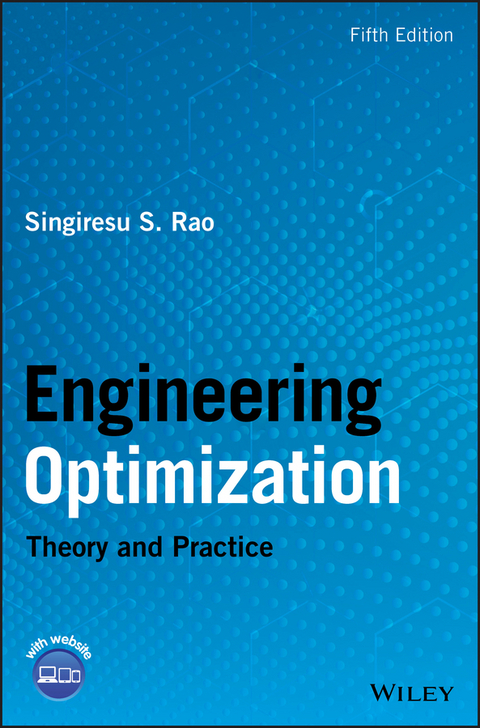
Engineering Optimization (eBook)
John Wiley & Sons (Verlag)
978-1-119-45479-3 (ISBN)
The revised and updated new edition of the popular optimization book for engineers
The thoroughly revised and updated fifth edition of Engineering Optimization: Theory and Practice offers engineers a guide to the important optimization methods that are commonly used in a wide range of industries. The author-a noted expert on the topic-presents both the classical and most recent optimizations approaches. The book introduces the basic methods and includes information on more advanced principles and applications.
The fifth edition presents four new chapters: Solution of Optimization Problems Using MATLAB; Metaheuristic Optimization Methods; Multi-Objective Optimization Methods; and Practical Implementation of Optimization. All of the book's topics are designed to be self-contained units with the concepts described in detail with derivations presented. The author puts the emphasis on computational aspects of optimization and includes design examples and problems representing different areas of engineering. Comprehensive in scope, the book contains solved examples, review questions and problems. This important book:
- Offers an updated edition of the classic work on optimization
- Includes approaches that are appropriate for all branches of engineering
- Contains numerous practical design and engineering examples
- Offers more than 140 illustrative examples, 500 plus references in the literature of engineering optimization, and more than 500 review questions and answers
- Demonstrates the use of MATLAB for solving different types of optimization problems using different techniques
Written for students across all engineering disciplines, the revised edition of Engineering Optimization: Theory and Practice is the comprehensive book that covers the new and recent methods of optimization and reviews the principles and applications.
Singiresu S. Rao is a Professor in the Mechanical and Aerospace Engineering Department at the University of Miami. His main areas of research include multi objective optimization and uncertainty models in engineering analysis, design and optimization.
Singiresu S. Rao is a Professor in the Mechanical and Aerospace Engineering Department at the University of Miami. His main areas of research include multi objective optimization and uncertainty models in engineering analysis, design and optimization.
Preface
The ever‐increasing demand on engineers to lower production costs to withstand global competition has prompted engineers to look for rigorous methods of decision making, such as optimization methods, to design and produce products and systems both economically and efficiently. Optimization techniques, having reached a degree of maturity by now, are being used in a wide spectrum of industries, including aerospace, automotive, chemical, electrical, construction, and manufacturing industries. With rapidly advancing computer technology, computers are becoming more powerful, and correspondingly, the size and the complexity of the problems that can be solved using optimization techniques are also increasing. Optimization methods, coupled with modern tools of computer‐aided design, are also being used to enhance the creative process of conceptual and detailed design of engineering systems.
The purpose of this textbook is to present the techniques and applications of engineering optimization in a comprehensive manner. The style of prior editions has been retained, with the theory, computational aspects, and applications of engineering optimization presented with detailed explanations. As in previous editions, essential proofs and developments of the various techniques are given in a simple manner without sacrificing accuracy. New concepts are illustrated with the help of numerical examples. Although most engineering design problems can be solved using nonlinear programming techniques, there are a variety of engineering applications for which other optimization methods, such as linear, geometric, dynamic, integer, and stochastic programming techniques, are most suitable. The theory and applications of all these techniques are also presented in the book. Some of the recently developed optimization methods, such as genetic algorithms, simulated annealing, particle swarm optimization, ant colony optimization, neural‐network‐based methods, and fuzzy optimization, do not belong to the traditional mathematical programming approaches. These methods are presented as modern methods of optimization. More recently, a class of optimization methods termed the metaheuristic optimization methods, have been evolving in the literature. The metaheuristic methods are also included in this edition. Favorable reactions and encouragement from professors, students, and other users of the book have provided me with the impetus to prepare this fifth edition of the book. The following changes have been made from the previous edition:
- Some less‐important sections were condensed or deleted.
- Some sections were rewritten for better clarity.
- Some sections were expanded.
- Some of the recently‐developed methods are reorganized in the form of a new chapter titled, Modern methods of optimization.
- A new chapter titled, Metaheuristic Optimization Methods, is added by including details of crow search, firefly, harmony search, teaching‐learning, and honey bee swarm optimization algorithms.
- A new chapter titled, Solution of optimization problems using MATLAB, is added to illustrate the use of MATLAB for the solution of different types of optimization problems.
Features
Each topic in Engineering Optimization: Theory and Practice is self‐contained, with all concepts explained fully and the derivations presented with complete details. The computational aspects are emphasized throughout with design examples and problems taken from several fields of engineering to make the subject appealing to all branches of engineering. A large number of solved examples, review questions, problems, project‐type problems, figures, and references are included to enhance the presentation of the material.
Specific features of the book include:
- More than 155 illustrative examples accompanying most topics.
- More than 540 references to the literature of engineering optimization theory and applications.
- More than 485 review questions to help students in reviewing and testing their understanding of the text material.
- More than 600 problems, with solutions to most problems in the instructor's manual.
- More than 12 examples to illustrate the use of Matlab for the numerical solution of optimization problems.
- Answers to review questions at the web site of the book, http://www.wiley.com/rao.
- Answers to selected problems are given at the end of the book.
I used different parts of the book to teach optimum design and engineering optimization courses at the junior/senior level as well as first‐year‐graduate‐level at Indian Institute of Technology, Kanpur, India; Purdue University, West Lafayette, Indiana; and University of Miami, Coral Gables, Florida. At University of Miami, I cover Chapter 1 and parts of Chapters 2, 3, 5, 6, 7, and 13 in a dual‐level course entitled Optimization in Design. In this course, a design project is also assigned to each student in which the student identifies, formulates, and solves a practical engineering problem of his/her interest by applying or modifying an optimization technique. This design project gives the student a feeling for ways that optimization methods work in practice. In addition, I teach a graduate level course titled Mechanical System Optimization in which I cover Chapters 1-7, and parts of Chapters 9, 10, 11, 13, and 17. The book can also be used, with some supplementary material, for courses with different emphasis such as Structural Optimization, System Optimization and Optimization Theory and Practice. The relative simplicity with which the various topics are presented makes the book useful both to students and to practicing engineers for purposes of self‐study. The book also serves as a reference source for different engineering optimization applications. Although the emphasis of the book is on engineering applications, it would also be useful to other areas, such as operations research and economics. A knowledge of matrix theory and differential calculus is assumed on the part of the reader.
Contents
The book consists of 17 chapters and 3 appendixes. Chapter 1 provides an introduction to engineering optimization and optimum design and an overview of optimization methods. The concepts of design space, constraint surfaces, and contours of objective function are introduced here. In addition, the formulation of various types of optimization problems is illustrated through a variety of examples taken from various fields of engineering. Chapter 2 reviews the essentials of differential calculus useful in finding the maxima and minima of functions of several variables. The methods of constrained variation and Lagrange multipliers are presented for solving problems with equality constraints. The Kuhn–Tucker conditions for inequality‐constrained problems are given along with a discussion of convex programming problems.
Chapters 3 and 4 deal with the solution of linear programming problems. The characteristics of a general linear programming problem and the development of the simplex method of solution are given in Chapter 3. Some advanced topics in linear programming, such as the revised simplex method, duality theory, the decomposition principle, and post‐optimality analysis, are discussed in Chapter 4. The extension of linear programming to solve quadratic programming problems is also considered in Chapter 4.
Chapters 5-7 deal with the solution of nonlinear programming problems. In Chapter 5, numerical methods of finding the optimum solution of a function of a single variable are given. Chapter 6 deals with the methods of unconstrained optimization. The algorithms for various zeroth‐, first‐, and second‐order techniques are discussed along with their computational aspects. Chapter 7 is concerned with the solution of nonlinear optimization problems in the presence of inequality and equality constraints. Both the direct and indirect methods of optimization are discussed. The methods presented in this chapter can be treated as the most general techniques for the solution of any optimization problem.
Chapter 8 presents the techniques of geometric programming. The solution techniques for problems of mixed inequality constraints and complementary geometric programming are also considered. In Chapter 9, computational procedures for solving discrete and continuous dynamic programming problems are presented. The problem of dimensionality is also discussed. Chapter 11 introduces integer programming and gives several algorithms for solving integer and discrete linear and nonlinear optimization problems. Chapter 11 reviews the basic probability theory and presents techniques of stochastic linear, nonlinear, and geometric programming. The theory and applications of calculus of variations, optimal control theory, and optimality criteria methods are discussed briefly in Chapter 12. Chapter 13 presents several modern methods of optimization including genetic algorithms, simulated annealing, particle swarm optimization, ant colony optimization, neural‐network‐based methods, and fuzzy system optimization. Chapter 14 deals with metaheuristic optimization algorithms and introduces nearly 20 algorithms with emphasis on Crow search, Firefly, Harmony search, Teaching‐Learning and Honey bee swarm...
| Erscheint lt. Verlag | 30.10.2019 |
|---|---|
| Sprache | englisch |
| Themenwelt | Mathematik / Informatik ► Mathematik |
| Technik ► Maschinenbau | |
| Schlagworte | chemical engineering • Chemische Verfahrenstechnik • Computer-aided Engineering • Computergestützte Verfahrenstechnik • design variables • design vector • Engineering Optimization • equality constraints • Graphical Optimization • Inequality constraints • Maschinenbau • Maschinenbau - Entwurf • Mathematics • Mathematik • mechanical engineering • Mechanical Engineering - Design • Nonlinear Programming • Objective function • Optimierung • Optimization • pre-assigned variables • standard optimization problem |
| ISBN-10 | 1-119-45479-4 / 1119454794 |
| ISBN-13 | 978-1-119-45479-3 / 9781119454793 |
| Informationen gemäß Produktsicherheitsverordnung (GPSR) | |
| Haben Sie eine Frage zum Produkt? |
 EPUB (Adobe DRM)
Kopierschutz: Adobe-DRM
Adobe-DRM ist ein Kopierschutz, der das eBook vor Mißbrauch schützen soll. Dabei wird das eBook bereits beim Download auf Ihre persönliche Adobe-ID autorisiert. Lesen können Sie das eBook dann nur auf den Geräten, welche ebenfalls auf Ihre Adobe-ID registriert sind.
Details zum Adobe-DRM
Dateiformat: EPUB (Electronic Publication)
EPUB ist ein offener Standard für eBooks und eignet sich besonders zur Darstellung von Belletristik und Sachbüchern. Der Fließtext wird dynamisch an die Display- und Schriftgröße angepasst. Auch für mobile Lesegeräte ist EPUB daher gut geeignet.
Systemvoraussetzungen:
PC/Mac: Mit einem PC oder Mac können Sie dieses eBook lesen. Sie benötigen eine
eReader: Dieses eBook kann mit (fast) allen eBook-Readern gelesen werden. Mit dem amazon-Kindle ist es aber nicht kompatibel.
Smartphone/Tablet: Egal ob Apple oder Android, dieses eBook können Sie lesen. Sie benötigen eine
Geräteliste und zusätzliche Hinweise
Buying eBooks from abroad
For tax law reasons we can sell eBooks just within Germany and Switzerland. Regrettably we cannot fulfill eBook-orders from other countries.
aus dem Bereich