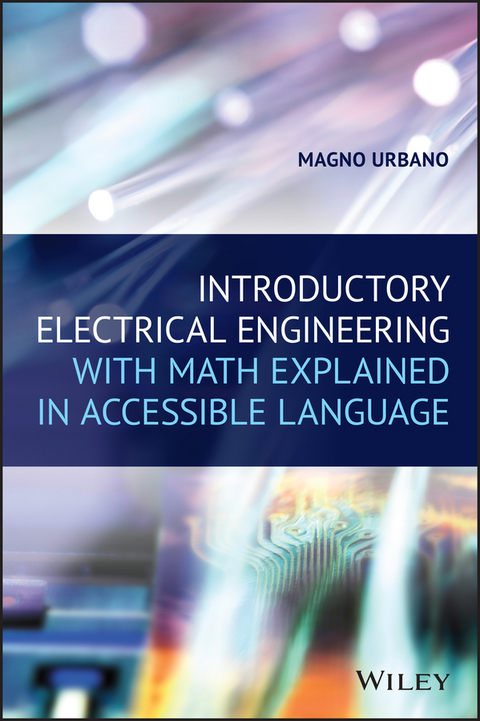
Introductory Electrical Engineering With Math Explained in Accessible Language (eBook)
John Wiley & Sons (Verlag)
978-1-119-58020-1 (ISBN)

Offers an understanding of the theoretical principles in electronic engineering, in clear and understandable terms
Introductory Electrical Engineering With Math Explained in Accessible Language offers a text that explores the basic concepts and principles of electrical engineering. The author-a noted expert on the topic-explains the underlying mathematics involved in electrical engineering through the use of examples that help with an understanding of the theory. The text contains clear explanations of the mathematical theory that is needed to understand every topic presented, which will aid students in engineering courses who may lack the necessary basic math knowledge.
Designed to breakdown complex math concepts into understandable terms, the book incorporates several math tricks and knowledge such as matrices determinant and multiplication. The author also explains how certain mathematical formulas are derived. In addition, the text includes tables of integrals and other tables to help, for example, find resistors' and capacitors' values. The author provides the accessible language, examples, and images that make the topic accessible and understandable. This important book:
• Contains discussion of concepts that go from the basic to the complex, always using simplified language
• Provides examples, diagrams, and illustrations that work to enhance explanations
• Explains the mathematical knowledge that is crucial to understanding electrical concepts
• Contains both solved exercises in-line with the explanations
Written for students, electronic hobbyists and technicians, Introductory Electrical Engineering With Math Explained in Accessible Language is a much-needed text that is filled with the basics concepts of electrical engineering with the approachable math that aids in an understanding of the topic.
MAGNO URBANO has worked in various fields including computer graphics, visual effects and programming for two of the largest broadcast companies in two continents: Globo TV Network in Brazil and RTP (Radio and Television of Portugal). Magno has developed and published about 120 applications for iPhone, iPad, macOS, and Apple TV, some of them hitting #1 or placing in the top 10 in multiple countries for several weeks. He has published 14 books in Europe, 2 in the United States, and over 50 courses on several themes.
Offers an understanding of the theoretical principles in electronic engineering, in clear and understandable terms Introductory Electrical Engineering With Math Explained in Accessible Language offers a text that explores the basic concepts and principles of electrical engineering. The author a noted expert on the topic explains the underlying mathematics involved in electrical engineering through the use of examples that help with an understanding of the theory. The text contains clear explanations of the mathematical theory that is needed to understand every topic presented, which will aid students in engineering courses who may lack the necessary basic math knowledge. Designed to breakdown complex math concepts into understandable terms, the book incorporates several math tricks and knowledge such as matrices determinant and multiplication. The author also explains how certain mathematical formulas are derived. In addition, the text includes tables of integrals and other tables to help, for example, find resistors and capacitors values. The author provides the accessible language, examples, and images that make the topic accessible and understandable. This important book: Contains discussion of concepts that go from the basic to the complex, always using simplified language Provides examples, diagrams, and illustrations that work to enhance explanations Explains the mathematical knowledge that is crucial to understanding electrical concepts Contains both solved exercises in-line with the explanations Written for students, electronic hobbyists and technicians, Introductory Electrical Engineering With Math Explained in Accessible Language is a much-needed text that is filled with the basics concepts of electrical engineering with the approachable math that aids in an understanding of the topic.
MAGNO URBANO has worked in various fields including computer graphics, visual effects and programming for two of the largest broadcast companies in two continents: Globo TV Network in Brazil and RTP (Radio and Television of Portugal). Magno has developed and published about 120 applications for iPhone, iPad, macOS, and Apple TV, some of them hitting #1 or placing in the top 10 in multiple countries for several weeks. He has published 14 books in Europe, 2 in the United States, and over 50 courses on several themes.
1
Scientific Method: General Concepts
1.1 Introduction
In this chapter, we will examine the scientific method and its concepts. These concepts must be well understood and are fundamental to achieve a solid foundation in electrical engineering.
1.2 Powers of 10
In science it is common to represent numbers like 100, 1000, and 10000, as 102, 103, and 104, respectively, in what is called powers of ten.
Powers of 10 show how many times 10 has to be multiplied by itself to obtain the final value.
In other words,
is equal to 10 multiplied by itself 4 times.
However, if we want to represent very small numbers like 0.1, 0.01, and 0.001, we have to use negative exponents, as 10−1, 10−2, 10−3, respectively.
This negative exponent represents how many times the number must be divided by 10.
Numbers like
10−1, 10−2, 10−3 represent
1/10, 1/100, 1/100, respectively.
Any number raised to 0 is equal to 1. Thus, 100 = 1.
1.3 Roots
Roots are the inverse operation of powers.
Roots are expressed in scientific notation as a fractional exponent:
Any number raised to a fractional exponent in the form is equal to .
1.4 Scientific Notation as a Tool
In science, we constantly have to deal with numbers that are very hard to write in natural form, for example, 0.000000000003434033323. Imagine how hard it would be to compare this number with 0.0000000000000212817716 and know which one is bigger.
To solve this problem and make it easy to compare and write huge or minuscule numbers, a methodology called scientific notation was born.
1.4.1 Very Large Numbers
To convert a large number like 324484738, for example, to scientific notation, we divide this number by 10, several times, until we get a nonzero number with just one digit in the integer part.
Example:
| 324484738 | ÷ | 10 | = | 32448473.8 |
| 32448473.8 | ÷ | 10 | = | 3244847.4 |
| 3244847.38 | ÷ | 10 | = | 324484.74 |
| 324484.738 | ÷ | 10 | = | 32448.474 |
| 32448.4738 | ÷ | 10 | = | 3244.8474 |
| 3244.84738 | ÷ | 10 | = | 324.48474 |
| 324.484738 | ÷ | 10 | = | 32.448474 |
| 32.4484738 | ÷ | 10 | = | 3.2448474 |
These numbers show that we have to divide the initial number 8 times by 10 to get a single digit alone in the integer part, like 3.24484738.
For that reason, the given number in scientific notation is represented as 3.24484738 × 10⁸.
1.4.2 Very Small Numbers
To convert a very small number to scientific notation, we must multiply the number by 10 several times, until we get a single‐digit number in the integer part. The number of times the multiplication happens will be the exponent.
In order to convert, for example, 0.00156 to scientific notation, it would be necessary to multiply it 3 times by 10 to obtain a single nonzero‐digit number:
| 0.00156 | × | 10 | = | 0.0156 |
| 0.0156 | × | 10 | = | 0.156 |
| 0.156 | × | 10 | = | 1.56 |
For that reason, 0.00156 is represented in scientific notation as 1.56 × 10⁻³.
Like we said before, negative exponents mean division. So, 1.56 × 10⁻³ can be also written as
That is exactly 0.00156.
1.4.3 Operations with Powers of 10
Operations like multiplication, division, etc. can be done with numbers represented in powers of 10.
This is how they are done.
1.4.3.1 Multiplication
To multiply two numbers, for example, 1.56 × 10⁻³ and 3.33 × 10⁸, we must first multiply the numbers without the powers
and then sum the exponents
The result would be 5.19 × 10⁵.
If the final result is not a number with a single nonzero digit in the integer part, we must make sure it is.
A final result of 24 × 1011 should be corrected to 2.4 × 10¹².
1.4.3.2 Division
As explained before, any number raised to a negative exponent is equal to that number divided by the same power:
If we want to divide 3 × 109 by 8 × 102, we can represent that division as
The denominator can be converted to a nominator if we invert the exponent
and we just converted a division into a multiplication.
We can now multiply the numbers without the powers obtaining
and add the powers
and the final result will be 24 × 107, which should be converted to a single‐digit number equal to 2.4 × 10⁸.
1.4.3.3 Adding and Subtracting
To add or subtract numbers represented in powers of 10, we must first make the numbers have the same exponent.
To add, for example, 2.4 × 10⁸ and 3 × 10⁹, we must first make both numbers have the same base. We chose 108. That will make the second number change to 30 × 108. We can now add both numbers:
The final result will be 32.4 × 10⁸, corrected to 3.24 × 10⁹.
1.4.3.4 Raising to a Number
To raise a number expressed in powers of 10 to a given exponent, we must raise the number without the power and then multiply the power by the exponent.
The cube of 2.4 × 10⁸ will be equal to the number alone raised to the cube
and the base multiplied by the exponent
The final result will be 13.824 × 1024, corrected to 1.3824 × 1025.
1.4.3.5 Expressing Roots as Exponents
All roots in the form can be expressed as an exponent in the form .
For example,
1.4.3.6 Extracting the Root
To extract a root of a number expressed in powers of 10, we have to raise the number alone, without the power, to the correspondent exponent and multiply the power by that exponent.
To calculate the square root of
we first have to write the number in the exponent form
We then extract the root of the number alone
and then multiply the base by the exponent
The result is 1.549 × 10⁴.
If the root is cubical, like
we first extract the cubical root of the number alone
and multiply the base by the equivalent exponent
The result is 1.338 × 10³.
A problem arises if we need to extract a root of a number expressed in powers of 10 that is raised to another number, like
This root can be written as
As usual, we could start by extracting the root of the number alone and then multiplying the base by the exponent.
But when we do that, we have an exponent that is 8 divided by 3, resulting in 108/3 or 102.666, which is not a very pretty result.
To improve the result, we have to convert the exponent first to something that can be divided by 3. The closest candidate is 9.
Hence, we convert 2.4 × 10⁸ into 0.24 × 10⁹, that is exactly the same number written differently.
Now we can proceed. We first extract the cubical root of the number alone
and multiply the base by the exponent
The result is 0.6214465 × 10³, which must be corrected to 6.214465 × 10².
1.4.4 Computers and Programming
Numbers written in scientific notation inside computer programs and other computer contexts use a specific syntax.
A number like 1.38 × 1025, for example, is normally written as 1.38E25 or 1.38e25.
Numbers with negative exponents have the sign before the number, for example, 1.38e − 25 or −3.43e − 12.
In almost all the cases, computer languages use decimal numbers as fraction number separators.
1.4.5 Engineering Notation
In engineering, scientific notation numbers are expressed with exponents of 10 that are multiples of 3, so they match one of the multiples of the International System (see Appendix A).
Following that rule, a number like 2 × 10⁻⁷ must be converted to...
| Erscheint lt. Verlag | 23.10.2019 |
|---|---|
| Sprache | englisch |
| Themenwelt | Technik ► Elektrotechnik / Energietechnik |
| Schlagworte | Circuit Theory & Design • concepts of electrical engineering • Electrical & Electronics Engineering • Elektrotechnik u. Elektronik • <p>Introduction to electrical engineering • math and electrical engineering • principles of electrical engineering • Schaltkreise - Theorie u. Entwurf • theory of electrical engineering</p> • understandable math for electrical engineering • understanding electrical engineering |
| ISBN-10 | 1-119-58020-X / 111958020X |
| ISBN-13 | 978-1-119-58020-1 / 9781119580201 |
| Informationen gemäß Produktsicherheitsverordnung (GPSR) | |
| Haben Sie eine Frage zum Produkt? |
 EPUB (Adobe DRM)
Kopierschutz: Adobe-DRM
Adobe-DRM ist ein Kopierschutz, der das eBook vor Mißbrauch schützen soll. Dabei wird das eBook bereits beim Download auf Ihre persönliche Adobe-ID autorisiert. Lesen können Sie das eBook dann nur auf den Geräten, welche ebenfalls auf Ihre Adobe-ID registriert sind.
Details zum Adobe-DRM
Dateiformat: EPUB (Electronic Publication)
EPUB ist ein offener Standard für eBooks und eignet sich besonders zur Darstellung von Belletristik und Sachbüchern. Der Fließtext wird dynamisch an die Display- und Schriftgröße angepasst. Auch für mobile Lesegeräte ist EPUB daher gut geeignet.
Systemvoraussetzungen:
PC/Mac: Mit einem PC oder Mac können Sie dieses eBook lesen. Sie benötigen eine
eReader: Dieses eBook kann mit (fast) allen eBook-Readern gelesen werden. Mit dem amazon-Kindle ist es aber nicht kompatibel.
Smartphone/Tablet: Egal ob Apple oder Android, dieses eBook können Sie lesen. Sie benötigen eine
Geräteliste und zusätzliche Hinweise
Buying eBooks from abroad
For tax law reasons we can sell eBooks just within Germany and Switzerland. Regrettably we cannot fulfill eBook-orders from other countries.
aus dem Bereich