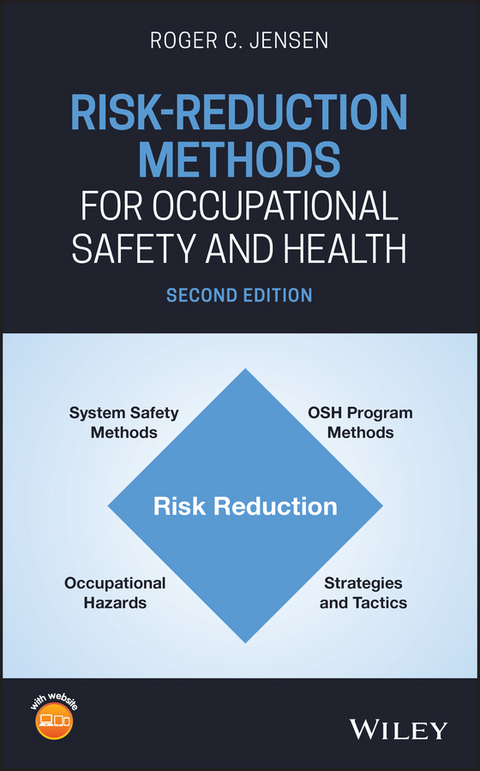
Risk-Reduction Methods for Occupational Safety and Health (eBook)
John Wiley & Sons (Verlag)
978-1-119-49397-6 (ISBN)
Provides a thorough overview of systematic methods for reducing risks encountered in diverse work places
Filled with more theory, numerous case examples, and references to new material than the original text, this latest edition of a highly acclaimed book on occupational safety and health includes substantial updates and expanded material on management systems, risk assessment methods, and OSH-relevant concepts, principles, and models.
Risk-Reduction Methods for Occupational Safety and Health is organized into five parts: background; analysis methods; programmatic methods for managing risk; risk reduction for energy sources; and risk reduction for other than energy sources. It comprehensively covers both system safety methods and OSH management methods applicable to occupational health and safety. Suitable for worldwide applications, the author's approach avoids reliance on the thousands of rules, codes, and standards by focusing on understanding hazards and reducing risks using strategies and tactics.
- Includes more content on methods for reducing risks, citations of recent research, and deeper coverage of OSH-relevant concepts, theories, and models
- Merges methods and principles traditionally associated with occupational hygiene, ergonomics, and safety
- Provides substantial updates on management systems and theories of occupational incidents, and includes new case studies in many chapters to help demonstrate the 'real world' need for identifying and implementing risk-reduction strategies
- Addresses occupational risks that go beyond current regulations and standards, taking an international approach by stressing risk-reduction strategies
- Supports adoption of the book for university courses by providing chapter-specific learning exercises and support materials for professors
Risk-Reduction Methods for Occupational Safety and Health is ideal for safety professionals, system safety engineers, safety engineers, industrial hygienists, ergonomists, and anyone with OSH responsibilities. It is also an excellent resource for students preparing for a career in OSH.
ROGER C. JENSEN, PhD, is a Professor in the Safety, Health, and Industrial Hygiene Department, Montana Technological University. He teaches courses titled Ergonomics, Safety Laboratory, Law & Ethics for OSH, Fire Protection, Risk Reduction Methods, and System Safety and PSM. Prior to his academic position, he had 30 years of experience in occupational safety and health.
ROGER C. JENSEN, PhD, is a Professor in the Safety, Health, and Industrial Hygiene Department, Montana Technological University. He teaches courses titled Ergonomics, Safety Laboratory, Law & Ethics for OSH, Fire Protection, Risk Reduction Methods, and System Safety and PSM. Prior to his academic position, he had 30 years of experience in occupational safety and health.
Chapter 1
Contributions to Occupational Safety and Health
Throughout this book, the field of occupational safety and health (OSH) is viewed broadly to include traditional occupational safety, industrial hygiene, occupational ergonomics, and, to a lesser extent, environmental pollution. To make the book internationally applicable, governmental regulations of the United States and other countries are infrequently mentioned. In this and other chapters, italic font is used for titles of books and journals, and for the first use of technical terms defined at the end of the chapter.
Much of Part I is based on information covered in traditional OSH books and journal articles. Part I begins by summarizing how the field of OSH grew out of contributions from governmental and private sector groups over an extended time span. Important contributions have come from: (i) the law‐making bodies of many countries, (ii) specialists in system safety, (iii) the public health community, (iv) private organizations, and (v) the sciences and engineering. The contributions of each are summarized in the five sections of this chapter.
1.1 CONTRIBUTIONS BY LAW MAKERS
The state of OSH today is the result of over 150 years of governmental attempts to address occupational injuries, illnesses, and fatalities. Some historical periods of major legislation ramped up the attention paid by the public and employers to OSH. Several book authors have provided excellent summaries [1, 2]. Some of the most noteworthy developments in legislation are summarized in the following two sections on OSH‐related laws and compensation laws, respectively.
1.1.1 OSH‐Related Laws
The industrial revolution started a transition in European and North American economies from primarily agriculture and small cottage industries to larger factories. During the period from 1840 to 1900, England pioneered some early legislative attempts to address concerns about working conditions. Among these concerns were long hours of work for women (often over 14 hours per day 7 days a week), working conditions of apprentices (many of whom were under 10 years of age), and lack of compensation for employees who lost limbs, developed diseases, and died at work. The lack of guarding hazardous machinery led to the “Great Factory Act” of 1844 followed with extensions in 1864 and 1867 due to increased concern for exposures to gases, dusts, and fumes found in workplaces [1].
In the United States, the military pushed development of rifles made with interchangeable parts. As that became successful, entrepreneurs opened factories to make other products using interchangeable parts. In the ensuing years, Federal and state legislation, as well as the common law, strongly supported manufacturing, mining, railroads, and other large businesses. The laws essentially disregarded employee safety and health until the early 1900s when workers' compensation (WC) laws were enacted. Several more decades passed before significant federal legislation created an infrastructure to support workplace safety and health.
Within a country, province, state, or other governed area, the enactment of legislation does not, by itself, lead to safer workplaces. To achieve the legislative intent, a support system is needed. One may say it involves four major components as depicted in Figure 1.1. First, legislation for supporting OSH is needed. It must provide means for adoption of regulations, codes, standards, and/or processes. This task is assigned by the legislation to governmental agencies. Second, the applicable governmental agencies must be established, funded, and provided with the tools to develop and update requirements, codes, and standards. Third, some means of enforcement is required – not so much for the top‐tier employers, but for business owners and managers who regard employee safety and health as an afterthought. The fourth major component of an effective OSH system is technology and qualified people to help employers to know how to comply with applicable requirements.
Figure 1.1 Components for an effective national OSH program.
Generally, the advanced countries have the most advanced national support system for OSH. Some countries have strong legislation, but limited commitment to implementation. A very different approach for motivating employers to support an effective OSH program derives from WC laws.
1.1.2 Workers' Compensation Laws
Concerns about lack of compensation for employees who suffered work‐related injuries, illnesses, and fatalities led to governmental‐driven compensation schemes for workers [1, 3]. In 1884, Germany pioneered what we today call WC systems [3]. The underlying motivation for these laws was a recognition that when an industry creates hazards that injure workers, it is simple justice to expect the industry to take responsibility. That concept of employer responsibility was apparently shared by law makers in many other countries, resulting in enactment of various forms of employee compensation systems [1, 3]. The adoption of WC systems in the United States and Canada involved both Federal and state/provincial compensation laws during the first quarter of the twentieth century. The WC laws are intended to compensate employees, or surviving families, for injuries, illnesses, or death arising from their job. In general, these systems are “no‐fault” systems. That means it does not matter if the employer or the employee was negligent or careless. The following background story is to help readers appreciate the difficulty of implementing WC laws.
The road to WC systems in the United States went state by state. The legislative process in New York illustrates how difficult it was. In an attempt to lead the way, the New York legislature enacted a WC law in 1910. It applied to a number of high‐hazard industries. The law required employers in these industries to compensate injured employees without regard to fault. Groups of employers challenged it in the New York court system. At the highest judicial level in the state, the new law was declared void because it violated the state and Federal constitutions. Specifically, the judges ruled that the law would require employers to pay money to injured employees in circumstances in which they previously would not have had an obligation to pay. This would violate the constitutions by depriving the employers of their property without an adequate legal process – as guaranteed by both the New York and Federal constitutions. The day after the opinion was released, a major fire broke out at the Triangle Shirtwaist Factory in downtown Manhattan causing death of 146 women employees, many of whom jumped from the eighth floor to escape the flames. Follow‐up newspaper coverage pointed out to the public that most fire exit doors had been locked, and an unlocked one led to an exterior fire escape stairway that was so poorly built or maintained it collapsed from the weight of many employees trying to escape. In addition, it was discovered that the factory owners had lied to the New York City building officials by claiming the rental was for storage space when in fact it was for factory work. Law suits by families of the dead women against the owners failed to bring compensation. As the public became increasingly aware of the lack or responsibility of business owners, the state legislature of New York amended their constitution to provide that nothing in their constitution shall be interpreted to limit the power of the legislature to provide payment of compensation for injuries or death regardless of fault. In 1914, the legislature also enacted a new WC law similar to the earlier one. It was challenged by employers, but the outcome was different. The new law was upheld by New York's highest court in the case of Jensen v. Southern Pacific Railroad, 215, N.Y. 514, 1915.
As this section indicates, legislation enacted during a 150‐year period substantially contributed to the present state of the OSH laws and WC legal systems. Another source of substantial contributions came from engineers working in the field of system safety.
1.2 CONTRIBUTIONS BY SYSTEM SAFETY SPECIALISTS
The specialty known as system safety has contributed substantially to the current practice of OSH. System safety developed in response to needs of the military and aerospace industries to reduce the enormous costs from failed missile launches and crashed aircraft. After World War II, the United States and the Soviet Union engaged in a race to gain a military advantage. During this period of rapid technological advances, safety took a back seat and numerous failures occurred during the testing and operational phases of these new systems [4]. Safety remained in the background during the 1950s and 1960s when a common practice was to design and build missiles and aircraft, fly them, investigate crashes, identify the apparent problems, fix those problems, and continue operations. This “fly–fix–fly” approach killed many pilots and destroyed many expensive missiles and aircraft.
The U.S. Air Force took the lead in changing the fly–fix–fly approach to one involving increased safety input during the design and testing phases of missiles, aircraft, and other major acquisitions. In particular, the Air Force published two sets of requirements: (i) Systems Safety Engineering for the Development of Air Force Ballistic Missiles, 1962; and (ii)...
| Erscheint lt. Verlag | 1.10.2019 |
|---|---|
| Sprache | englisch |
| Themenwelt | Naturwissenschaften ► Chemie ► Technische Chemie |
| Technik ► Elektrotechnik / Energietechnik | |
| Wirtschaft | |
| Schlagworte | Arbeitssicherheit u. Umweltschutz i. d. Chemie • Chemical and Environmental Health and Safety • chemical engineering • chemical health • Chemie • Chemische Verfahrenstechnik • Chemistry • Compliance • Electrical & Electronics Engineering • Elektrotechnik u. Elektronik • Environmental Health • Environmental Safety • ergonomics</p> • Hazard • Industrial Hygiene • <p>risk reduction • Occupational • Occupational Health • Occupational safety • OSH • Risk • risk analysis • Safety • safety engineering • Systems Engineering & Management • Systemtechnik u. -management |
| ISBN-10 | 1-119-49397-8 / 1119493978 |
| ISBN-13 | 978-1-119-49397-6 / 9781119493976 |
| Informationen gemäß Produktsicherheitsverordnung (GPSR) | |
| Haben Sie eine Frage zum Produkt? |
 EPUB (Adobe DRM)
Kopierschutz: Adobe-DRM
Adobe-DRM ist ein Kopierschutz, der das eBook vor Mißbrauch schützen soll. Dabei wird das eBook bereits beim Download auf Ihre persönliche Adobe-ID autorisiert. Lesen können Sie das eBook dann nur auf den Geräten, welche ebenfalls auf Ihre Adobe-ID registriert sind.
Details zum Adobe-DRM
Dateiformat: EPUB (Electronic Publication)
EPUB ist ein offener Standard für eBooks und eignet sich besonders zur Darstellung von Belletristik und Sachbüchern. Der Fließtext wird dynamisch an die Display- und Schriftgröße angepasst. Auch für mobile Lesegeräte ist EPUB daher gut geeignet.
Systemvoraussetzungen:
PC/Mac: Mit einem PC oder Mac können Sie dieses eBook lesen. Sie benötigen eine
eReader: Dieses eBook kann mit (fast) allen eBook-Readern gelesen werden. Mit dem amazon-Kindle ist es aber nicht kompatibel.
Smartphone/Tablet: Egal ob Apple oder Android, dieses eBook können Sie lesen. Sie benötigen eine
Geräteliste und zusätzliche Hinweise
Buying eBooks from abroad
For tax law reasons we can sell eBooks just within Germany and Switzerland. Regrettably we cannot fulfill eBook-orders from other countries.
aus dem Bereich