


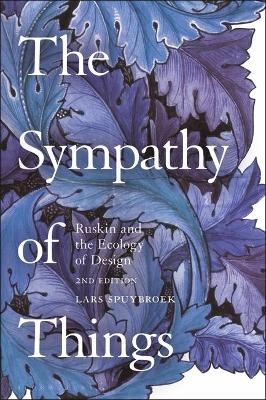
The Sympathy of Things
Ruskin and the Ecology of Design
Seiten
2019
Bloomsbury Visual Arts (Verlag)
978-1-350-14277-0 (ISBN)
Bloomsbury Visual Arts (Verlag)
978-1-350-14277-0 (ISBN)
‘If there is one thing we can learn from John Ruskin, it is that each age must find its own way to beauty’ writes Lars Spuybroek in The Sympathy of Things, his ground-breaking work which proposes a radical new aesthetics for the digital era.
Spuybroek argues that we must 'undo' the twentieth century and learn to understand the aesthetic insights of the nineteenth-century art critic John Ruskin, from which he distils pointers for the contemporary age. Linking philosophy, design, and the digital, with art history, architecture, and craft, Spuybroek explores the romantic notion of ‘sympathy’, a core concept in Ruskin's aesthetics, re-evaluating it as the driving force of the twenty-first century aesthetic experience. For Ruskin, beauty always comprises variation, imperfection and fragility, three concepts that wholly disappeared from our mindsets during the twentieth century, but which Spuybroek argues to be central to contemporary aesthetics and design.
Revised throughout, and a new foreword by philosopher Brian Massumi, this is a new edition of a seminal work which has drawn praise from fields as diverse as digital architecture and speculative realism, and will continue to be influential as it wrests Ruskin’s ideas out of the Victorian era and reconstructs them for the modern age.
Spuybroek argues that we must 'undo' the twentieth century and learn to understand the aesthetic insights of the nineteenth-century art critic John Ruskin, from which he distils pointers for the contemporary age. Linking philosophy, design, and the digital, with art history, architecture, and craft, Spuybroek explores the romantic notion of ‘sympathy’, a core concept in Ruskin's aesthetics, re-evaluating it as the driving force of the twenty-first century aesthetic experience. For Ruskin, beauty always comprises variation, imperfection and fragility, three concepts that wholly disappeared from our mindsets during the twentieth century, but which Spuybroek argues to be central to contemporary aesthetics and design.
Revised throughout, and a new foreword by philosopher Brian Massumi, this is a new edition of a seminal work which has drawn praise from fields as diverse as digital architecture and speculative realism, and will continue to be influential as it wrests Ruskin’s ideas out of the Victorian era and reconstructs them for the modern age.
Lars Spuybroek is Professor of Architectural Design at the Georgia Institute of Technology in Atlanta, USA. He is the author of NOX: Machining Architecture (2004), The Architecture of Continuity (2008), Research & Design: The Architecture of Variation (2009) and Research & Design: Textile Tectonics (2011). He is an award-winning architect with his practice NOX.
Foreword
Preface
1. The Digital Nature of Gothic
2. The Matter of Ornament
3. Abstraction and Sympathy
4. The Radical Picturesque
5. The Ecology of Design
Notes
Bibliography
Index
| Erscheinungsdatum | 24.09.2019 |
|---|---|
| Zusatzinfo | 35 bw illus |
| Verlagsort | London |
| Sprache | englisch |
| Maße | 156 x 232 mm |
| Gewicht | 600 g |
| Themenwelt | Technik ► Architektur |
| ISBN-10 | 1-350-14277-8 / 1350142778 |
| ISBN-13 | 978-1-350-14277-0 / 9781350142770 |
| Zustand | Neuware |
| Informationen gemäß Produktsicherheitsverordnung (GPSR) | |
| Haben Sie eine Frage zum Produkt? |
Mehr entdecken
aus dem Bereich


aus dem Bereich
Grundlagen, Normen, Vorschriften
Buch | Hardcover (2024)
Springer Vieweg (Verlag)
CHF 219,95
Tragkonstruktion und Schichtaufbau
Buch | Hardcover (2024)
Birkhäuser (Verlag)
CHF 119,95
Arbeitsschritte - Fallbeispiele - Detailzeichnungen - Dokumente - …
Buch | Hardcover (2024)
DIN Media (Verlag)
CHF 92,40


