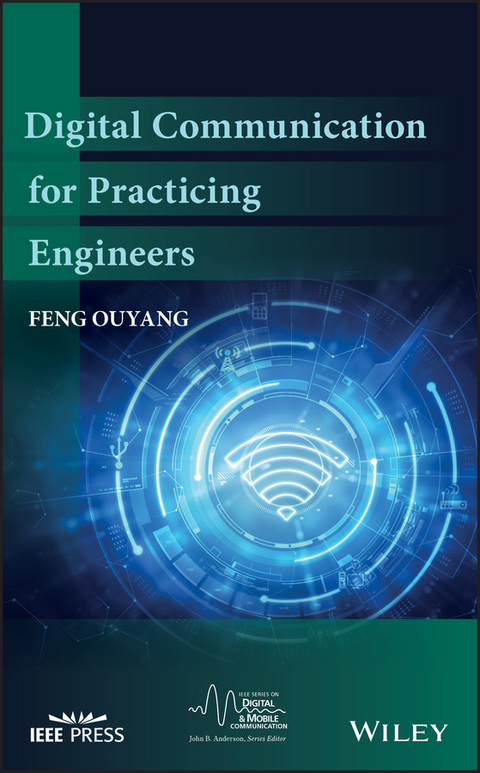
Digital Communication for Practicing Engineers (eBook)
John Wiley & Sons (Verlag)
978-1-119-41802-3 (ISBN)
Offers concise, practical knowledge on modern communication systems to help students transition smoothly into the workplace and beyond
This book presents the most relevant concepts and technologies of today's communication systems and presents them in a concise and intuitive manner. It covers advanced topics such as Orthogonal Frequency-Division Multiplexing (OFDM) and Multiple-Input Multiple-Output (MIMO) Technology, which are enabling technologies for modern communication systems such as WiFi (including the latest enhancements) and LTE-Advanced.
Following a brief introduction to the field, Digital Communication for Practicing Engineers immerses readers in the theories and technologies that engineers deal with. It starts off with Shannon Theorem and Information Theory, before moving on to basic modules of a communication system, including modulation, statistical detection, channel coding, synchronization, and equalization. The next part of the book discusses advanced topics such as OFDM and MIMO, and introduces several emerging technologies in the context of 5G cellular system radio interface. The book closes by outlining several current research areas in digital communications. In addition, this text:
- Breaks down the subject into self-contained lectures, which can be read individually or as a whole
- Focuses on the pros and cons of widely used techniques, while providing references for detailed mathematical analysis
- Follows the current technology trends, including advanced topics such as OFDM and MIMO
- Touches on content this is not usually contained in textbooks such as cyclo-stationary symbol timing recovery, adaptive self-interference canceler, and Tomlinson-Harashima precoder
- Includes many illustrations, homework problems, and examples
Digital Communication for Practicing Engineers is an ideal guide for graduate students and professionals in digital communication looking to understand, work with, and adapt to the current and future technology.
FENG OUYANG, PHD, is a senior member of professional staff for Wireless Technology Analysis at the Johns Hopkins University Applied Physics Laboratory and an adjunct faculty member at the John Hopkins University Whiting School of Engineering. He was previously a technical manager at Conexant Systems and a staff member at Bell Labs. He has served as TPC member and session chair for IEEE MILCOM and IEEE Globecom. He earned his Ph.D. in Applied and Engineering Physics from Cornell University.
FENG OUYANG, PHD, is a senior member of professional staff for Wireless Technology Analysis at the Johns Hopkins University Applied Physics Laboratory and an adjunct faculty member at the John Hopkins University Whiting School of Engineering. He was previously a technical manager at Conexant Systems and a staff member at Bell Labs. He has served as TPC member and session chair for IEEE MILCOM and IEEE Globecom. He earned his Ph.D. in Applied and Engineering Physics from Cornell University.
CHAPTER 1
INTRODUCTION
1.1 WHY THIS BOOK?
This book is intended for practicing engineers in the digital communication field. It can be used as a textbook for master’s level courses (e.g., for part‐time professional education programs) or self‐study. As such, the book has some unique characteristics comparing a typical textbook on the same subject.
A typical textbook strives to provide comprehensive and pedagogically sophisticated coverage of the concepts and theories. Such treatment makes it easier for the students to grasp key knowledge points. However, practicing engineers already have good general engineering knowledge and powerful self‐learning skills. They need information sources that can be digested quickly. This book selects concepts and technologies that are most relevant to today’s communication systems and presents them concisely and intuitively.
Instead of becoming well‐versed in the entire field of digital communications, practicing engineers are more interested in getting knowledge on the specific subfields of their work. This book is organized as self‐contained chapters. One can choose to read one or several relevant chapters, instead of the entire book.
Practicing engineers are more interested in applying existing techniques to their particular problems, rather than inventing new techniques. This book focuses on the pros and cons of broadly used techniques, rather than detailed mathematical analyses that may lead to discoveries. For example, on adaptive filtering, this book discusses in detail the tradeoff between performance and complexity of various methods and the tradeoff between convergence speed and final accuracy based on parameter choices.
Advanced topics such as orthogonal frequency division multiplexing (OFDM) and multiple‐input multiple‐output (MIMO), which are enabling technologies for modern communication systems such as WiFi and LTE‐Advanced, are covered in more detail than usual (Chapters 10 and 11). This book also briefly describes other emerging technologies, some of which are adopted in the 5G cellular standards. These contents help practicing engineers follow the current technology trend.
This book also covers some contents that are usually out of scope for textbooks, such as cyclostationary symbol timing recovery (Chapter 7), adaptive self‐interference canceller (Chapter 8), and Tomlinson–Harashima precoder (Chapter 9). These techniques are used in many popular communications systems and are therefore useful to practicing engineers.
In addition to practicing engineers, regular students of digital communications can benefit from this book’s unique perspective and treatment, by using it as a primary or supplementary textbook.
1.2 HOW TO USE THIS BOOK
A textbook typically strikes a balance between details and suspense. Omitting some details in derivation and leaving some open questions help to keep the readers engaged and inspired. On the other hand, narrative gaps increase the difficulty in understanding. Since its targeted readers are likely to be self‐studying without professors or peers available to answer questions, this book biases to providing more details and leaving fewer gaps. Some of the homework problems provide leads for further exploration and contemplation.
Another balance is between conceptual discourses and mathematical details. Since the book is designed for self‐study, it is important to provide detailed derivations to important conclusions. On the other hand, these derivations may distract the readers from the thread of concept development. To address this concern, we mark the important mathematical results with solid‐line frames. The readers may focus on the text and framed equations in the first pass. Detailed derivations contained in other equations can be revisited once the conceptual landscape is understood.
This book is based on the author’s experience of teaching “Advanced Digital Communication Systems” at the master’s level. In general, the material in each chapter is suitable for one 3‐hour lecture. The exceptions are Chapters 5 and 9, which are suitable for two lectures each. Overall, this book is suitable for a master’s level course of one semester, while some homework problems can be used as class projects.
1.3 SCOPE
1.3.1 The Physical Layer Transceiver
The prevailing Open Systems Interconnection (OSI) model divides a system into seven layers [1]. This book focuses on layer 1, known as the physical layer, or the PHY layer.
The PHY layer functions as a “bit pipe” of the system. A PHY transmitter takes bits from the upper layers and sends them through the physical medium (copper wire, fiber optics, electromagnetic waves, etc.) to the receiver. A PHY receiver recovers the bits and passes them to the upper layers. A transceiver is a combination of a transmitter and a receiver. The PHY layer is about point‐to‐point or point‐to‐multipoint (in the case of broadcast) connections, as opposed to a multi‐hop network, which is the concern of the upper layers. The PHY layer transports bits from a transmitter to a receiver with a controlled error probability. The upper layers may perform other functionalities (such as retransmission) to achieve virtually error‐free communication.
Figure 1.1 shows the general physical layer architecture of a transmitter/receiver pair. The “Bit Source” block at the transmitter side and the “Bit Output” block at the receiver side are interfaces to the upper layers. At the transmitter side, channel coding is applied to the data bits (Chapter 5) to enhance protection against random errors. Modulation is then performed to convert the bits into signals (i.e., time‐varying voltages) (Chapter 3). The signal is then conditioned in various steps and transmitted through the physical medium, known as the channel (Chapters 3 and 4). At the receiver side, the signal is conditioned and demodulated to recover the encoded bits (Chapters 4, 8, and 9). Channel decoding is then performed to recover the data bits (Chapter 5), which is then passed to the upper layer. Chapters 10 and 11 cover more advanced modulation and demodulation techniques.
Figure 1.1 Physical layer architecture.
1.3.2 Prerequisites
This book is for master’s level study. It assumes the readers have some training in electrical engineering and beginning digital communications [2]. For example, the readers should have basic knowledge about filters, shift registers, antennas, etc.
As to mathematics, the readers should have knowledge on statistics (Gaussian distribution and the Bayes’ theorem), calculus, basic differential equations, linear algebra (especially eigenanalysis and singular value decomposition), and Fourier transform. Some mathematics topics are included in the appendices of the relevant chapters. Notably, Chapter 3 includes the formulation of the Fourier transform, which is also used in other chapters. These appendices intend to clarify conventions and notations, rather than teaching the knowledge from scratch. On the other hand, the required mathematics concepts and properties are very limited in this book. Readers can fill potential knowledge gaps by consulting other textbooks or online tutorials.
1.3.3 Topics Not Covered
This book focuses on advanced and practical topics in digital communications. Some topics such as analog modulation techniques and noncoherent detections are usually covered in the prerequisite courses [2] and are not repeated in this book. While covering basic concepts and techniques of digital communications, the book focuses on the mainstream commercial applications such as mobile cellular systems and wireless local area network (WLAN). Special applications such as underwater communications, satellite communications, military communications, and optical communications are not covered in this book.
This book is on point‐to‐point communications, that is, a single transmitter–receiver pair. The issue of access, that is, multiple users sharing a medium in coordinated or uncoordinated ways, is only briefly addressed in Chapters 10–13. Since the scope is limited to the PHY‐layer, protocols and networking issues are not discussed.
Some of the uncovered topics are briefly discussed in Chapter 13.
1.4 ROADMAP
The book can be roughly divided into four parts.
The first part covers the basic techniques. It starts with Chapter 2, which introduces the foundation of modern digital communication theories: the Shannon theorem. In addition to guiding the development of channel coding, the Shannon theorem also provides some valuable insights into the practical case of white noise channels. Chapter 3 covers several techniques involved in the modulation process, which converts bits to symbols. These techniques include modulation, pulse shaping, and up‐converting. They are based on various interesting mathematical concepts discussed in the chapter. Chapter 4 discusses the reverse process, that is, converting received symbols to bits. The chapter focuses on optimal demodulation theories and analyses of error probability. A detailed study of the additive white...
| Erscheint lt. Verlag | 4.9.2019 |
|---|---|
| Reihe/Serie | IEEE Press Series on Digital & Mobile Communication |
| IEEE Press Series on Digital & Mobile Communication | IEEE Series on Digital & Mobile Communication |
| Sprache | englisch |
| Themenwelt | Technik ► Elektrotechnik / Energietechnik |
| Technik ► Nachrichtentechnik | |
| Schlagworte | 5G • cellular systems • communications • Computer Science • Digital Communications • Drahtlose Kommunikation • Electrical & Electronics Engineering • Electrical Engineering • Elektrotechnik u. Elektronik • Engineering • MIMO • mm-Wave • Mobile & Wireless Communications • Mobile Communications • OFDM • Problem-Based Learning • wireless communications |
| ISBN-10 | 1-119-41802-X / 111941802X |
| ISBN-13 | 978-1-119-41802-3 / 9781119418023 |
| Informationen gemäß Produktsicherheitsverordnung (GPSR) | |
| Haben Sie eine Frage zum Produkt? |
 EPUB (Adobe DRM)
Kopierschutz: Adobe-DRM
Adobe-DRM ist ein Kopierschutz, der das eBook vor Mißbrauch schützen soll. Dabei wird das eBook bereits beim Download auf Ihre persönliche Adobe-ID autorisiert. Lesen können Sie das eBook dann nur auf den Geräten, welche ebenfalls auf Ihre Adobe-ID registriert sind.
Details zum Adobe-DRM
Dateiformat: EPUB (Electronic Publication)
EPUB ist ein offener Standard für eBooks und eignet sich besonders zur Darstellung von Belletristik und Sachbüchern. Der Fließtext wird dynamisch an die Display- und Schriftgröße angepasst. Auch für mobile Lesegeräte ist EPUB daher gut geeignet.
Systemvoraussetzungen:
PC/Mac: Mit einem PC oder Mac können Sie dieses eBook lesen. Sie benötigen eine
eReader: Dieses eBook kann mit (fast) allen eBook-Readern gelesen werden. Mit dem amazon-Kindle ist es aber nicht kompatibel.
Smartphone/Tablet: Egal ob Apple oder Android, dieses eBook können Sie lesen. Sie benötigen eine
Geräteliste und zusätzliche Hinweise
Buying eBooks from abroad
For tax law reasons we can sell eBooks just within Germany and Switzerland. Regrettably we cannot fulfill eBook-orders from other countries.
aus dem Bereich