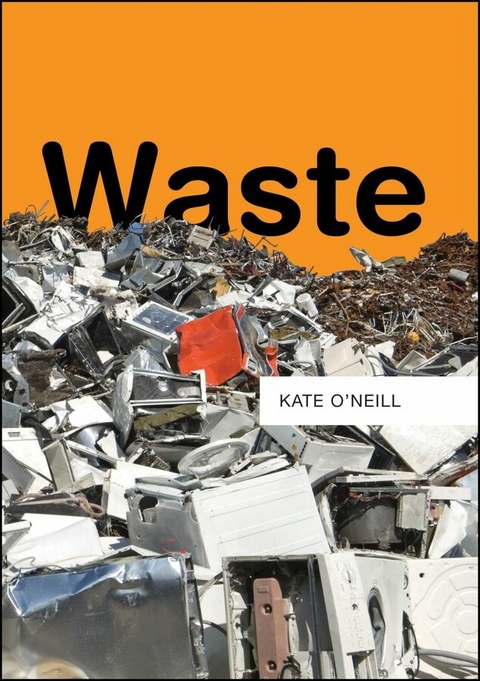
Waste is one of the planet's last great resource frontiers. From furniture made from up-cycled wood to gold extracted from computer circuit boards, artisans and multinational corporations alike are finding ways to profit from waste while diverting materials from overcrowded landfills. Yet beyond these benefits, this 'new' resource still poses serious risks to human health and the environment.
In this unique book, Kate O'Neill traces the emergence of the global political economy of wastes over the past two decades. She explains how the emergence of waste governance initiatives and mechanisms can help us deal with both the risks and the opportunities associated with the hundreds of millions - possibly billions - of tons of waste we generate each year. Drawing on a range of fascinating case studies to develop her arguments, including China's role as the primary recipient of recyclable plastics and scrap paper from the Western world, 'Zero-Waste' initiatives, the emergence of transnational waste-pickers' alliances, and alternatives for managing growing volumes of electronic and food wastes, O'Neill shows how waste can be a risk, a resource, and even a livelihood, with implications for governance at local, national, and global levels.
Kate O'Neill is Associate Professor in the Department of Environmental Science, Policy, and Management at UC Berkeley.
Waste is one of the planet s last great resource frontiers. From furniture made from up-cycled wood to gold extracted from computer circuit boards, artisans and multinational corporations alike are finding ways to profit from waste while diverting materials from overcrowded landfills. Yet beyond these benefits, this new resource still poses serious risks to human health and the environment. In this unique book, Kate O Neill traces the emergence of the global political economy of wastes over the past two decades. She explains how the emergence of waste governance initiatives and mechanisms can help us deal with both the risks and the opportunities associated with the hundreds of millions possibly billions of tons of waste we generate each year. Drawing on a range of fascinating case studies to develop her arguments, including China s role as the primary recipient of recyclable plastics and scrap paper from the Western world, Zero-Waste initiatives, the emergence of transnational waste-pickers alliances, and alternatives for managing growing volumes of electronic and food wastes, O Neill shows how waste can be a risk, a resource, and even a livelihood, with implications for governance at local, national, and global levels.
Kate O'Neill is Associate Professor in the Department of Environmental Science, Policy, and Management at UC Berkeley.
Figures and Tables
List of Acronyms
Preface and Acknowledgements
Chapter 1: The Global Political Economy of Waste
Chapter 2: Understanding Wastes
Chapter 3: Waste Work
Chapter 4: Discarded Electronics
Chapter 5: Food Waste
Chapter 6: Plastic Scrap
Conclusion: A World without Waste?
Notes
Selected Readings
References
"Kate O'Neill's latest work takes us on an eye-popping journey through rich case studies of wastes and their movement around the planet."
Josh Lepawsky, Memorial University of Newfoundland
"A marvelously crafted and grippingly written book about one of the most pressing challenges facing our planet. The sooner you read it, the more you will learn about the ways in which we systematically fail to use so much of what we extract and how governments, businesses, and individuals can turn to this expanding 'global resource frontier' to reduce our impact."
Ben Cashore, Yale University
"In this important book, Kate O'Neill expertly traces the complex international trade flows behind the prodigious volumes of waste generated by global consumer society. A valuable and illuminating contribution to current debates about if and how we make the shift to more sustainable lifestyles."
Maurie Cohen, New Jersey Institute of Technology
CHAPTER TWO
Understanding Wastes
In 2017, in the wake of a string of deadly hurricanes across North America and typhoons in Asia, fires in California and Portugal, and the ongoing destruction from the war in Syria, “disaster waste” on a large scale started to grab headlines. It is made up of rubble, but also materials of value (copper, steel, surviving household items), and hazardous wastes (leaked oil, raw sewage, decaying food). Disaster waste also includes human remains, which make its disposal even more difficult and sensitive. As climate change (and conflict) escalate, disaster waste across the globe will pose considerable challenges in recovery processes that can last years, yet governments and relief agencies are only now starting to pay attention to it. Disaster waste embodies wastes in all their complexity. It shows the shifting terrain of wastes as a policy arena. No two disasters are the same, but there will always be value to recover and damage to mend in afflicted areas.
This chapter focuses on understanding wastes: how they are defined, how they are classified, and why they have value. It also introduces wastes and waste management in practical terms: what are the main types of wastes? How much is produced? And what are the ways they can be disposed of? This chapter identifies how value is derived from wastes, and the controversies around these processes. It notes the contingency of wastes’ values in rapidly changing global markets.
What are Wastes?
What then is waste? Is there such a thing or are there only different wastes? Is the difference in degree between a blob of mustard on a dinner plate and a worn out nuclear reactor so great (in terms of size or hazard) that it becomes a difference in kind? Or are there features common to all wastes that not only justify one designation but also suggest a common solution to the problems they face? (Gourlay 1992, p. 20)
Defining waste with precision is extremely hard, perhaps impossible. In many jurisdictions, its definition for regulatory purposes is subject to intense legal contestation. The US in particular has a highly adversarial regulatory system that has been brought to bear on waste definition and regulation (Kagan 2001). There is very little agreement across or within countries as to common definitions of wastes. Nor is there a widely accepted distinction between waste and scrap or resource. These inconsistencies complicate and obstruct efforts to enhance transparency about wastes and their movements and to improve global governance. Box 2.1 offers a series of definitions from influential sources, which, on careful reading, differ significantly.
Each definition incorporates different understandings of whether what we throw away still has value that can be reclaimed or is at the end of its useful life. The Oxford English Dictionary does not leave room for post-discard use, for example, and neither does the World Health Organization (WHO). At the other end of the spectrum, “matter out of place,” the definition of waste that has been so influential in the field of Discard Studies (see below) emphasizes the very contextual nature of dirt (discards, waste). Ken Gourlay, who wrote on the global politics of waste in its early days, captures in a clear and elegant way the contextual dimensions of waste. His definition assigns responsibility (“we,” whoever that may be), while opening the door to a useful afterlife for “what we do not want or fail to use.”
Box 2.1: Definitions of waste
- “Refuse matter; unserviceable material remaining over from any process of manufacture; the useless by-products of any industrial process; material or manufactured articles so damaged as to be useless or unsaleable” (Oxford English Dictionary Online)
- “‘Wastes’ are substances or objects which are disposed of or are intended to be disposed of or are required to be disposed of by the provisions of national law” (Text of the 1989 United Nations Basel Convention on the Control of Transboundary Movements of Hazardous Wastes and Their Disposal)
- “Something, which the owner no longer wants at a given time and space and which has no current or perceived market value” (World Health Organization)
- “Unwanted or discarded materials ‘rejected as useless, unneeded or surplus to requirements’” (Wilson et al. 2015, p. 22)
- “What we do not want or what we fail to use” (Gourlay 1992, p. 21)
- “Matter out of place” (adapted from Mary Douglas’s classic definition of dirt in Douglas 1966)
Adapted from Gourlay (1992)
This point – that things that have been discarded can be both wastes and resources – is encapsulated in the many different words for “waste” in figure 2.1. Some of these words represent the end of life perspective, others refurbishment, reuse, and resale.
Given the rich historical lexicon of words for waste, detritus, litter, etc., I have surely left many colorful terms out of this word cloud, which came out of several years’ research and reading. I weighted the terms myself. “Scrap” is the second standout term because distinguishing between it and waste – with and without perceived value – is at the heart of global disputes over the international trade in wastes and scrap. Scrap is the generic term for used goods and materials that can be resold and remade into something with value. In the US, for example, there is a clear demarcation of what constitutes “scrap” for the purposes of the market, but this kind of distinction does not hold worldwide, creating legal, political, and cultural gaps that are hard to bridge (see chapter 6).
Figure 2.1: Words for waste
Source: Author, created using WordItOut.com
Some advocates of the global circular economy suggest avoiding the term waste and its synonyms altogether (see the book’s conclusion). Using terms like used, second-hand, or secondary helps shift the paradigm away from seeing discarded goods as “end-of-life,” certainly for consumer goods. Chapter 4, on electronic waste, demonstrates the power of this distinction, and how it is being used to assert the right to repair broken electronics and appliances. At the same time, not all waste can be reclaimed, and some remains dangerous and unusable, such as medical wastes from radiation or chemotherapy. Some materials can only be repaired or recycled a few times before they become useless: plastic, for instance, downcycles quickly. Resources exist only when there are people ready to use or buy them. For instance, it is hard to find markets for nuclear waste, raw sewage, or toxic ash, at least for now. It remains important to choose terminology that does not gloss over the very real shadows of waste production and recycling.
Tracking Wastes’ Journeys: Streams and Objects
This book’s primary empirical cases – electronic, food and plastic wastes or scrap – are complex examples of how the new global waste economy works. They can be viewed as objects, or things, for example, cellphones, leafy greens, and plastic straws. Their journeys can be followed from “birth” to afterlife. And they are waste streams, containing items of value (gold and metals, recyclable plastic, compost), and risk (mercury and dioxin, contaminated foodstuffs). This section introduces these two ways of thinking about wastes (scrap, etc.) and their lifecycles. While we often think of wastes as objects, recognizable things or commodities, they are also defined in terms of streams. These two ways of conceptualizing wastes help govern how wastes are produced, handled, disposed of, or sent back into use.
Wastes as Objects
One way to understand wastes-as-resources is to see them as objects. Electronics, batteries (from AA household batteries to those that power hybrid and electric cars), tires, plastic water bottles, straws and coffee pods, second-hand cars, and used mattresses and clothes all cut across standard categories of waste. They contain organic, metal, plastic, recyclable, non-recyclable, hazardous elements, or some combination. When we use a product, it is easy to think only about the use that we get out of it and ignore its life before we buy it and after we throw it away. This is even true of the most ubiquitous commodities, such as the clothes we wear.
These discarded objects do not always vanish. Often, they are recognizable when they show up in landfills, on pavements, and in scrapyards. The rusted bodies of discarded cars used to litter the US landscape. They show up as props in movies: Stephano Bloch has written about the after-life of mattresses dumped on the streets of Los Angeles (Bloch 2013). Several years ago, I was doing a search of images of end-of-life ships and, by strange coincidence, happened across the ship that had taken my dad to England in 1961 and my newly-wed parents back to Australia in 1965. It was virtually intact, but trashed, in a marine scrap yard in China. I recognized the name, The Oriana, sent the photo to my dad for confirmation, and he was able to point out their cabin.
Tracing the journeys of “things” like T-shirts from points of discard demonstrates how they acquire, lose, and reacquire value over time. Such analyses also increase the visibility – and...
| Erscheint lt. Verlag | 4.9.2019 |
|---|---|
| Sprache | englisch |
| Themenwelt | Naturwissenschaften ► Biologie ► Ökologie / Naturschutz |
| Naturwissenschaften ► Geowissenschaften ► Geografie / Kartografie | |
| Sozialwissenschaften ► Politik / Verwaltung | |
| Technik ► Bauwesen | |
| Schlagworte | activism • Bauingenieur- u. Bauwesen • Civil Engineering & Construction • economy • Environment • environmental • Environmental Economics & Politics • Environmental impact • Environmental Studies • Garbage • Geographie • Geography • Global • incineration • Landfill • Plastic • Policy • Political Geography • Politics • Politische Geographie • pollution • rubbish • Scrap • surplus • sustainability • Umweltbelastung • Umweltforschung • Umweltökonomie • Umweltökonomie u. -politik • Waste |
| ISBN-10 | 0-7456-8743-1 / 0745687431 |
| ISBN-13 | 978-0-7456-8743-8 / 9780745687438 |
| Informationen gemäß Produktsicherheitsverordnung (GPSR) | |
| Haben Sie eine Frage zum Produkt? |
 EPUB (Adobe DRM)
Kopierschutz: Adobe-DRM
Adobe-DRM ist ein Kopierschutz, der das eBook vor Mißbrauch schützen soll. Dabei wird das eBook bereits beim Download auf Ihre persönliche Adobe-ID autorisiert. Lesen können Sie das eBook dann nur auf den Geräten, welche ebenfalls auf Ihre Adobe-ID registriert sind.
Details zum Adobe-DRM
Dateiformat: EPUB (Electronic Publication)
EPUB ist ein offener Standard für eBooks und eignet sich besonders zur Darstellung von Belletristik und Sachbüchern. Der Fließtext wird dynamisch an die Display- und Schriftgröße angepasst. Auch für mobile Lesegeräte ist EPUB daher gut geeignet.
Systemvoraussetzungen:
PC/Mac: Mit einem PC oder Mac können Sie dieses eBook lesen. Sie benötigen eine
eReader: Dieses eBook kann mit (fast) allen eBook-Readern gelesen werden. Mit dem amazon-Kindle ist es aber nicht kompatibel.
Smartphone/Tablet: Egal ob Apple oder Android, dieses eBook können Sie lesen. Sie benötigen eine
Geräteliste und zusätzliche Hinweise
Buying eBooks from abroad
For tax law reasons we can sell eBooks just within Germany and Switzerland. Regrettably we cannot fulfill eBook-orders from other countries.
aus dem Bereich