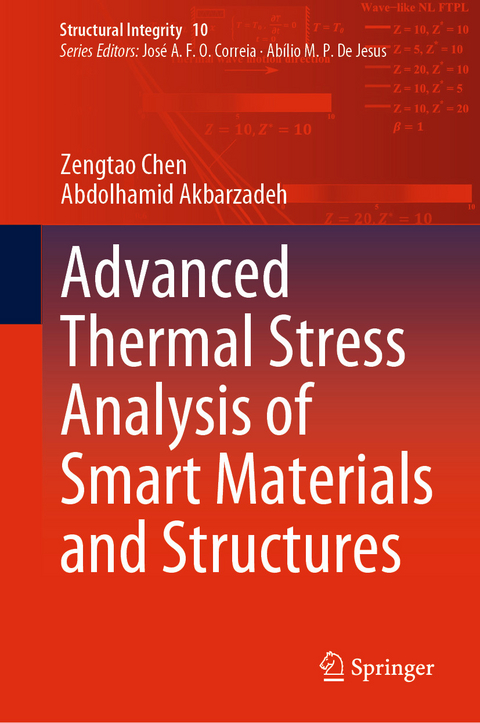
Advanced Thermal Stress Analysis of Smart Materials and Structures (eBook)
X, 304 Seiten
Springer International Publishing (Verlag)
978-3-030-25201-4 (ISBN)

This is the first single volume monograph that systematically summarizes the recent progress in using non-Fourier heat conduction theories to deal with the multiphysical behaviour of smart materials and structures.
The book contains six chapters and starts with a brief introduction to Fourier and non-Fourier heat conduction theories. Non-Fourier heat conduction theories include Cattaneo-Vernotte, dual-phase-lag (DPL), three-phase-lag (TPL), fractional phase-lag, and nonlocal phase-lag heat theories. Then, the fundamentals of thermal wave characteristics are introduced through reviewing the methods for solving non-Fourier heat conduction theories and by presenting transient heat transport in representative homogeneous and advanced heterogeneous materials. The book provides the fundamentals of smart materials and structures, including the background, application, and governing equations. In particular, functionally-graded smart structures made of piezoelectric, piezomagnetic, and magnetoelectroelastic materials are introduced as they represent the recent development in the industry.
Preface 6
Contents 8
1 Heat Conduction and Moisture Diffusion Theories 12
1.1 Introduction 12
1.2 Heat Conduction 13
1.2.1 Fourier Heat Conduction 13
1.2.1.1 Thermal Boundary Conditions 15
1.2.1.2 Thermal Initial Conditions 17
1.2.1.3 Thermal Interfacial Conditions 17
1.2.2 Non-Fourier Heat Conduction 18
1.2.2.1 Cattaneo-Vernotte Heat Conduction 18
1.2.2.2 Dual-Phase-Lag Heat Conduction 20
1.2.2.3 Three-Phase-Lag Heat Conduction 22
1.2.2.4 Fractional Phase-Lag Heat Conduction 24
1.2.2.5 Nonlocal Phase-Lag Heat Conduction 26
1.3 Moisture Diffusion 27
1.3.1 Fickian Moisture Diffusion 27
1.3.2 Non-Fickian Moisture Diffusion 29
References 31
2 Basic Problems of Non-Fourier Heat Conduction 34
2.1 Introduction 34
2.2 Laplace Transform and Laplace Inversion 34
2.2.1 Fast Laplace Inverse Transform 35
2.2.2 Reimann Sum Approximation 36
2.2.3 Laplace Inversion by Jacobi Polynomial 36
2.3 Non-Fourier Heat Conduction in a Semi-infinite Strip 37
2.4 Nonlocal Phase-Lag Heat Conduction in a Finite Strip 42
2.4.1 Molecular Dynamics to Determine Correlating Nonlocal Length 48
2.4.1.1 Nonlocal Heat Conduction in Functionally Graded Materials 51
2.5 Three-Phase-Lag Heat Conduction in 1D Strips, Cylinders, and Spheres 53
2.5.1 Effect of Bonding Imperfection on Thermal Wave Propagation 57
2.5.2 Effect of Material Heterogeneity on Thermal Wave Propagation 59
2.5.3 Thermal Response of a Lightweight Sandwich Circular Panel with a Porous Core 61
2.6 Dual-Phase-Lag Heat Conduction in Multi-dimensional Media 64
2.6.1 DPL Heat Conduction in Multi-dimensional Cylindrical Panels 64
2.6.2 DPL Heat Conduction in Multi-dimensional Spherical Vessels 69
References 73
3 Multiphysics of Smart Materials and Structures 75
3.1 Smart Materials 75
3.1.1 Piezoelectric Materials 77
3.1.1.1 Potential Field Equations 79
3.1.2 Magnetoelectroelastic Materials 79
3.1.2.1 Potential Field Equations 80
3.1.2.2 Conservation Equations 81
3.1.2.3 Fourier Heat Conduction and Fickian Moisture Diffusion 82
3.1.3 Advanced Smart Materials 83
3.2 Thermal Stress Analysis in Homogenous Smart Materials 84
3.2.1 Solution for the a Thermomagnetoelastic FGM Cylinder 86
3.2.2 Solution for Thermo-Magnetoelectroelastic Homogeneous Cylinder 92
3.2.3 Benchmark Results 96
3.3 Thermal Stress Analysis of Heterogeneous Smart Materials 100
3.3.1 Solution Procedures 102
3.3.2 Benchmark Results 107
3.4 Effect of Hygrothermal Excitation on One-Dimensional Smart Structures 108
3.4.1 Solution Procedure 111
3.4.2 MEE Hollow Cylinder 117
3.4.3 MEE Solid Cylinder 118
3.4.4 Benchmark Results 120
3.5 Remarks 124
References 125
4 Coupled Thermal Stresses in Advanced Smart Materials 128
4.1 Functionally Graded Materials 128
4.2 Hyperbolic Coupled Thermopiezoelectricity in One-Dimensional Rod 129
4.2.1 Introduction 130
4.2.2 Homogeneous Rod Problem 131
4.2.2.1 Fundamental and Governing Equations 132
4.2.3 Solution Procedure 134
4.2.3.1 Solution in Laplace Domain 134
4.2.3.2 Numerical Inversion of Laplace Transform 139
4.2.4 Results and Discussion 140
4.3 Hyperbolic Coupled Thermopiezoelectricity in Cylindrical Smart Materials 143
4.3.1 Introduction 144
4.3.2 Hollow Cylinder Problem 144
4.3.2.1 Fundamental and Governing Equations 145
4.3.3 Solution Procedure 148
4.3.3.1 Solution in Laplace Domain 149
4.3.3.2 Galerkin Finite Element Method 149
4.3.3.3 Numerical Inversion of the Laplace Transform 151
4.3.4 Results and Discussion 151
4.4 Coupled Thermopiezoelectricity in One-Dimensional Functionally Graded Smart Materials 155
4.4.1 Introduction 155
4.4.2 The Functionally Graded Rod Problem 156
4.4.2.1 Fundamental and Governing Equations 157
4.4.3 Solution Procedures 159
4.4.3.1 Solution in Laplace Domain 159
4.4.3.2 Coupled Thermopiezoelectricity Analysis 160
4.4.3.3 Uncoupled Thermopiezoelectricity Analysis 163
4.4.3.4 Numerical Inversion of the Laplace Transform 165
4.4.4 Results and Discussion 165
4.4.5 Introduction of Dual Phase Lag Models 170
4.4.5.1 Fundamental and Governing Equations 171
4.4.6 Results of Dual Phase Lag Model Analysis 172
4.5 Remarks 177
References 178
5 Thermal Fracture of Advanced Materials Based on Fourier Heat Conduction 180
5.1 Introduction 180
5.2 Extended Displacement Discontinuity Method and Fundamental Solutions for Thermoelastic Crack Problems 180
5.2.1 Fundamental Solutions for Unit Point Loading on a Penny-Shaped Interface Crack 183
5.2.1.1 Solution for Unit-Point Displacement Discontinuity in the Z-Direction of the Crack 185
5.2.1.2 Unit Point Temperature Discontinuity of the Crack 188
5.2.1.3 Unit-Point Displacement Discontinuity in the y-Direction of the Crack 190
5.2.1.4 Unit Point Displacement Discontinuity in the x-Direction of the Crack 194
5.2.2 Boundary Integral-Differential Equations for Interfacial Cracks 194
5.2.2.1 Hypersingular Integral-Differential Equations 196
5.2.2.2 Singular Behavior Near the Interface Crack Front 197
5.2.2.3 Singular Stress and Heat Flux Fields Ahead of the Interfacial Crack Front 201
5.2.3 Stress Intensity Factor and Energy Release Rate 203
5.3 Interface Crack Problems in Thermopiezoelectric Materials 206
5.3.1 Basic Equations 207
5.3.2 Fundamental Solutions for Unit-Point Extended Displacement Discontinuities 209
5.3.2.1 Fundamental Solution for a Unit-Point Temperature Discontinuity 210
5.3.3 Boundary Integral-Differential Equations for an Interfacial Crack in Piezothermoelastic Materials 213
5.3.4 Hyper-Singular Integral-Differential Equations 215
5.3.4.1 Solution Method for the Extended Displacement Discontinuity ||W||?+?G||?|| 217
5.3.4.2 Extended Stress ?Z???L1Dz/L2 and Extended Intensity Factor KI1 218
5.3.5 Solution Method of the Integral-Differential Equations 219
5.3.5.1 Singular Behavior Near the Interface Crack Front 223
5.3.5.2 Singular Fields Around Interfacial Cracks in Piezoethermoelastic Materials 226
5.3.6 Extended Stress Intensity Factors 228
5.4 Fundamental Solutions for Magnetoelectrothermoelastic Bi-Materials 229
5.5 Fundamental Solutions for Interface Crack Problems in Quasi-Crystalline Materials 234
5.5.1 Fundamental Solutions for Unit-Point EDDs 237
5.6 Application of General Solution in the Problem of an Interface Crack of Arbitrary Shape 243
5.7 Summary 244
References 245
6 Advanced Thermal Fracture Analysis Based on Non-Fourier Heat Conduction Models 252
6.1 Introduction 252
6.2 Hyperbolic Heat Conduction in a Cracked Half-Plane with a Coating 252
6.2.1 Basic Equations 254
6.2.2 Temperature Field 256
6.2.3 Temperature Gradients 260
6.2.4 Numerical Results 261
6.3 Thermoelastic Analysis of a Partially Insulated Crack in a Strip 264
6.3.1 Definition of the Problem 265
6.3.1.1 Thermal-Elastic Field Equations 266
6.3.2 Thermal Stresses 268
6.3.3 Asymptotic Stress Field Near Crack Tip 273
6.3.4 Numerical Results and Discussions 275
6.4 Thermal Stresses in a Circumferentially Cracked Hollow Cylinder Based on Memory-Dependent Heat Conduction 278
6.4.1 Problem Formulation 279
6.4.2 Thermal Axial Stress in an Un-cracked Hollow Cylinder 280
6.4.3 Thermal Stress in the Axial Direction 283
6.4.4 Stress Intensity Factors 288
6.4.4.1 Embedded Crack /varvec{({r}_{{in}} /lt {c^{/prime}} /lt {d^{/prime}} /lt 1)} 288
6.4.4.2 Outer Edge Crack /varvec{( {r_{in} /lt c^{/prime} /lt d^{/prime} = 1} )} 289
6.4.4.3 Inner Edge Crack /varvec{( {r_{in} = c^{/prime} /lt d^{/prime} /lt 1} )} 291
6.4.5 Results and Discussion 292
6.5 Transient Thermal Stress Analysis of a Cracked Half-Plane of Functionally Graded Materials 293
6.5.1 Formulation of the Problem and Basic Equations 296
6.5.1.1 Heat Conduction Equations 297
6.5.1.2 Thermal Stress Field Equations 298
6.5.2 Solution of the Temperature Field 299
6.5.3 Solution of Thermal Stress Field 302
6.5.4 Numerical Results and Discussion 305
6.6 Summary 307
References 307
7 Future Perspectives 312
7.1 Heat Conduction Theories 312
7.2 Application in Advanced Manufacturing Technologies 313
| Erscheint lt. Verlag | 3.9.2019 |
|---|---|
| Reihe/Serie | Structural Integrity | Structural Integrity |
| Zusatzinfo | X, 304 p. 104 illus., 44 illus. in color. |
| Sprache | englisch |
| Themenwelt | Mathematik / Informatik ► Mathematik |
| Technik ► Maschinenbau | |
| Schlagworte | fracture mechanics • Non-Fourier Heat Conduction • Partial differential equations • smart materials and structures • Thermal Stress Analysis |
| ISBN-10 | 3-030-25201-9 / 3030252019 |
| ISBN-13 | 978-3-030-25201-4 / 9783030252014 |
| Informationen gemäß Produktsicherheitsverordnung (GPSR) | |
| Haben Sie eine Frage zum Produkt? |
 PDF (Wasserzeichen)
DRM: Digitales Wasserzeichen
Dieses eBook enthält ein digitales Wasserzeichen und ist damit für Sie personalisiert. Bei einer missbräuchlichen Weitergabe des eBooks an Dritte ist eine Rückverfolgung an die Quelle möglich.
Dateiformat: PDF (Portable Document Format)
Mit einem festen Seitenlayout eignet sich die PDF besonders für Fachbücher mit Spalten, Tabellen und Abbildungen. Eine PDF kann auf fast allen Geräten angezeigt werden, ist aber für kleine Displays (Smartphone, eReader) nur eingeschränkt geeignet.
Systemvoraussetzungen:
PC/Mac: Mit einem PC oder Mac können Sie dieses eBook lesen. Sie benötigen dafür einen PDF-Viewer - z.B. den Adobe Reader oder Adobe Digital Editions.
eReader: Dieses eBook kann mit (fast) allen eBook-Readern gelesen werden. Mit dem amazon-Kindle ist es aber nicht kompatibel.
Smartphone/Tablet: Egal ob Apple oder Android, dieses eBook können Sie lesen. Sie benötigen dafür einen PDF-Viewer - z.B. die kostenlose Adobe Digital Editions-App.
Buying eBooks from abroad
For tax law reasons we can sell eBooks just within Germany and Switzerland. Regrettably we cannot fulfill eBook-orders from other countries.
aus dem Bereich