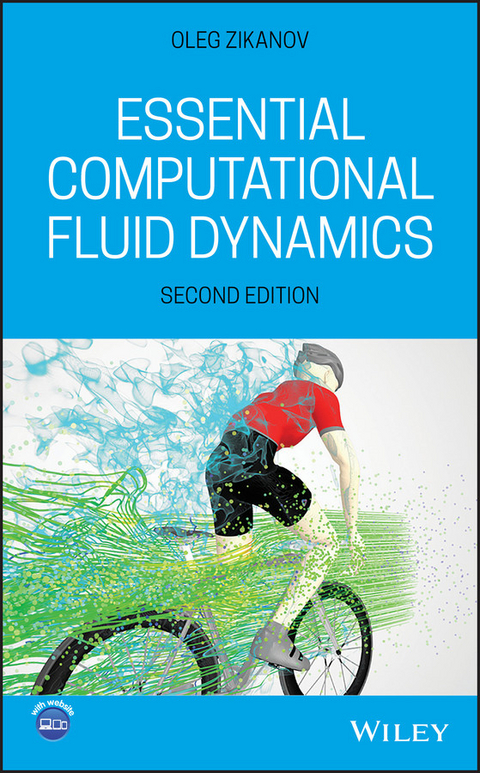
Essential Computational Fluid Dynamics (eBook)
John Wiley & Sons (Verlag)
978-1-119-47481-4 (ISBN)

Provides a clear, concise, and self-contained introduction to Computational Fluid Dynamics (CFD)
This comprehensively updated new edition covers the fundamental concepts and main methods of modern Computational Fluid Dynamics (CFD). With expert guidance and a wealth of useful techniques, the book offers a clear, concise, and accessible account of the essentials needed to perform and interpret a CFD analysis.
The new edition adds a plethora of new information on such topics as the techniques of interpolation, finite volume discretization on unstructured grids, projection methods, and RANS turbulence modeling. The book has been thoroughly edited to improve clarity and to reflect the recent changes in the practice of CFD. It also features a large number of new end-of-chapter problems.
All the attractive features that have contributed to the success of the first edition are retained by this version. The book remains an indispensable guide, which:
- Introduces CFD to students and working professionals in the areas of practical applications, such as mechanical, civil, chemical, biomedical, or environmental engineering
- Focuses on the needs of someone who wants to apply existing CFD software and understand how it works, rather than develop new codes
- Covers all the essential topics, from the basics of discretization to turbulence modeling and uncertainty analysis
- Discusses complex issues using simple worked examples and reinforces learning with problems
- Is accompanied by a website hosting lecture presentations and a solution manual
Essential Computational Fluid Dynamics, Second Edition is an ideal textbook for senior undergraduate and graduate students taking their first course on CFD. It is also a useful reference for engineers and scientists working with CFD applications.
OLEG ZIKANOV, PHD, is a Professor of Mechanical Engineering at the University of Michigan-Dearborn, MI, USA. His teaching activities are in the area of thermal-fluid sciences with focus on CFD, fluid dynamics, and energy technologies. He is an active researcher in the field of computational analysis of fluid flow phenomena.
OLEG ZIKANOV, PHD, is a Professor of Mechanical Engineering at the University of Michigan-Dearborn, MI, USA. His teaching activities are in the area of thermal-fluid sciences with focus on CFD, fluid dynamics, and energy technologies. He is an active researcher in the field of computational analysis of fluid flow phenomena.
Chapter 1
What Is CFD?
1.1 Introduction
We start with a definition
CFD (Computational Fluid Dynamics) is a set of numerical methods applied to obtain approximate solutions of problems of fluid dynamics and heat transfer.
According to this definition, CFD is not a science on its own but a way to apply the methods of one discipline (numerical analysis) to another (heat and mass transfer). We will deal with details later. Right now, a brief discussion is in order of why exactly we need CFD.
A distinctive feature of the science of fluid flow and heat and mass transfer is the approach it takes toward description of physical processes. Instead of bulk properties, such as momentum or angular momentum of a body in mechanics or total energy or entropy of a system in thermodynamics, the analysis focuses on distributed properties. We try to determine the entire fields such as temperature , velocity , density , etc.1 Even when an integral characteristic, such as the friction coefficient or the net rate of heat transfer, is the ultimate goal of the analysis, it is derived from distributed fields.
The approach is very attractive by virtue of the level of details it provides. Evolution of the entire temperature distribution within a body can be determined. The effect of internal processes of a fluid flow such as motion, rotation, and deformation of minuscule fluid particles can be taken into account. Of course, the opportunities come at a price, most notably in the form of dramatically increased complexity of the governing equations. Except for a few strongly simplified models, the equations for distributed properties are partial differential equations, often nonlinear.
As an example of complexity, let us consider a seemingly simple task of mixing and dissolving sugar in a cup of hot coffee. An innocent question of how long would it take to completely dissolve the sugar leads to a very complex physical problem that includes a possibly turbulent two‐phase (coffee and sugar particles) flow with variable physical properties and a chemical reaction (dissolving). Heat transfer (within the cup and between the cup and surroundings) is also of importance because temperature strongly affects the rate of the reaction. No simple solution of the problem exists. Of course, we can rely on the experience acquired after repeating the process daily (perhaps more than once) for many years. We can also add a couple of extra, possibly unnecessary, stirs. If, however, the task in question is more serious – for example, optimizing an oil refinery or designing a new aircraft – relying on everyday experience or excessive effort is not an option. We must find a way to understand and predict the process.
Generally, we can distinguish between three approaches to solving fluid flow and heat transfer problems:
- Theoretical approach: Finding analytical solutions of governing equations or arriving to conclusions on the basis of some theoretical considerations.
- Experimental approach: Staging an experiment using a model of the real object.
- Numerical approach: Using computational procedures to find a solution of the governing equations.
Let us look at these approaches in more detail.
Theoretical Approach. The approach has a crucial advantage of providing exact solutions. Among the disadvantages, the most important is that analytical solutions are only possible for a very limited class of problems, typically formulated in an artificial, idealized way. One example is the Hagen–Poiseuille solution for a flow in an infinitely long pipe (see Figure 1.1). The steady‐state laminar velocity profile is
where is the velocity, is the pipe radius, is the constant pressure gradient that drives the flow, and is the dynamic viscosity of the fluid. The solution is, indeed, simple and gives insight into the nature of flows in pipes and ducts, so its inclusion into all textbooks of fluid dynamics is not surprising. At the same time, the solution is correct only if the pipe is infinitely long,2 temperature is constant, and the fluid is perfectly incompressible. Furthermore, even if we were able to build such a pipe and find some use for it, the solution would be correct only at Reynolds numbers ( is the density of the fluid) below, approximately, 1200. Above this limit, the flow would take fully three‐dimensional and time‐dependent transitional or turbulent form, for which no analytical solution is possible.
Figure 1.1 Laminar flow in an infinite pipe.
It can also be noted that derivation of analytical solutions often requires substantial mathematical skills, which are not among the strongest traits of many modern engineers and scientists, especially if compared to the situation of 30 or 40 years ago. Several reasons can be named for the deterioration of such skills, one, no doubts, being development of computers and numerical methods, including the CFD.
Experimental approach: Well‐known examples are the wind tunnel experiments, which help to design and optimize the external shapes of airplanes (also of ships, cars, buildings, and other objects). Another example is illustrated in Figure 1.2. The main disadvantages of the experimental approach are the technical difficulty (sometimes it takes several years before an experiment is set up and all technical problems are resolved) and high cost.
Figure 1.2 The experiment for studying thermal convection at the Ilmenau University of Technology, Germany. Turbulent convection similar to the convection observed in the atmosphere of Earth or Sun is simulated by air motion within a large barrel with thermally insulated walls and uniformly heated bottom.
Source: Courtesy of André Thess.
Numerical (computational) approach: Here, again, we employ our ability to describe almost any fluid flow or heat transfer process as a solution of a set of partial differential equations. An approximation to this solution is found by a computer executing an algorithm. This approach is not problem‐free either. We will discuss the problems throughout the book. The computational approach, however, beats the analytical and experimental methods in some very important aspects: universality, flexibility, accuracy, and cost.
1.2 Brief History of CFD
The history of CFD is a fascinating subject, which, unfortunately, we can only touch in passing. The idea to calculate approximate solutions of differential equations describing fluid flows and heat transfer is relatively old, definitely older than computers themselves. Development of numerical methods for solving ordinary and partial differential equations started in the first half of the twentieth century. The computations at that time required the use of calculation tables and dull mechanical work of tens, if not hundreds, of people. No wonder that only the apparently most important (often military‐related) problems were addressed and only simple one‐dimensional equations were solved.
Invention and subsequent fast development of computers opened a wonderful possibility of performing millions and, then, millions of millions of arithmetic operations in a matter of seconds. Together with the rapid development of the algorithms of numerical mathematics, this has led to impressive growth of speed and abilities of CFD analysis. First simulations of realistic two‐dimensional flows were performed in the late 1960s, while three‐dimensional flows could be seriously approached since the 1980s. Again, military tasks, such as modeling shock waves from an explosion or a flow past a hypersonic jet aircraft, were addressed first. In fact, development of faster and bigger computers until 1980s was largely motivated by the demands of the military‐related CFD.
Over the last several decades, the field of CFD has changed profoundly. From a scientific discipline, in which researchers worked on unique projects using specially developed codes, it has transformed into an everyday tool of engineering design and scientific research. In engineering, the simulations are routinely used as “virtual experiments” replacing or complementing prototyping and other design techniques. The problem‐specific codes are still developed for scientific purposes, but the practice has almost entirely switched to the use of commercial or open‐source CFD codes. The market is largely divided between few major brands, such as ANSYS, STAR‐CCM, OpenFOAM, or COMSOL. Standard codes are widely used in other areas of active CFD applications, such as meteorology, oceanography, or astrophysics. The codes differ in appearance and capabilities but are all essentially numerical solvers of partial differential equations with attached physical and turbulence models and algorithms for grid generation and post‐processing of results.
1.3 Outline of the Book
This book is intended as a brief but complete introduction into CFD. The focus is not on development of algorithms but on the fundamental principles, formulation of CFD problems, the most basic and common computational techniques, and essentials of a good CFD analysis. The book's main task is to prepare the reader to make educated choices while using one of the available CFD codes. A reader seeking deeper and more detailed understanding of specific computational methods is encouraged to use more advanced and more specialized texts, references to some of...
| Erscheint lt. Verlag | 30.8.2019 |
|---|---|
| Sprache | englisch |
| Themenwelt | Technik ► Maschinenbau |
| Schlagworte | CFD • CFD analysis • Classical & Fluid Mechanics • computational fluid dynamics • Computational / Numerical Methods • Engineering • finite difference discretization • finite volume discretization • Fluid Flow • fluid mechanics • heat transfer • Hydraulics • Klassische u. Strömungsmechanik • <p>fluid dynamics • Maschinenbau • mechanical engineering • Physics • Physik • RANS modeling • Rechnergestützte / Numerische Verfahren im Maschinenbau • steady-state problems • Strömungsmechanik • thermal fluid science</p> • Thermodynamik |
| ISBN-10 | 1-119-47481-7 / 1119474817 |
| ISBN-13 | 978-1-119-47481-4 / 9781119474814 |
| Informationen gemäß Produktsicherheitsverordnung (GPSR) | |
| Haben Sie eine Frage zum Produkt? |
 EPUB (Adobe DRM)
Kopierschutz: Adobe-DRM
Adobe-DRM ist ein Kopierschutz, der das eBook vor Mißbrauch schützen soll. Dabei wird das eBook bereits beim Download auf Ihre persönliche Adobe-ID autorisiert. Lesen können Sie das eBook dann nur auf den Geräten, welche ebenfalls auf Ihre Adobe-ID registriert sind.
Details zum Adobe-DRM
Dateiformat: EPUB (Electronic Publication)
EPUB ist ein offener Standard für eBooks und eignet sich besonders zur Darstellung von Belletristik und Sachbüchern. Der Fließtext wird dynamisch an die Display- und Schriftgröße angepasst. Auch für mobile Lesegeräte ist EPUB daher gut geeignet.
Systemvoraussetzungen:
PC/Mac: Mit einem PC oder Mac können Sie dieses eBook lesen. Sie benötigen eine
eReader: Dieses eBook kann mit (fast) allen eBook-Readern gelesen werden. Mit dem amazon-Kindle ist es aber nicht kompatibel.
Smartphone/Tablet: Egal ob Apple oder Android, dieses eBook können Sie lesen. Sie benötigen eine
Geräteliste und zusätzliche Hinweise
Buying eBooks from abroad
For tax law reasons we can sell eBooks just within Germany and Switzerland. Regrettably we cannot fulfill eBook-orders from other countries.
aus dem Bereich