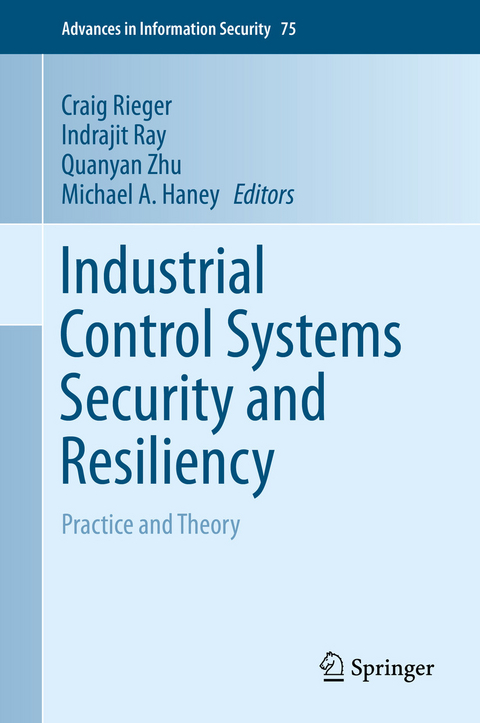
Industrial Control Systems Security and Resiliency (eBook)
X, 276 Seiten
Springer International Publishing (Verlag)
978-3-030-18214-4 (ISBN)
Preface 6
Contents 9
Part I: Current and New Practice 11
Current Standards for Cyber-Hygiene in Industrial Control System Environments 12
Introduction 12
Ways to Address Cyber-Hygiene 13
Standards 14
North American Electric Reliability Corporation Critical Infrastructure Protection (NERC CIP) 14
ISA/IEC 62443 14
Underwriters Laboratories (UL) 2900 15
National Institute for Standards and Publications (NIST) Special Publications 18
Department of Homeland Security (DHS) and Department of Energy (DOE) Publications 19
Smart Grid Publications 19
French Network and Information Security Agency (ANSSI) 20
Bundesamt für Sicherheit in der Informationstechnik (BSI) 21
Personnel Training 22
Summary 23
Consequence-Based Resilient Architectures 25
The Challenges of Security by Design 25
The Vulnerability Mitigation Cycle 26
Consequence-Driven Cyber-Informed Engineering 27
The ``Future´´ Analysis Problem and Consequence Prioritization 29
System of Systems Analysis 31
Adversarial Approach and Consequence-Based Targeting 32
Mitigation and Elimination of Risk 33
References 34
Part II: Cyber-Modeling, Detection, and Forensics 37
Cyber-Physical Anomaly Detection for Power Grid with Machine Learning 38
Cybersecurity of Modern Power System 38
Overview of Modern Power System 38
Cyber-Systems Relying on Wide-Area Communication 39
SCADA (Supervisory Control and Data Acquisition) 39
WAMS (Wide Area Measurement System) 40
AMI (Advanced Metering Infrastructure) 40
Greenhouse for Malicious Cyber-Attacks 40
Cyber-Physical System Anomaly Detection 41
CPS Anomaly Detection Applications 42
Detection Location 42
Detection Nature 43
Challenges for CPS Anomaly Detection 45
Timing Performance 45
Big Data 45
Detection Model Online Update 46
CPS Anomaly Detection with Machine Learning 46
Case Study: Clustering-Based Generation Control Anomaly Detection 47
Problem 48
Experiment 49
Scenarios and Data Collection 50
Dimensionality Reduction 52
Clustering Results 52
Conclusion 52
References 56
Toward the Science of Industrial Control Systems Security and Resiliency 57
Introduction 57
State of the Art of Research, Challenges, and Solutions 58
Supervisory Control and Data Acquisition Systems 58
Potential Cyber-Threats on SCADA 59
Research Challenges and Formal Frameworks 61
Threat Analysis Architecture 61
Formal Approach Characteristics 62
Formal Framework for SCADA Security Analysis 63
Methodology 63
Physical Model 64
Cyber-Physical Attack Model 65
Modeling Adversary Attributes 66
Interdependency Models 67
Example Case Study 68
Formal Model for SCADA Resiliency Analysis 69
Methodology 69
SCADA Cyber-Physical System Modeling 70
Modeling of Attacks and Security Controls 71
Modeling of Resiliency Threats Based on SCADA Operations 72
Example Case Study 73
Conclusion 74
References 74
Toward Cyber-Resiliency Metrics for Action Recommendations Against Lateral Movement Attacks 76
Introduction 76
Background and Related Work 80
Network Model and Iterative Reachability Computation of Lateral Movement 81
Notation and Tripartite Graph Model 81
Reachability of Lateral Movement on User-Host Graph 82
Reachability of Lateral Movement on Host-Application Graph 83
Reachability of Lateral Movement on Tripartite User-Host-Application Graph 85
Segmentation on User-Host Graph 85
Hardening on Host-Application Graph 88
Experimental Results 91
Dataset Description and Experiment Setup 91
Segmentation Against Lateral Movement 91
Hardening Against Lateral Movement 92
Performance Evaluation on Actual Lateral Movement Attacks 94
Conclusion and Future Work 95
References 96
Part III: Proactive Defense Mechanism Design 98
Moving Target, Deception, and Other Adaptive Defenses 99
Introduction 100
Foundations of Moving Target Defense 101
Moving Target Defense Principles 103
Types of Moving Target Defense 105
Examples of Moving Target Defense 107
Platform-Based 107
Network-Based 108
Runtime Environment-Based 109
Application-Based 109
Industrial Control System Applications of Moving Target Defense 110
Considerations 110
ICS Examples 112
Strategy Selection 113
Cost-Benefit Analysis 114
Other Practical Considerations 115
Responsive Defenses 116
Conclusion 118
References 118
Beyond Mirages: Deception in ICS-Lessons Learned from Traditional Networks 123
Introduction 123
Deception Background 123
State of the Art in Deception in ICS 126
Advanced Concepts from Traditional Networks 128
Temporal Deceptions 131
Spatial Deceptions 132
Client Validation and Manipulation 135
Potential Transfer to ICS, Challenges, and Opportunities 136
Attacker in the Internet 138
Attacker Has Compromised a Corporate User 140
Attacker in the Control Center 142
Attacker on the Wind Farm´s Local Network 144
Conclusion 144
References 145
Moving Target Defense to Improve Industrial Control System Resiliency 147
Introduction 147
Challenges 149
MTD Within Critical Infrastructure 149
Background 150
MTD Techniques 152
MTD Categories 152
Dynamic Platforms 153
Dynamic Runtime Environments 153
Dynamic Networks 154
Dynamic Data 154
Dynamic Software 155
Dead Code 155
Stack Directions 156
Equivalent Instruction Substitution 157
MTD Applications and Scenarios Within ICS 157
Industrial Control Systems 158
Use Case 158
Constraints 160
Requirements 161
Experimentation 161
Adversarial Scenario 163
Metrics 163
Conclusion 168
References 168
Proactive Defense Through Deception 172
Introduction 173
Related Work 174
Threat Model 176
Motivating Example 176
Deception Approach 178
View Model 179
Problem Statement 181
Algorithms 181
Algorithm TopKDistance 182
Algorithm TopKDistance 184
Fingerprinting 185
Sin FP3 186
p0f 188
Nessus 188
Fingerprint Manipulation 189
Implementation 191
Operating System Fingerprint Module 191
Service Fingerprint Module 192
Experimental Evaluation 192
Evaluation of TopKDistance 194
Evaluation of TopKBudget 197
Legitmate User Perspective 199
Attacker Perspective 201
Drawbacks and Limitations 201
Conclusions 203
References 204
Next-Generation Architecture and Autonomous Cyber-Defense 206
Synopsis 206
Overview 206
Understanding the Challenges 209
ICS Networks 209
Challenges to ICS Networks 211
ICS Network Defenses 213
Requirements for a Next-Generation Architecture 215
Theory of ACD and Next-Generation Architecture 217
Strategy for Resilience 217
The Reactive Cycle 218
The Background Cycle 220
Resilient Control Design 220
Resilience Components and Metrics 222
Challenge Tolerance 222
Trustworthiness 224
Implementation 226
Memory Unit 227
Resilience Knowledge Base 227
Defensive Measures: Defend Subsystem 228
Challenge Detection Subsystem 230
Resilience Manager 232
Evaluation Subsystems 232
Prediction Subsystems 233
Analysis Subsystem 233
Response Subsystem 234
Refinement 234
Conclusion 234
Appendix 1: Acronyms 235
References 235
Part IV: Human System Interface 238
Fault Understanding, Navigation, and Control Interface: A Visualization System for Cyber-Resilient Operations for Advanced Nuc... 239
Introduction 239
Development of New Systems for New Reactors 241
New Operational Philosophy and Operator Support Systems 242
Fault Understanding, Navigation, and Control Interface (FUNCI) 243
Form and Function of FUNCI 245
Case Study Scenarios 248
Vibration Fault (Spoof) 249
Ramp Rate Surge (No Spoof) 249
CV Fault 1 (Spoof with Text) 249
CV Fault 2 (Spoof with Trend) 249
Case Study Results 250
Lessons Learned 250
Conclusions and Discussion 251
References 252
Part V: Metrics 255
Resilient Control System Metrics 256
Introduction 257
Modern Distribution System Resilience Metric 259
Single-Asset Description 260
Type of Single Assets 262
Concise Asset Description 263
Groupings of Assets in the MDS 264
Resilient Metrics in the Context of the Grid Topology 266
Example Aggregation of Assets in a Distribution System 267
Mapping to DIRE Curve 269
Cyber/Communication/Control Effects on the System 272
The Cost of Resilience 274
Conclusions 275
References 276
| Erscheint lt. Verlag | 29.8.2019 |
|---|---|
| Reihe/Serie | Advances in Information Security | Advances in Information Security |
| Zusatzinfo | X, 276 p. 98 illus., 81 illus. in color. |
| Sprache | englisch |
| Themenwelt | Informatik ► Theorie / Studium ► Künstliche Intelligenz / Robotik |
| Technik ► Nachrichtentechnik | |
| Schlagworte | Cognitive • consequence • Control • Cyber • cyber threats • DCS • Deception • ICS • Interdisciplinary • Intrusion Detection • Malware • metrics • Network Security • operator errors • PLC • Resilience • Resilient Design • Scada • security • sensing |
| ISBN-10 | 3-030-18214-2 / 3030182142 |
| ISBN-13 | 978-3-030-18214-4 / 9783030182144 |
| Informationen gemäß Produktsicherheitsverordnung (GPSR) | |
| Haben Sie eine Frage zum Produkt? |
 PDF (Wasserzeichen)
DRM: Digitales Wasserzeichen
Dieses eBook enthält ein digitales Wasserzeichen und ist damit für Sie personalisiert. Bei einer missbräuchlichen Weitergabe des eBooks an Dritte ist eine Rückverfolgung an die Quelle möglich.
Dateiformat: PDF (Portable Document Format)
Mit einem festen Seitenlayout eignet sich die PDF besonders für Fachbücher mit Spalten, Tabellen und Abbildungen. Eine PDF kann auf fast allen Geräten angezeigt werden, ist aber für kleine Displays (Smartphone, eReader) nur eingeschränkt geeignet.
Systemvoraussetzungen:
PC/Mac: Mit einem PC oder Mac können Sie dieses eBook lesen. Sie benötigen dafür einen PDF-Viewer - z.B. den Adobe Reader oder Adobe Digital Editions.
eReader: Dieses eBook kann mit (fast) allen eBook-Readern gelesen werden. Mit dem amazon-Kindle ist es aber nicht kompatibel.
Smartphone/Tablet: Egal ob Apple oder Android, dieses eBook können Sie lesen. Sie benötigen dafür einen PDF-Viewer - z.B. die kostenlose Adobe Digital Editions-App.
Buying eBooks from abroad
For tax law reasons we can sell eBooks just within Germany and Switzerland. Regrettably we cannot fulfill eBook-orders from other countries.
aus dem Bereich