


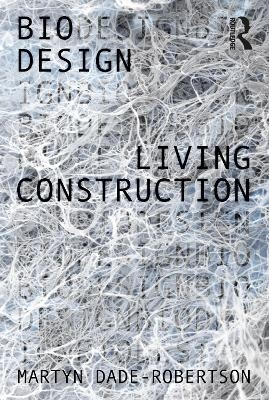
Living Construction
Seiten
2020
Routledge (Verlag)
978-1-138-36303-8 (ISBN)
Routledge (Verlag)
978-1-138-36303-8 (ISBN)
This book, the first in the Bio Design series, acts as a bridge between design speculation and scientific reality, and between contemporary design thinking, in areas such as architecture, product design and fashion design, and the traditional engineering approaches which currently dominate bio technologies.
Modern biotechnologies give us unprecedented control of the fundamental building blocks of life. For designers, across a range of disciplines, emerging fields such as synthetic biology offer the promise of new sustainable materials and structures which may be grown, are self-assembling, self-healing and adaptable to change. While there is a thriving speculative discourse on the future of design in the age of biotechnology, there are few realized design applications.
This book, the first in the Bio Design series, acts as a bridge between design speculation and scientific reality and between contemporary design thinking, in areas such as architecture, product design and fashion design, and the traditional engineering approaches which currently dominate biotechnologies. Filled with real examples, Living Construction reveals how living cells construct and transform materials through methods of fabrication and assembly at multiple scales and how designers can utilize these processes.
Modern biotechnologies give us unprecedented control of the fundamental building blocks of life. For designers, across a range of disciplines, emerging fields such as synthetic biology offer the promise of new sustainable materials and structures which may be grown, are self-assembling, self-healing and adaptable to change. While there is a thriving speculative discourse on the future of design in the age of biotechnology, there are few realized design applications.
This book, the first in the Bio Design series, acts as a bridge between design speculation and scientific reality and between contemporary design thinking, in areas such as architecture, product design and fashion design, and the traditional engineering approaches which currently dominate biotechnologies. Filled with real examples, Living Construction reveals how living cells construct and transform materials through methods of fabrication and assembly at multiple scales and how designers can utilize these processes.
Martyn Dade-Robertson is Professor of Emerging Technology at the School of Architecture, Planning and Landscape at Newcastle University and the Co-Director of the Hub for Biotechnology in the Built Environment. He holds degrees in architecture, architectural computing and synthetic biology.
1. Introduction 2. The designs of the natural 3. The logic of living assembly 4. Fabrication in the living 5. Conclusion: the craft of living construction
| Erscheinungsdatum | 21.01.2020 |
|---|---|
| Reihe/Serie | Bio Design |
| Zusatzinfo | 26 Line drawings, black and white; 6 Halftones, black and white; 32 Illustrations, black and white |
| Verlagsort | London |
| Sprache | englisch |
| Maße | 129 x 198 mm |
| Gewicht | 167 g |
| Themenwelt | Technik ► Architektur |
| Technik ► Umwelttechnik / Biotechnologie | |
| ISBN-10 | 1-138-36303-0 / 1138363030 |
| ISBN-13 | 978-1-138-36303-8 / 9781138363038 |
| Zustand | Neuware |
| Informationen gemäß Produktsicherheitsverordnung (GPSR) | |
| Haben Sie eine Frage zum Produkt? |
Mehr entdecken
aus dem Bereich



aus dem Bereich
Grundlagen, Normen, Vorschriften
Buch | Hardcover (2024)
Springer Vieweg (Verlag)
CHF 219,95
Tragkonstruktion und Schichtaufbau
Buch | Hardcover (2024)
Birkhäuser (Verlag)
CHF 119,95
Arbeitsschritte - Fallbeispiele - Detailzeichnungen - Dokumente - …
Buch | Hardcover (2024)
DIN Media (Verlag)
CHF 92,40


