


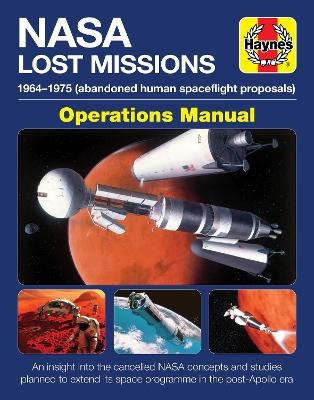
NASA's Lost Missions
1964-1975 (abandoned human spaceflight proposals)
Seiten
2021
J H Haynes & Co Ltd (Verlag)
978-1-78521-211-6 (ISBN)
J H Haynes & Co Ltd (Verlag)
978-1-78521-211-6 (ISBN)
- Titel ist leider vergriffen;
keine Neuauflage - Artikel merken
In the mid-1960s, NASA developed detailed plans to use
left-over Apollo hardware for more ambitions projects such as
space stations, space bases, Moon-orbiting laboratories, and manned missions to Mars by
the mid-1980s. This book tells the technical story of those abandoned projects using previously unpublished archive material.
In the mid-1960s NASA began planning what to do after the goal of President Kennedy had been met and astronauts had landed on the Moon. A comprehensive plan quickly emerged to use left-over Apollo hardware to mount an expanding range of new capabilities – space stations, space bases, Moon-orbiting laboratories and temporary human settlements on the lunar surface.
But NASA wanted more and looked to what it called a “Post-Apollo” era in which new and more exciting possibilities could set in train a series of missions which would have astronauts landing on the surface of Mars by the mid-1980s.
The so-called Post-Apollo Program would support development of nuclear rocket engines for powering big rocket stages (Nuclear Shuttles) plying between Earth orbit and Moon orbit and between Earth orbit and Mars, sending human expeditions deep into the solar system.
By the end of the 1960s, as Americans were about to land on the Moon, studies were refined and a plea went out to industry to design 12-man Earth orbiting space stations, 100-man space bases with artificial weightlessness, shuttlecraft plying between the surface of the Earth and low-Earth orbit, Space Tug vehicles kept in space shuttling satellites between low-Earth orbit (where they had been delivered by shuttlecraft) and geostationary orbit where communications and TV satellites reside to do their work.
Using elements of this vast space transportation network, the first missions to Mars would occur during the first half of the 1980s, building bases on the surface of the Red Planet to set up the first scientific surveys, with vehicles taking scientists and explorers hundreds of kilometres across the dusty plains.
Back came the detailed design plans for these mighty and ambitious projects, supported by the film industry which visited NASA facilities, during which Kubrick and Clarke wrote “2001: A Space Odyssey” using the plans already been put on blueprints in countless design offices of the US aerospace industry. There were even detailed maps of which area to send out expeditions across the surface of the Moon and the surface of Mars.
By the early 1970s all these dreams were gone and the plans so comprehensively laid out had been relegated to the dusty shelves of history. But some projects lingered on. NASA and the Atomic Energy Commission built and tested prototype nuclear rocket motors which would have powered what was called the Nuclear Shuttle (the rocket stages always kept in space and refuelled from tankers brought up in shuttlecraft).
But, eventually, all these plans were to be abandoned and all that was left was to build the Space Shuttle, eventually putting together a modular space station at the end of the century.
All the plans, documentation, images and graphics pushing this Post-Apollo plan are in the possession of the author, and this book proposes to publish all these exciting and ambitious projects supported by colour artwork, detailed engineering drawings and images of hardware on test, including the nuclear rocket motors.
It tells the story of what have been and what was abandoned but what lives on in the memory and in the preserved archives of those involved in its formulation – including the author.
left-over Apollo hardware for more ambitions projects such as
space stations, space bases, Moon-orbiting laboratories, and manned missions to Mars by
the mid-1980s. This book tells the technical story of those abandoned projects using previously unpublished archive material.
In the mid-1960s NASA began planning what to do after the goal of President Kennedy had been met and astronauts had landed on the Moon. A comprehensive plan quickly emerged to use left-over Apollo hardware to mount an expanding range of new capabilities – space stations, space bases, Moon-orbiting laboratories and temporary human settlements on the lunar surface.
But NASA wanted more and looked to what it called a “Post-Apollo” era in which new and more exciting possibilities could set in train a series of missions which would have astronauts landing on the surface of Mars by the mid-1980s.
The so-called Post-Apollo Program would support development of nuclear rocket engines for powering big rocket stages (Nuclear Shuttles) plying between Earth orbit and Moon orbit and between Earth orbit and Mars, sending human expeditions deep into the solar system.
By the end of the 1960s, as Americans were about to land on the Moon, studies were refined and a plea went out to industry to design 12-man Earth orbiting space stations, 100-man space bases with artificial weightlessness, shuttlecraft plying between the surface of the Earth and low-Earth orbit, Space Tug vehicles kept in space shuttling satellites between low-Earth orbit (where they had been delivered by shuttlecraft) and geostationary orbit where communications and TV satellites reside to do their work.
Using elements of this vast space transportation network, the first missions to Mars would occur during the first half of the 1980s, building bases on the surface of the Red Planet to set up the first scientific surveys, with vehicles taking scientists and explorers hundreds of kilometres across the dusty plains.
Back came the detailed design plans for these mighty and ambitious projects, supported by the film industry which visited NASA facilities, during which Kubrick and Clarke wrote “2001: A Space Odyssey” using the plans already been put on blueprints in countless design offices of the US aerospace industry. There were even detailed maps of which area to send out expeditions across the surface of the Moon and the surface of Mars.
By the early 1970s all these dreams were gone and the plans so comprehensively laid out had been relegated to the dusty shelves of history. But some projects lingered on. NASA and the Atomic Energy Commission built and tested prototype nuclear rocket motors which would have powered what was called the Nuclear Shuttle (the rocket stages always kept in space and refuelled from tankers brought up in shuttlecraft).
But, eventually, all these plans were to be abandoned and all that was left was to build the Space Shuttle, eventually putting together a modular space station at the end of the century.
All the plans, documentation, images and graphics pushing this Post-Apollo plan are in the possession of the author, and this book proposes to publish all these exciting and ambitious projects supported by colour artwork, detailed engineering drawings and images of hardware on test, including the nuclear rocket motors.
It tells the story of what have been and what was abandoned but what lives on in the memory and in the preserved archives of those involved in its formulation – including the author.
Dr David Baker worked with NASA on the Gemini, Apollo and Shuttle programmes between 1965 and 1990. He has written more than 100 books on space flight, aviation and military technology, and had more than 1,000 articles published. David is currently the editor of Spaceflight, the monthly space news magazine of the British Interplanetary Society, of which he is also a Fellow.
| Erscheinungsdatum | 02.04.2020 |
|---|---|
| Reihe/Serie | Operations Manual |
| Zusatzinfo | 300 Illustrations |
| Verlagsort | Somerset |
| Sprache | englisch |
| Maße | 210 x 270 mm |
| Themenwelt | Technik ► Luft- / Raumfahrttechnik |
| ISBN-10 | 1-78521-211-7 / 1785212117 |
| ISBN-13 | 978-1-78521-211-6 / 9781785212116 |
| Zustand | Neuware |
| Informationen gemäß Produktsicherheitsverordnung (GPSR) | |
| Haben Sie eine Frage zum Produkt? |
Mehr entdecken
aus dem Bereich


aus dem Bereich
Prozessautomatisierung, Bioverfahrenstechnik, Advanced Process …
Buch | Softcover (2025)
De Gruyter Oldenbourg (Verlag)
CHF 76,90
Grundlagen, Mathematik, Kartenkunde, leistungsbasierte Navigation
Buch | Softcover (2022)
De Gruyter Oldenbourg (Verlag)
CHF 102,10
Learning-Based BI-Level Models and Algorithms
Buch | Softcover (2025)
De Gruyter (Verlag)
CHF 125,90


