Chemistry for Pharmacy Students (eBook)
John Wiley & Sons (Verlag)
978-1-119-39448-8 (ISBN)
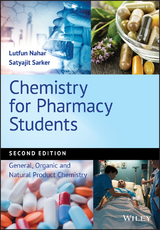
Introduces the key areas of chemistry required for all pharmacy degree courses and focuses on the properties and actions of drug molecules
This new edition provides a clear and comprehensive overview of the various areas of general, organic, and natural products chemistry (in relation to drug molecules). Structured to enhance student understanding, it places great emphasis on the applications of key theoretical aspects of chemistry required by all pharmacy and pharmaceutical science students. This second edition particularly caters for the chemistry requirements in any 'Integrated Pharmacy Curricula', where science in general is meant to be taught 'not in isolation', but together with, and as a part of, other practice and clinical elements of the course.
Chemistry for Pharmacy Students: General, Organic and Natural Product Chemistry, 2nd Edition is divided into eight chapters. It opens with an overview of the general aspects of chemistry and their importance to modern life, with emphasis on medicinal applications. The text then moves on to discuss the concepts of atomic structure and bonding and the fundamentals of stereochemistry and their significance to pharmacy in relation to drug action and toxicity. Various aspects of organic functional groups, organic reactions, heterocyclic chemistry, nucleic acids and their pharmaceutical importance are then covered in subsequent chapters, with the final chapter dealing with drug discovery and development, and natural product chemistry.
- Provides a student-friendly introduction to the main areas of chemistry required by pharmacy degree courses
- Written at a level suitable for non-chemistry students in pharmacy, but also relevant to those in life sciences, food science, and the health sciences
- Includes learning objectives at the beginning of each chapter
- Focuses on the physical properties and actions of drug molecules
Chemistry for Pharmacy Students: General, Organic and Natural Product Chemistry, 2nd Edition is an essential book for pharmacy undergraduate students, and a helpful resource for those studying other subject areas within pharmaceutical sciences, biomedical sciences, cosmetic science, food sciences, and health and life sciences.
Lutfun Nahar, BSc (Hons), PhD, MRSC, FHEA, is an Honorary Lecturer, and actively involved in research at the Faculty of Science at Liverpool John Moores University, UK. She has published well over 350 peer-reviewed scientific papers, invited reviews, abstracts, books, and book chapters in the areas of Synthetic Organic Medicinal and Natural Products Chemistry. She is the Managing Editor of the Wiley journal, Phytochemical Analysis. Her scientific profile has been published in every edition of the Marquis 'Who's Who in the World' since 2009, and 'Who's Who in Science and Engineering' since 2010.
Satyajit Sarker BPharm (Hons), MPharm, PhD, FHEA, is a Professor of Pharmacy, and the Director of School of Pharmacy and Biomolecular Sciences at Liverpool John Moores University, UK. He is the President of the Phytochemical Society of Europe, and the Editor-in-Chief of the Wiley journal, Phytochemical Analysis. He has over 520 publications to his credit. His scientific profile has been published in every edition of the Marquis 'Who's Who in the World' since 2010.
Introduces the key areas of chemistry required for all pharmacy degree courses and focuses on the properties and actions of drug molecules This new edition provides a clear and comprehensive overview of the various areas of general, organic, and natural products chemistry (in relation to drug molecules). Structured to enhance student understanding, it places great emphasis on the applications of key theoretical aspects of chemistry required by all pharmacy and pharmaceutical science students. This second edition particularly caters for the chemistry requirements in any Integrated Pharmacy Curricula , where science in general is meant to be taught not in isolation , but together with, and as a part of, other practice and clinical elements of the course. Chemistry for Pharmacy Students: General, Organic and Natural Product Chemistry, 2nd Edition is divided into eight chapters. It opens with an overview of the general aspects of chemistry and their importance to modern life, with emphasis on medicinal applications. The text then moves on to discuss the concepts of atomic structure and bonding and the fundamentals of stereochemistry and their significance to pharmacy in relation to drug action and toxicity. Various aspects of organic functional groups, organic reactions, heterocyclic chemistry, nucleic acids and their pharmaceutical importance are then covered in subsequent chapters, with the final chapter dealing with drug discovery and development, and natural product chemistry. Provides a student-friendly introduction to the main areas of chemistry required by pharmacy degree courses Written at a level suitable for non-chemistry students in pharmacy, but also relevant to those in life sciences, food science, and the health sciences Includes learning objectives at the beginning of each chapter Focuses on the physical properties and actions of drug molecules Chemistry for Pharmacy Students: General, Organic and Natural Product Chemistry, 2nd Edition is an essential book for pharmacy undergraduate students, and a helpful resource for those studying other subject areas within pharmaceutical sciences, biomedical sciences, cosmetic science, food sciences, and health and life sciences.
Lutfun Nahar, BSc (Hons), PhD, MRSC, FHEA, is an Honorary Lecturer, and actively involved in research at the Faculty of Science at Liverpool John Moores University, UK. She has published well over 350 peer-reviewed scientific papers, invited reviews, abstracts, books, and book chapters in the areas of Synthetic Organic Medicinal and Natural Products Chemistry. She is the Managing Editor of the Wiley journal, Phytochemical Analysis. Her scientific profile has been published in every edition of the Marquis "Who's Who in the World" since 2009, and "Who's Who in Science and Engineering" since 2010. Satyajit Sarker BPharm (Hons), MPharm, PhD, FHEA, is a Professor of Pharmacy, and the Director of School of Pharmacy and Biomolecular Sciences at Liverpool John Moores University, UK. He is the President of the Phytochemical Society of Europe, and the Editor-in-Chief of the Wiley journal, Phytochemical Analysis. He has over 520 publications to his credit. His scientific profile has been published in every edition of the Marquis "Who's Who in the World" since 2010.
Chapter 1
Introduction
Learning Objectives
After completing this chapter, students should be able to
- describe the role of chemistry in modern life;
- define some of the physical properties of drugs, for example, melting point, boiling point, polarity, solubility and acid‐base properties;
- explain the terms pH, pK a, buffer and neutralization.
1.1 ROLE OF CHEMISTRY IN MODERN LIFE
Chemistry is the science of the composition, structure, properties and reactions of matters, especially of atomic and molecular systems.
Life itself is full of chemistry, that is, life is the reflection of a series of continuous biochemical processes. Right from the composition of the cell to the whole organism, the presence of chemistry is conspicuous. Human beings are physically constructed of chemicals, live in a plethora of chemicals and are dependent on chemicals for their quality of modern life. All living organisms are composed of numerous organic substances. Evolution of life begins from one single organic compound called a nucleotide. Nucleotides join together to form the building blocks of life. Our identities, heredities and continuation of generations, all are governed by chemistry.
In our everyday life, whatever we see, use or consume have been the gifts of research in chemistry for thousands of years. In fact, chemistry is applied everywhere in modern life. From the colour of our clothes to the shapes of our PCs, all are possible due to chemistry. It has played a major role in pharmaceutical advances, forensic science and modern agriculture. Diseases and their remedies have also been a part of human lives. Chemistry plays an important role in understanding diseases and their remedies; that is, drugs.
Medicines or drugs that we take for the treatment of various ailments are chemicals, either organic or inorganic molecules. However, most drugs are organic molecules. These molecules are either obtained from natural sources or synthesized in chemistry laboratories. Some important drug molecules are discussed here.
Aspirin, an organic molecule, is chemically known as acetyl salicylic acid and is an analgesic (relieves pain), antipyretic (reduces fever) and anti‐inflammatory (reduces swelling) drug. Studies suggest that aspirin can also reduce the risk of heart attack. It is probably the most popular and widely used analgesic drug because of its structural simplicity and low cost. Salicin is the precursor of aspirin. It is found in the willow tree bark, whose medicinal properties have been known since 1763. Aspirin was developed and synthesized in order to avoid the irritation in the stomach caused by salicylic acid, which is also a powerful analgesic, derived from salicin. In fact, salicin is hydrolysed in the gastrointestinal tract to produce D‐glucose and salicyl alcohol (see Section 8.4). Salicyl alcohol, on absorption, is oxidized to salicylic acid and other salicylates. However, aspirin can easily be synthesized from phenol using the Kolbe reaction (see Section 4.7.10.6).
Paracetamol (acetaminophen), an N‐acylated aromatic amine having an acyl group (R─CO─) substituted on nitrogen, is an important over‐the‐counter headache remedy. It is a mild analgesic and antipyretic medicine. The synthesis of paracetamol involves the reaction of p‐aminophenol and acetic anhydride (see Section 4.7.10.6).
L‐Dopa (L‐3,4‐dihydroxyphenylalanine), an amino acid, is a precursor of the neurotransmitters dopamine, norepinephrine (noradrenaline) and epinephrine (adrenaline), collectively known as catecholamines, and found in humans as well as in some animals and plants. It has long been used as a treatment for Parkinson's disease and other neurological disorders. L‐Dopa was first isolated from the seedlings of Vicia faba (broad bean) by Marcus Guggenheim in 1913, and later it was synthesized in the lab for pharmaceutical uses.
Morphine is a naturally occurring opiate analgesic found in opium and is a strong pain reliever, classified as a narcotic analgesic (habit‐forming) (see Section 8.2.2.5). Opium is the dried latex obtained from the immature poppy (Papaver somniferum) seeds. Morphine is widely used in clinical pain management, especially for pain associated with terminal cancers and post‐surgery pain.
Penicillin V (phenoxymethylpenicillin), an analogue of the naturally occurring penicillin G (see Section 7.3.2), is a semisynthetic narrow‐spectrum antibiotic useful for the treatment of bacterial infections. Penicillin V is quite stable even in high humidity and strong acidic medium (e.g. gastric juice). However, it is not active against beta‐lactamase‐producing bacteria. As we progress through various chapters of this book, we will come across a series of other examples of drug molecules and their properties.
In order to have proper understanding and knowledge about these drugs and their behaviour, there is no other alternative but to learn chemistry. Everywhere, from discovery to development, from production and storage to administration, and from desired actions to adverse effects of drugs, chemistry is directly involved.
In the drug discovery stage, suitable sources of potential drug molecules are explored. Sources of drug molecules can be natural, such as a narcotic analgesic, morphine, from P. somniferum (poppy plant), synthetic, such as a popular analgesic and antipyretic, paracetamol, and semisynthetic, such as penicillin V. Whatever the source is, chemistry is involved in all processes in the discovery phase. For example, if a drug molecule has to be purified from a natural source, for example, plant, the processes like extraction, isolation and identification are used, and all these processes involve chemistry (see Section 8.1.3.1).
Similarly, in the drug development steps, especially in pre‐formulation and formulation studies, the structures and the physical properties (e.g. solubility and pH), of the drug molecules are exploited. Chemistry, particularly physical properties of drugs, is also important to determine storage conditions. Drugs having an ester functionality, for example, aspirin, could be quite unstable in the presence of moisture and should be kept in a dry and cool place. The chemistry of drug molecules dictates the choice of the appropriate route of administration. Efficient delivery of drug molecules to the target sites requires manipulation of various chemical properties and processes; for example, microencapsulation, nanoparticle‐aided delivery and so on. When administered, the action of a drug inside our body depends on its binding to the appropriate receptor and its subsequent metabolic processes, all of which involve complex enzyme‐driven biochemical reactions.
All drugs are chemicals, and pharmacy is a subject that deals with the study of various aspects of drugs. Therefore, it is needless to say that to become a good pharmacist the knowledge of the chemistry of drugs is essential. Before moving on to the other chapters, let us try to understand some of the fundamental chemical concepts in relation to the physical properties of drug molecules (see Section 1.6).
1.2 SOLUTIONS AND CONCENTRATIONS
A solution is a mixture where a solute is uniformly distributed within a solvent. A solute is the substance that is present in smaller quantities and a solvent usually the component that is present in greater quantity. Simply, a solution is a special type of homogenous mixture composed of two or more substances. For example, sugar (solute) is added to water (solvent) to prepare sugar solution. Similarly, saline (solution) is a mixture of sodium chloride (NaCl) (solute) and water (solvent). Solutions are extremely important in life as most chemical reactions, either in laboratories or in living organisms, take place in solutions.
Ideally, solutions are transparent and light can pass through the solutions. If the solute absorbs visible light, the solution will have a colour. We are familiar with liquid solutions, but a solution can also be in any state, such as solid, liquid or gas. For example, air is a solution of oxygen, nitrogen and a variety of other gases all in the gas state; steel is also a solid‐state solution of carbon and iron. Solutes may be crystalline solids, such as sugars and salts that dissolve readily into solutions, or colloids, such as large protein molecules, which do not readily dissolve into solutions (see Section 1.3).
In Chemistry, especially in relation to drug molecules, their dosing, therapeutic efficacy, adverse reactions and toxicity, we often come across with the term concentration, which can simply be defined as the amount of solute per unit of solvent. Concentration is always the ratio of solute to solvent and it can be expressed in many ways. The most common method of expressing the concentration is based on the amount of solute in a fixed amount of solution where the quantities can be expressed in weight (w/w), in volume (v/v) or both (w/v). For example, a solution containing 10 g of NaCl and 90 g of water is a 10% (w/w) aqueous solution of NaCl.
Weight measure (w/w) is often used to express concentration and is commonly known as percent concentration (parts per 100), as shown in the previous example of 10% NaCl aqueous solution. It is the ratio of one part of solute to one hundred parts of...
| Erscheint lt. Verlag | 9.7.2019 |
|---|---|
| Sprache | englisch |
| Themenwelt | Naturwissenschaften ► Chemie ► Technische Chemie |
| Technik | |
| Schlagworte | become a chemist • Biochemie • biochemistry • Biomedical Sciences • biomolecular studies • Biowissenschaften • Chemie • Chemistry • Chemistry for Pharmacy Students</p> • chemistry text • Drug • drug chemistry • drug development • drug discovery • Drug Discovery and Development • General Chemistry • guide to chemistry • guide to organic chemistry • guide to pharmacology • Heterocyclic Chemistry • introduction to chemistry • Life Sciences • <p>pharmacy • medicinal chemistry • Medicine • natural product chemistry • Natural Products • Organic Chemistry • organic functional groups • organic reactions • Organische Chemie • Pharmaceutical & Medicinal Chemistry • Pharmaceutical Chemistry • Pharmaceutical science • Pharmaceutical Sciences • Pharmaceutics • Pharmacological studies • pharmacy studies • Pharmazeutische Chemie • Pharmazeutische u. Medizinische Chemie • physical properties • phytochemistry • stereochemistry |
| ISBN-10 | 1-119-39448-1 / 1119394481 |
| ISBN-13 | 978-1-119-39448-8 / 9781119394488 |
| Informationen gemäß Produktsicherheitsverordnung (GPSR) | |
| Haben Sie eine Frage zum Produkt? |
 EPUB (Adobe DRM)
Kopierschutz: Adobe-DRM
Adobe-DRM ist ein Kopierschutz, der das eBook vor Mißbrauch schützen soll. Dabei wird das eBook bereits beim Download auf Ihre persönliche Adobe-ID autorisiert. Lesen können Sie das eBook dann nur auf den Geräten, welche ebenfalls auf Ihre Adobe-ID registriert sind.
Details zum Adobe-DRM
Dateiformat: EPUB (Electronic Publication)
EPUB ist ein offener Standard für eBooks und eignet sich besonders zur Darstellung von Belletristik und Sachbüchern. Der Fließtext wird dynamisch an die Display- und Schriftgröße angepasst. Auch für mobile Lesegeräte ist EPUB daher gut geeignet.
Systemvoraussetzungen:
PC/Mac: Mit einem PC oder Mac können Sie dieses eBook lesen. Sie benötigen eine
eReader: Dieses eBook kann mit (fast) allen eBook-Readern gelesen werden. Mit dem amazon-Kindle ist es aber nicht kompatibel.
Smartphone/Tablet: Egal ob Apple oder Android, dieses eBook können Sie lesen. Sie benötigen eine
Geräteliste und zusätzliche Hinweise
Buying eBooks from abroad
For tax law reasons we can sell eBooks just within Germany and Switzerland. Regrettably we cannot fulfill eBook-orders from other countries.
aus dem Bereich