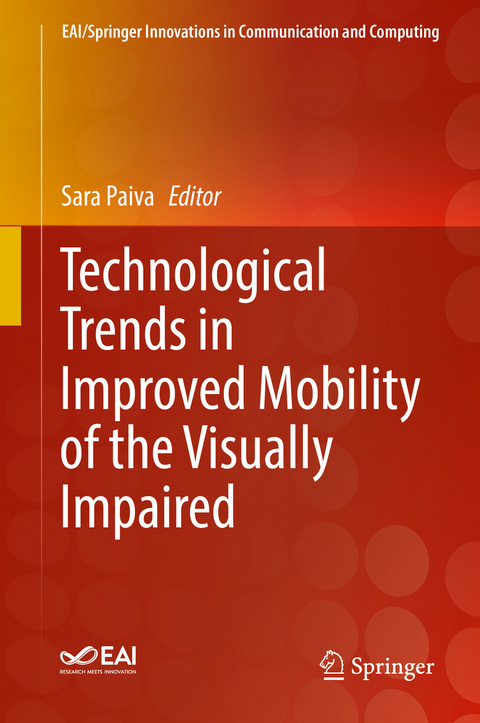
Technological Trends in Improved Mobility of the Visually Impaired (eBook)
424 Seiten
Springer International Publishing (Verlag)
978-3-030-16450-8 (ISBN)
- Features practical, tested applications of technological mobility solutions for visual impaired people;
- Presents topics such as obstacle detection systems, urban mobility, smart home services, and ambient assisted living;
- Includes a number of application examples in education, health, electronics, tourism, and transportation.
Preface 6
Contents 7
Part I Literature Reviews and Surveys 9
1 Smart Cities to Improve Mobility and Quality of Life of the Visually Impaired 10
1.1 Introduction 10
1.2 Related Work 12
1.2.1 Public Areas in Smart Cities for Visually Impaired People 13
1.2.2 Transport Systems in Smart Cities for Visually Impaired People 15
1.2.3 Homes of Visually Impaired People in Smart Cities 17
1.2.4 Mobile Assistive Vision Support Systems for Obstacle Detection and Space Perception 18
Obstacle Detection 18
Space Perception 19
1.3 Crowdsourcing to Help Visually Impaired People in Smart Cities 20
1.4 Internet of Things Applications for Visually Impaired People 22
1.4.1 IoT Architecture 22
Independent Shopping Scenario 24
Smart Learning Scenario 25
Domestic Environment Scenario 26
1.5 Artificial Intelligence (AI), Virtual Reality (VR) and Augmented Reality (AU) Solutions for Visually Impaired People 26
1.6 Conclusion 31
References 32
2 A Survey on Accessible Context-Aware Systems 36
2.1 Introduction 36
2.2 Research Objectives and Methodology 40
2.3 Disabilities and Context-Awareness 42
2.3.1 Blind and Visually Impaired 42
2.3.2 Motor Disabled 46
2.3.3 Cognitive Disabled 49
2.3.4 Hearing Disabled 50
2.4 Discussion 50
2.4.1 Analysis of the State-of-the-Art Solutions 50
2.4.2 Strategies for Making Context-Aware Systems Accessible 55
2.4.3 Interaction Models of Different Types of Disability 58
2.4.4 Existing Reviews on Context-Aware Systems 59
2.4.5 The Proposed Multi-Layer CAS Framework 61
2.5 Conclusions and Future Work 64
References 66
3 Smart Systems to Improve the Mobility of People with Visual Impairment Through IoM and IoMT 71
3.1 Introduction 71
3.2 Visual Impairments – Types and Causes 74
3.2.1 Types of Visual Impairments 74
3.2.2 Cause of Visual Impairments 75
3.2.3 Diagnosis of Visual Impairment Affections 76
3.3 Technologies Used for Visual Impairments 77
3.3.1 Visual Impairment Treatment Methods 77
3.3.2 User Interface 78
3.3.3 Braille Touchscreen Keyboards 78
3.3.4 Google Glass as Assistive Technology 79
3.4 Smart System Integrated to Improve Mobility 80
3.4.1 Useful Technologies 80
3.4.2 Assistive Technologies for Visual Impairment Mobility by IoM and IoMT 81
3.5 Future Challenge in Mobility Improvement for Visual Impairment 86
References 88
4 Comprehensive Literature Reviews on Ground Plane Checking for the Visually Impaired 91
4.1 Introduction 91
4.2 Taxonomy of Assistive Technologies 92
4.3 Ground Plane Hazards 93
4.4 Techniques to Detect Obstacles and Ground Plane Hazards 93
4.4.1 Assistive Device for Obstacle Detection 94
Range Sensors Based Assistive Technologies 94
Vision Sensors Based Assistive Technologies 97
4.4.2 Assistive Device for Staircases and Steps Detection 99
Range Sensors Based Assistive Technologies 99
Vision Sensors Based Assistive Technologies 100
4.4.3 Assistive Device for Potholes Detection 101
Range Sensors Based Assistive Technologies 101
Vision Sensors Based Assistive Technologies 103
4.4.4 Assistive Device for Ramp, Drainage, and Loose Surface Detection 104
4.5 Discussions 104
4.6 Recommendations 106
References 107
5 Technologies and Systems to Improve Mobility of Visually Impaired People: A State of the Art 110
5.1 Introduction 110
5.2 Outdoor Navigation 111
5.3 Indoor Navigation 115
5.4 Obstacle Avoidance 119
5.5 Discussion 123
5.6 Conclusions 126
References 127
Part II Navigation Systems Proposals 129
6 Cloud Video Guidance as “Deus ex Machina” for the Visually Impaired 130
6.1 Introduction 130
6.2 Related Work 132
6.3 Generic System Architecture 133
6.3.1 Overview 133
6.3.2 Resource Sharing and Customization 135
6.4 Application Workflow 136
6.5 Data Capturing 138
6.5.1 Overview of Video Coding in the Proposed System 138
6.5.2 Smart Middleware and Video Codec Optimizations 139
6.6 Cross-Layer System Deployment and Optimizations 142
6.7 Conclusions 143
References 144
7 Virtual Vision Architecture for VIP in Ubiquitous Computing 147
7.1 Introduction 147
7.2 Related Work 148
7.3 Architecture 150
7.3.1 Head Obstacle Detection System and Tail Obstacle Detection System 150
Mobile Kinect (MK) 150
Ultrasonic Sensor (US) 152
Passive Infrared Sensor (PIR) 152
7.3.2 Alert and Notification System 153
Headset 153
Caregivers 154
Linear Resonant Actuators (LRA) 154
7.3.3 Health Monitoring System 154
Body Temperature Measurement 154
Heartbeat Sensor 155
ECG Sensor 155
7.3.4 Speech Recognition Engine 156
Automatic Speech Recognition 156
Natural Language Understanding 157
Natural Language Generation 157
Dialogue Management and Control 157
Text-to-Speech Synthesis 158
7.3.5 Positioning and Location System 158
Camera 159
GPS 159
Gyroscope 159
Accelerometer 159
Magnetometer 159
Finger Print Scanner 160
7.4 Materials and Methods 160
7.4.1 Asymmetric Encryption 160
7.4.2 Selenium Architecture 161
7.4.3 Distance Calculation Methods 162
Method 1 163
Method 2 164
Method 3 164
7.5 Results and Discussion 168
7.5.1 Proposed Method 1 168
Information Management System 168
Web Interaction Workflow 168
Web Interaction Illustration 170
Two-Step Authentications 170
7.5.2 Proposed Method 2 172
Obstacle Detection System 172
7.6 Conclusion 178
7.7 Future Enhancement 178
References 178
8 Intelligent Vision Impaired Indoor Navigation Using Visible Light Communication 182
8.1 Introduction 182
8.2 System Overview 185
8.2.1 System Architecture and Framework 185
8.2.2 Database Optimization 190
8.2.3 Use of a Best Path Algorithm 193
8.2.4 Node Identification and Localization with Direction 195
8.3 Evaluation 198
8.3.1 Test Case 01: Navigation System Testing 198
8.3.2 Test Case 02: Navigation System Testing (Test Map 2) 199
8.3.3 Test Case 03: Wrong Direction Navigation Testing (Test Map 2) 200
8.3.4 Issues in Implementation 206
8.4 Conclusion 206
References 207
9 AmIE: An Ambient Intelligent Environment for Blind and Visually Impaired People 208
9.1 Introduction 208
9.2 Literature Review 209
9.2.1 Indoor Positioning and Navigation 210
9.2.2 Context-Aware and Ambient Intelligent Environments 211
9.2.3 Background 213
9.3 Motivation and Objectives 213
9.4 Amie System Development 214
9.5 Implementation Aspects 220
9.5.1 Project Features 220
9.5.2 Nodes Implementation 221
9.5.3 Distance Measurement and Algorithms 223
9.5.4 Control Unit Communication with Sensor Nodes 226
9.5.5 Control Unit Communication with Mobile Application 227
9.5.6 Mobile Application Development 228
9.6 Analysis and Evaluation 229
9.6.1 System Testing and Results 229
9.6.2 System Effectiveness and Evaluation 231
9.6.3 Closely Related Work 233
9.6.4 Limitations and Future Work 234
9.7 Conclusion 235
References 236
10 Digital Enhancement of Cultural Experience and Accessibility for the Visually Impaired 238
10.1 Introduction 238
10.2 Vision-Based Navigation in Outdoor Cultural Environments 241
10.3 Human Vision Via Computer Vision 242
10.3.1 Artificial Neural Networks for Computer Vision 243
10.3.2 Obstacle Detection 244
Object Detection Methods 245
Obstacle Detection for the Visually Impaired 246
10.3.3 Object and Scene Recognition 248
Generic Recognition Approaches 248
Object or Scene Recognition for the Visually Impaired 250
10.3.4 Visual Distance Estimation 250
Visual Size Estimation 252
10.4 Emotion-Aware Speech User Interface and Decision Making 253
10.4.1 Voice User Interface 253
10.4.2 Emotion Recognition 254
10.4.3 CNN-Based Speech and Emotion Recognition 255
10.4.4 Higher-Level Decision Making 255
10.5 User Requirements 256
10.6 Discussion 263
10.7 Conclusions 265
References 266
Part III Case Studies and Applications 273
11 Toward Sustainable Domestication of Smart IoT Mobility Solutions for the Visually Impaired Persons in Africa 274
11.1 Introduction 274
11.2 Overview of Key Background Concepts 276
11.2.1 Internet of Things (IoT) 276
11.2.2 Internet of Everything (IoE) 278
Prospects, Promises, and Potentials of IoE 279
Landscape of IoT and IoE in Africa 280
11.2.3 Cloud Computing 280
11.2.4 Big Data and Data Mining 280
11.3 Smart IoT Mobility Solutions for the Visually Impaired Persons 281
11.3.1 Specific Applications of IoT as Smart Mobility Solutions 281
11.3.2 Implementation Instances and Application Examples in Africa 281
11.4 Technology Transfer, Domestication, and Sustainability 286
11.4.1 Technical Definitions and Characteristic Features 286
11.4.2 The Need and Significance of Technology Domestication 287
11.4.3 Domestication Factors and Strategic Process 287
11.4.4 Support for a Sustainable Domestication 289
11.5 Sustainable Domestication of Smart IoT Mobility Solutions 290
11.5.1 Sustainable Domestication of Technology in Africa 290
11.5.2 Adoption Challenges and Implementation Barriers 291
11.5.3 Facilitation Factors and Growth Catalysts 293
11.5.4 Technical Recommendations 294
11.6 Conclusion 295
References 296
12 Large-Scale Interactive Environments for Mobility Training and Experience Sharing of Blind Children 300
12.1 Introduction 300
12.1.1 Sensory Integration 300
12.1.2 Chapter Organization 301
12.2 Gaming Activities for Blind Children 302
12.2.1 3D Sound Virtual Environments Games 302
12.2.2 Orientation and Mobility Games with Physical Interaction 303
12.3 “Following the Cuckoo Sound”: An Interactive Physical Environment to Train Children to Avoid Veering 304
12.3.1 Large-Scale Interactive Environments for Therapy and Rehabilitation 304
12.3.2 Application Design 305
12.3.3 Assessment 306
12.3.4 Method 306
12.3.5 Quantitative and Qualitative Results 308
12.3.6 Discussion 308
12.4 Conclusion 312
12.4.1 Lesson Learned from Blind Children While Testing “Following the Cuckoo Sound” 313
12.4.2 Interactive Virtual Soundscapes for Blind Children 314
References 314
13 HapAR: Handy Intelligent Multimodal Haptic and Audio-Based Mobile AR Navigationfor the Visually Impaired 318
13.1 Introduction 318
13.2 Problem Analysis and Literature Review 319
13.3 Methods 324
13.4 Tests and Evaluation 326
13.5 Future Work and Conclusions 332
References 332
14 A Context-Aware Voice Operated Mobile Guidance System for Visually Impaired Persons 334
14.1 Introduction 334
14.2 Context Awareness and Navigation Systems for Visually Impaired Persons 335
14.2.1 Types of Context 335
Intrinsic Context 335
Extrinsic Context 336
14.2.2 Navigation Systems 337
14.3 Technological Analysis 339
14.4 Mobile Vision: A Context-Aware Voice Operated Mobile Guidance System for Visually Impaired Persons 340
14.4.1 Navigation Map Modelling 341
14.4.2 Overall System Architecture 341
14.4.3 Path Determination Algorithm 341
14.4.4 Determination of User Orientation 343
14.4.5 Obstacle Detection Mechanism 343
14.4.6 Power Consumption Management 344
14.4.7 Interaction Mechanisms Used in Mobile Vision 344
Voice Feedback Mechanism 345
Voice Recording Mechanism 345
Shake-to-Respond Mechanism 345
Haptic Feedback Mechanism 345
14.4.8 Context Triggered Actions 346
14.4.9 Mobile Vision System Components 346
Voice Operated Navigation Support 346
Innovative Interaction Mechanisms 347
Real-Time Environmental Information 348
Back End Cloud Service 348
14.5 Evaluation of Mobile Vision System and Future Works 349
14.5.1 Future Works 351
14.6 Conclusion 352
References 352
15 Modelling the Creation of Verbal Indoor Route Descriptions for Visually Impaired Travellers 354
15.1 Introduction 354
15.2 Orientation and Mobility (O& M) Skills
15.3 Related Work 357
15.3.1 Localisation 357
15.3.2 Hybrid Models of Environments 358
15.3.3 Adaptive Routing Algorithms 359
15.3.4 Verbal Route Descriptions (VRDs) 360
15.4 Iterative User-Centred Approach 361
15.4.1 Acquisition and Analysis 362
Linguistic Structure of Verbal Route Descriptions 363
Sequence of Directions 363
Fixed Objects as Landmarks 364
15.4.2 Synthesising a Formal Model 364
Choice of Suitable Route 364
Segmentation of the Route 365
Development of Strategies for Segments 366
15.4.3 Generating Verbal Route Descriptions 367
15.4.4 Evaluation of Verbal Route Descriptions 368
Technical Setup 369
Results 370
15.5 Discussion and Conclusion 371
References 373
16 An Aid System for Autonomous Mobility of Visually Impaired People on the Historical City Walls in Lucca, Italy 377
16.1 Introduction 377
16.2 State of the Art in the Field of Mobility Aids for Visually Impaired People 378
16.2.1 GPS-Based Geo-Localization and Guidance 378
16.2.2 Obstacle Detection 380
16.2.3 Enhancement of the User's Visibility 385
16.2.4 Obstacle Detection and Environment Recognition by Means of Vision Systems 386
16.2.5 User Localization via Signal Reception and Processing 387
16.2.6 RFID-Based Guidance Systems 388
16.2.7 Guidance Systems Based on Guide Tiles 389
16.2.8 White Cane 389
16.2.9 Dog Guides 390
16.3 The Proposed System 390
16.3.1 The Virtual Path 392
16.3.2 The Smart Cane 396
16.3.3 The Mobile Device and the Android Application 399
16.3.4 The Software for the Service Management 404
16.4 Installation of the System on the Historical Walls of Lucca City 404
16.5 Conclusion 407
References 408
Index 410
| Erscheint lt. Verlag | 1.7.2019 |
|---|---|
| Reihe/Serie | EAI/Springer Innovations in Communication and Computing | EAI/Springer Innovations in Communication and Computing |
| Zusatzinfo | VIII, 424 p. 193 illus., 148 illus. in color. |
| Sprache | englisch |
| Themenwelt | Medizin / Pharmazie |
| Technik ► Elektrotechnik / Energietechnik | |
| Technik ► Nachrichtentechnik | |
| Schlagworte | Aid systems for visually impaired people • Ambient assisted living for visually impaired people • Indoor navigation for visually impaired people • Obstacle detection systems for visually impaired people • Outdoor navigation for visually impaired people • Transport sustainability for visually impaired people • Urban mobility for visually impaired people • visually impaired people |
| ISBN-10 | 3-030-16450-0 / 3030164500 |
| ISBN-13 | 978-3-030-16450-8 / 9783030164508 |
| Informationen gemäß Produktsicherheitsverordnung (GPSR) | |
| Haben Sie eine Frage zum Produkt? |
 PDF (Wasserzeichen)
DRM: Digitales Wasserzeichen
Dieses eBook enthält ein digitales Wasserzeichen und ist damit für Sie personalisiert. Bei einer missbräuchlichen Weitergabe des eBooks an Dritte ist eine Rückverfolgung an die Quelle möglich.
Dateiformat: PDF (Portable Document Format)
Mit einem festen Seitenlayout eignet sich die PDF besonders für Fachbücher mit Spalten, Tabellen und Abbildungen. Eine PDF kann auf fast allen Geräten angezeigt werden, ist aber für kleine Displays (Smartphone, eReader) nur eingeschränkt geeignet.
Systemvoraussetzungen:
PC/Mac: Mit einem PC oder Mac können Sie dieses eBook lesen. Sie benötigen dafür einen PDF-Viewer - z.B. den Adobe Reader oder Adobe Digital Editions.
eReader: Dieses eBook kann mit (fast) allen eBook-Readern gelesen werden. Mit dem amazon-Kindle ist es aber nicht kompatibel.
Smartphone/Tablet: Egal ob Apple oder Android, dieses eBook können Sie lesen. Sie benötigen dafür einen PDF-Viewer - z.B. die kostenlose Adobe Digital Editions-App.
Buying eBooks from abroad
For tax law reasons we can sell eBooks just within Germany and Switzerland. Regrettably we cannot fulfill eBook-orders from other countries.
aus dem Bereich