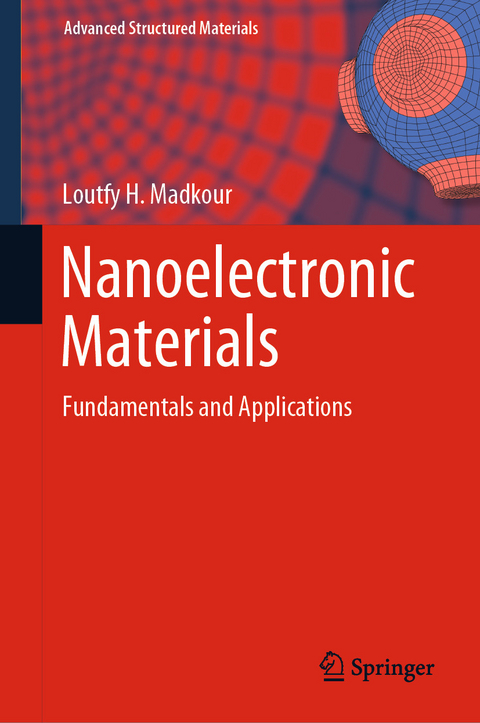
Nanoelectronic Materials (eBook)
XLV, 783 Seiten
Springer International Publishing (Verlag)
978-3-030-21621-4 (ISBN)

This book presents synthesis techniques for the preparation of low-dimensional nanomaterials including 0D (quantum dots), 1D (nanowires, nanotubes) and 2D (thin films, few layers), as well as their potential applications in nanoelectronic systems. It focuses on the size effects involved in the transition from bulk materials to nanomaterials; the electronic properties of nanoscale devices; and different classes of nanomaterials from microelectronics to nanoelectronics, to molecular electronics. Furthermore, it demonstrates the structural stability, physical, chemical, magnetic, optical, electrical, thermal, electronic and mechanical properties of the nanomaterials. Subsequent chapters address their characterization, fabrication techniques from lab-scale to mass production, and functionality.
In turn, the book considers the environmental impact of nanotechnology and novel applications in the mechanical industries, energy harvesting, clean energy, manufacturing materials, electronics, transistors, health and medical therapy. In closing, it addresses the combination of biological systems with nanoelectronics and highlights examples of nanoelectronic-cell interfaces and other advanced medical applications.
The book answers the following questions:
• What is different at the nanoscale?
• What is new about nanoscience?
• What are nanomaterials (NMs)?• What are the fundamental issues in nanomaterials?
• Where are nanomaterials found?
• What nanomaterials exist in nature?• What is the importance of NMs in our lives?
• Why so much interest in nanomaterials?
• What is at nanoscale in nanomaterials?• What is graphene?
• Are pure low-dimensional systems interesting and worth pursuing?
• Are nanotechnology products currently available?• What are sensors?
• How can Artificial Intelligence (AI) and nanotechnology work together?
• What are the recent advances in nanoelectronic materials?• What are the latest applications of NMs?
Dr. LOUTFY H. MADKOUR has been a Professor of Physical Chemistry and Nano Science at the Department of Chemistry, Faculty of Science, Al Baha University, Saudi Arabia, since 2012. He received his B.Sc., M.Sc. and Ph.D. in Physical Chemistry from Cairo University, Minia University and Tanta University (Egypt), respectively. He began working as a Lecturer in Chemistry at Tanta University in 1982 and as a Professor of Physical Chemistry in 1999. He has conducted a series of studies in the fields of electrochemistry, corrosion science, density functional theory, molecular dynamic simulation, nanoscience, nanotechnology, nanomedicine, analytical chemistry, polarography, electrolytic extraction of heavy metals from natural ores and deposits, electrochemical thermodynamics and environmental chemistry. His previous research accomplishments include the biosynthesis of metallic nanoparticles (MNPs) and toxicology studies for pharmacological applications in medicine and therapy. He has published 150 peer-reviewed original research articles, 11 review articles, and 4 books on physical chemistry, practical and applied chemistry, corrosion science, nanoscience and nanomedicine.
Prof. Madkour is an Editorial Board member for several international journals, e.g. the International Journal of Industrial Chemistry (IJIC); International Journal of Ground Sediment & Water; Global Drugs and Therapeutics (GDT); Journal of Targeted Drug Delivery; Journal of Clinical and Medical Research; and International Journal of Environmental Chemistry. In addition to serving as a Reviewer for many international ELSEVIER and SPRINGER journals, he is a member of many prestigious international societies, including the American Association for the Advancement of Science (AAAS), European Desalination Society (EDS), Egyptian Chemical Society (ECS), Egyptian Corrosion Bulletin Society and American Chemical Society (ACS).
Preface 6
About This Book 9
Summary 11
A Look Ahead 13
Contents 17
Contents 27
Editorial Board Member by Author 29
Recent Published Research Articles by Author 31
Recent Published Books by Author 35
Abbreviations 38
1 Introduction to Nanotechnology (NT) and Nanomaterials (NMs) 45
Abstract 45
1.1 Nanotechnology Debate 46
1.2 Nanomaterials (NMs) 62
1.2.1 What Are the Fundamental Issues in Nanomaterials? 62
1.2.2 Nano Scale and Nanostructures 65
1.2.3 Nanostructured Materials 68
1.3 The Nanoworld 70
1.4 Atoms, Clusters and Nanograins 74
1.5 What Is Different at the Nanoscale? 77
1.6 History of Nanomaterials 83
References 88
2 Principles of Computational Simulations Devices and Characterization of Nanoelectronic Materials 92
2.1 Charged Particle Single Nanometre Manufacturing 93
2.2 Exotic Effects and Potential 95
2.3 Preliminary Concepts: Elements from Solid State Physics 96
2.4 Computing Electronic Transport 96
2.4.1 Electronic Structure Calculations 96
2.4.2 Density-Functional Theory 97
2.4.3 Another Three Alternate Approaches Are 98
2.5 Basics of DFT and Methodology 105
2.6 Characterization of Nanomaterials 108
2.6.1 Morphological Characterizations 109
2.6.2 Structural Characterizations 110
2.6.3 Particle Size and Surface Area Characterization 113
2.6.4 Optical Characterizations 113
2.7 Characterization Techniques 115
2.7.1 Microscopy Techniques for 2D Materials 115
2.7.1.1 Atomic Force Microscopy 115
2.7.1.2 Ultrasonic Force Microscopy 116
2.7.1.3 Electron Microscopy Techniques 117
2.7.2 Raman Spectroscopy 119
2.7.3 Photoluminescence (PL) Spectroscopy 121
2.7.4 X-Ray Diffraction 122
2.7.5 Characterization Possibilities 124
References 124
3 Where Are Nanomaterials (Nms) Found? 133
3.1 Nanoparticles Are All Around Us 133
3.2 What Nanomaterials Exist in Nature? 140
3.3 Environmental Nanoparticles and Colloids 140
3.4 Humic Substances 140
3.5 Volcanic Ashes 140
3.6 Desert Sources of Nanoparticles 141
3.7 Biological Nanoparticles 142
References 142
4 Benefits of Nanomaterials and Nanowire Geometry 143
4.1 The Nanobulk Stage (10–15 Years) 143
4.2 Advances of Nanomaterials (NMs) 144
4.3 The Nanoworld Stage (15–40 Years) 144
4.4 NMs Enhanced Surface Plasmon Resonance for Biological and Chemical Sensing Applications 145
4.5 Benefits of the Nanowire Geometry 150
4.5.1 Absorption 150
4.5.2 Exciton Formation 153
4.5.3 Charge Separation 154
4.5.4 Carrier Collection 154
4.5.5 Cost 158
4.6 Disadvantages of Nanomaterials (NMs) 158
References 161
5 Why So Much Interest in Nanomaterials (NMs)? 164
5.1 Recent Advances of Nanostructured Materials 165
5.2 New Properties Can Be Created 165
5.3 Some Present and Future Applications of Nanomaterials 166
5.3.1 Applications of Nanowires 167
5.4 Engineered Nanoparticles Change Shape in Soil and Groundwater 168
5.5 Applications of Field-Effect Transistors (FET) 173
5.6 Fabrication of 1-D Nanostructures 173
5.6.1 Carbon Nanotubes (CNTs) 174
5.6.2 Silicon Nanowires (SiNWs) 174
5.6.3 SiONWs Are Interest in SNOM and Integrated Optics 175
5.6.4 Conducting Polymer Nanowires (CP NWs) 177
References 180
6 Examples of Nanomaterials with Various Morphologies 182
6.1 Carbon Nanotubes (CNTs) 183
6.2 Nanoparticles 184
6.2.1 Classification of NPs 185
6.2.1.1 Carbon-Based NPs 185
6.2.1.2 Metallic Nano Particles 186
6.2.1.3 Ceramics NPs 189
6.2.1.4 Semiconductor NPs 189
6.2.1.5 Polymeric NPs 189
6.2.1.6 Lipid-Based NPs 189
6.3 Other Application Examples of Nanoparticles are 190
6.4 Quantum Dots 190
6.5 Nanoshell 193
6.6 Metal Rubber 194
6.7 Nanopores 195
6.8 Nanoparticles with Different Morphologies 196
6.8.1 Example of a Phase Contrast 202
6.8.2 Summary of Different Shapes for Various Metal Nanocrystals 203
References 204
7 Carbon Nanomaterials and Two-Dimensional Transition Metal Dichalcogenides (2D TMDCs) 206
7.1 Classification of 2D Materials 209
7.1.1 Layered van der Waals Solids 209
7.1.2 Layered Ionic Solids 210
7.1.3 Surface Assisted Nonlayered Solids 210
7.2 2D Materials, Their Properties, and Applications 210
7.3 Crystal Structure of 2D Materials 217
7.4 Electronic, Optical, and Mechanical Properties of 2D Materials 219
7.5 2D van der Waals Heterostructures 222
7.6 Fabrication of 2D Heterostructures 226
7.6.1 Heterostructures by Manual Stacking 226
7.6.2 Direct Synthesis of 2D Heterostructures 228
7.7 2D Heterostructures and Their Applications 230
7.7.1 Biosensor 232
7.7.2 Solar Cells (Photovoltaic) 234
7.7.3 Field Effect Transistors (FET) 236
7.7.4 Photodetector 238
7.7.5 Thermoelectric Devices 240
7.8 Fullerenes Molecules 241
7.9 Diamond Molecules 244
7.10 Carbon Nanotubes (Carbon-Based NPs) 245
7.11 Graphene Background 252
7.12 Potential Applications of Graphene 258
7.12.1 Solar Cells/Photovoltaics 261
7.12.2 Semiconductors 262
7.12.3 Water Filtration 263
7.12.4 Superconductivity 264
7.12.5 The Latest Developments Graphene Supercapacitors 264
7.13 Applications of Carbon Nanotubes (CNTs) 266
7.13.1 Carbon Nanotubes and Electronics 268
7.13.2 Carbon Nanotubes and Energy 268
7.13.3 Carbon Nanotubes in Healthcare 268
7.13.4 Carbon Nanotubes and the Environment 269
7.14 The Future of Graphene Research 269
References 275
8 Nanoelectronics and Role of Surfaces Interfaces 287
8.1 The Development of Microelectronics 287
8.2 The Region of Nanostructures 288
8.3 Crystal Structure and Dense Planes 289
8.4 The Surface Energy ? 291
8.5 Transistor Scaling 293
8.5.1 Single-Electron Transistor (SET) 296
8.6 Molecular Electronics 300
8.7 Multi Walled Carbon Nanotubes (CNTs) 300
References 306
9 Classification of Nanostructured Materials 308
9.1 Glitter’s Classification of Nanostructured Materials (NSM) 312
9.2 Classification of Nanomaterials by Dimensionality 316
9.3 Some Classifications Definitions 320
9.3.1 Nanostructures (NSs) 320
9.3.2 Nanostructured Materials (NSMs) 320
9.3.3 Nanocomposites (NCMs) 320
9.4 Elementary Building Units (Nanostructures) 321
9.5 Quantum Confinement from 3D to 0D 321
9.5.1 Physical and Chemical Nature of Nanoparticles 327
9.6 Matrix-Reinforced and Layered Nanocomposites 330
9.6.1 Microcrystal Matrix (Micro-Nano Type) 331
9.6.2 Nanocrystal Matrix (Nanocomposites) 331
9.7 Nanowires (NWs) 331
9.7.1 Unique Applications of Nanowires 335
9.7.2 Different Types of Nanowires 336
9.7.3 Basic Growth Mechanism 336
9.7.4 Why Study Nanowires? 339
9.7.5 Types of Nanowires (NWs) 345
References 345
10 Processing of Nanomaterials (NMs) 347
10.1 Top-Down Approaches 352
10.1.1 Ball Milling: Mechanical Crushing of Solids into Nanocrystallites 354
10.1.2 Photolithography 355
10.1.3 Gas Phase Processes 357
10.2 Bottom-Up Approach 357
10.2.1 Gas Phase Processes 359
10.2.2 Liquid Phase Processes: Sol-Gel Process 362
10.2.3 Liquid Phase Processes: Synthesis of Metal Nanoparticles 365
10.2.4 Material Synthesis 373
10.3 Two Approaches with the Same Goal 377
10.4 Methods for Creating Nanostructures 378
10.4.1 Mechanical Grinding 378
10.4.2 Wet Chemical Synthesis of Nanomaterials 380
10.4.2.1 Sol-Gel Process 380
10.4.3 Gas Phase Synthesis of Nanomaterials 382
10.4.3.1 Furnace 383
10.4.3.2 Flame Assisted Ultrasonic Spray Pyrolysis 384
10.4.3.3 Gas Condensation Processing (GCP) 385
10.4.3.4 Chemical Vapour Condensation (CVC) 387
10.4.4 Sputtered Plasma Processing 389
10.4.4.1 Microwave Plasma Processing 389
10.4.5 Particle Precipitation Aided 390
10.4.6 Laser Ablation 390
References 391
11 Techniques for Elaboration of Nanomaterials 392
11.1 Vapor-Phase Synthesis 394
11.1.1 Gas-Vapor Deposition 396
11.1.2 Plasma-Based Synthesis 396
11.1.3 Molecular Beam Epitaxy 398
11.1.4 Inert Gas Condensation 399
11.1.5 Flame Pyrolysis 400
11.2 Liquid Phase Synthesis 401
11.2.1 Colloidal Methods 401
11.2.2 Solution Precipitation 402
11.2.3 Electrodeposition 402
11.3 Sol–Gel Technique 404
11.3.1 Sol–Gel Process 406
11.3.2 Sol–Gel Coating Processes 408
11.3.3 Reverse Micelles as Nanoreactors 411
11.3.4 Sol–Gel Applications 412
11.4 Solid-State Phase Synthesis 412
11.4.1 Mechanical Milling, Attrition and Alloying 413
11.4.2 Severe Plastic Deformation 416
11.5 Other Methods 419
11.6 Consolidation of Nanopowders 420
11.6.1 Sintering of Nanoparticles 421
11.6.2 Non-conventional Processing 424
11.6.2.1 Microwave Sintering 424
11.6.2.2 Field-Assisted Sintering (FAS) 425
11.6.2.3 Shockwave Consolidation 427
References 428
12 Synthesis Methods For 2D Nanostructured Materials, Nanoparticles (NPs), Nanotubes (NTs) and Nanowires (NWs) 429
12.1 Synthesis Methods for 2D Materials 429
12.1.1 Micromechanical Exfoliation Using Scotch Tape 430
12.1.2 Liquid Exfoliation 430
12.1.3 Chemical Vapor Deposition (CVD) 433
12.1.4 Van der Waal Epitaxial Growth on Substrate 434
12.1.5 Hydrothermal Synthesis 437
12.2 Synthesis Methods of Nanoparticles NPs 439
12.2.1 Top-Down Syntheses 440
12.2.2 Bottom-Up Syntheses 441
12.3 Synthesis Methods of Nanotubes (NTs) 445
12.3.1 Arc Discharge 445
12.3.2 Laser Ablation for Production of SWNTs 446
12.3.3 Chemical Vapour Deposition (CVD) 446
12.3.4 Flame Synthesis 447
12.4 Synthesis Methods of Nanowires NWs 449
12.4.1 Lithography (Top-Down) 451
12.4.2 Spontaneous Growth 453
12.4.2.1 Evaporation (Dissolution) Condensation 455
12.4.2.2 Vapor (or Solid)-Liquid-Solid Growth (VLS or SLS) 457
12.4.2.3 Stress Induced Re-Crystallization 471
12.4.3 Template-Based Synthesis 472
12.4.3.1 Electrochemical Deposition 478
12.4.3.2 Electrophoretic Deposition (Electrophoresis) 484
12.4.4 Electro-spinning 486
References 487
13 Chemistry and Physics for Nanostructures Semiconductivity 493
13.1 Conductivity of Nanowires NWs 495
13.2 Welding Nanowires 497
13.3 Silicon-Germanium Nanowires SiGe NWs 498
13.4 Growth Techniques, Morphology, and Structural Properties of SiGe NWs 500
13.4.1 Alloyed Nanowires 500
13.4.2 Axial Heterostructures 502
13.4.3 Radial Heterostructures 503
13.5 Chemical and Physical Properties of Nanowires 504
13.5.1 Electronic Properties 504
13.5.1.1 Modulation of the Electronic Properties by Composition Control 504
13.5.1.2 Interfaces at Work: Strain, Band-Offset, and Carrier Gases 505
13.5.1.3 Doped Nanowires 505
13.5.2 Thermal and Thermoelectric Properties 506
13.6 Theoretical Modeling 507
13.6.1 Electronic Structure 507
13.6.1.1 Quantum Confinement Effect and Band Offset 507
13.6.1.2 Size Effects 507
13.6.1.3 Alloying and Interface Effects 507
13.6.1.4 Strain Effects 508
13.6.1.5 Addition of Impurities 508
13.6.1.6 Electronic Transport 509
13.6.1.7 Optical Properties 509
13.6.2 Phonons and Thermal Conductivity 509
13.6.2.1 Breakdown of Fourier’s Law at Nanoscale 509
13.6.2.2 Numerical Simulations of Thermal Properties 509
References 511
14 Properties of Nanostructured Materials (NSMs) and Physicochemical Properties of (NPs) 515
14.1 Properties of Nanoscale Matter 516
14.2 Nanoscale Materials Show Quantum Confinement Effects 516
14.2.1 Nanoscale Luminescent Materials Are Mostly Less Efficient Than Microscale Materials 518
14.2.2 CdSe Nanocrystals 519
14.3 The Physical Properties of Nanoclusters 523
14.3.1 The Morphology 523
14.3.2 The Lattice Parameter 527
14.3.3 The Phase Changes 529
14.4 The Electronic Properties 536
14.5 The Magnetic Properties and Classifications of Magnetic Nanomaterials 546
14.6 The Optical Properties 554
14.7 The Electrical Properties 562
14.8 The Mechanical Properties of Nanomaterials 567
14.8.1 Elasticity, Plasticity, Dislocations, Hardening, Twinning, Toughness … 569
14.8.2 The Role of Grain Boundaries 578
14.8.3 Hardness, Ductility, Toughness of Nanomaterials 579
14.9 Thermal Properties of NSMs 593
14.10 Chemical Properties of NSMs 595
14.11 Physicochemical Properties of NPs 596
14.11.1 Electronic and Optical Properties 596
14.11.2 Magnetic Properties 597
14.11.3 Mechanical Properties 597
14.11.4 Thermal Properties 599
References 599
15 Applications of Nanomaterials and Nanoparticles 601
15.1 Applications of NMs in Mechanical Industries 601
15.1.1 Functional Coatings and Layers 604
15.1.2 MR Contrast Enhancement and Hyperthermia 610
15.2 Applications of NMs in Health and Medical Therapy 611
15.3 Applications in Manufacturing and Materials 619
15.4 Applications in the Environment 619
15.5 Applications in the Electronics 622
15.6 Applications in Energy Harvesting 623
15.7 Current and Future Trends 625
15.8 Examples of Nanomaterials’ Applications 625
15.8.1 Fuel Cells 625
15.8.2 Catalysis 627
15.8.3 Phosphors for High-Definition TV 628
15.8.4 Next-Generation Computer Chips 629
15.8.5 Elimination of Pollutants 629
15.8.6 Sun-Screen Lotion 630
15.8.7 Sensors 630
15.8.8 Tools 631
15.8.9 Nanomedicine 631
15.8.10 Paint, Ink 632
15.8.11 Nanoinclusions 633
15.8.12 Deodorant/Antiperspirant (Shaving/Depilatory Products) 634
References 635
16 Environmental Impact of Nanotechnology and Novel Applications of Nano Materials and Nano Devices 640
16.1 From Microelectronics to Nanoelectronics and Molecular Electronics 642
16.2 Nano in Energy and Clean Energy 645
16.3 The Environmental Impact of Nanotechnology 652
16.3.1 Positive Impacts 653
16.3.2 Negative Impacts 654
16.3.3 Green Technology 654
16.4 AI and Nanotechnology How Do They Work Together? 654
16.4.1 Microscopy 655
16.4.2 Chemical Modelling 656
16.4.3 Nanocomputing 656
16.5 Novel Nanotubes and Encapsulated Nanowires 657
16.5.1 Carbon Nanotube Sensors—Applications and Advantages 658
16.5.2 Carbon Nanotube Optics and Their Uses 661
16.5.3 Graphene as a Renewable Energy [134] 663
16.6 Novel Applications of Nanowires and Nanotubes 665
16.6.1 Novel Photodetectors 666
16.6.2 White Light-Emitting Diodes 667
16.6.3 Nanowire Applications in Electronics 668
16.6.4 Devices and Applications of SiGe Nanostructures 669
16.6.5 High-Performance Nanoelectronic Components 670
16.6.6 Si1?XGex Alloy Nanowire Transistor 670
16.6.7 Si-Shell Ge-Core Nanowire Transistor 670
16.6.8 From Quantum Transport to Superconductivity: SiGe Nanowires as Platforms for Fundamental Physics Studies 670
16.7 Nanowire-Based Transistors (Nanotube Field-Effect Transistor) 671
16.7.1 Nanowire Based Field Effect Transistors 672
16.7.2 Sensing of Proteins and Chemicals Using Semiconductor Nanowires 673
16.7.3 Limitations of Sensing with Silicon Nanowire FET Devices 674
16.7.4 Field Emitting Transistor (FET) Based on C-NTs 674
16.7.5 Logical Circuits 677
16.7.6 Voltage Inverter 677
16.7.7 Chips with Logical Elements 677
16.8 Sensing Devices 680
16.9 Racetrack Memory 681
16.10 Nanowire-Based Metamaterials 686
16.11 Indicators and Flat Displays 688
16.11.1 Thermometer 690
16.12 Nanowire Photovoltaics 690
16.12.1 Silicon Nanowire Based Solar Cells and Anodes for Li-Ion Batteries 692
16.12.2 Dye-Sensitized Solar Cells 693
16.13 Nanowires and Nano-Composite as Corrosion Inhibitors 695
16.13.1 Corrosion Resistant of ZnO Nanowires Coatings 697
16.13.2 Corrosion Resistance of Nanoparticle—Incorporated Nano Coatings 700
16.13.3 Novel Advantage of Nano-Coatings [172] 701
16.13.4 Nanoparticle—Based Coatings for Magnesium Alloys with Thermal and Mechanical Stability 701
16.13.5 Corrosion Resistant Zeolite Coatings 702
16.13.6 Epoxy Coatings-Influence of Nanoparticles on the Anti-corrosion and Mechanical Properties of Epoxy Coatings 706
16.13.7 Nano Particle Incorporated Self-cleaning Paints and Biocidal Coatings 707
16.13.8 Nanoparticle Based Antimicrobial Corrosion Coatings 708
16.14 Superconducting Nanowire Single-Photon Detectors (SNSPDs) 710
16.14.1 Origins of Device Concept 711
16.14.2 SNSPD Device Physics 713
16.14.3 Evolution of SNSPD Devices 715
16.14.4 Noise Mechanisms in SNSPDs: Dark Counts and Timing Jitter 715
16.14.5 Cooling, Optical Coupling and Device Readout 718
16.15 Superconducting Nanowire Photodetector Arrays 720
16.15.1 Theory of Operation 721
16.15.2 Example Applications of the SNPD Array Include 722
References 723
17 Interfacing Biology Systems with Nanoelectronics for Nanodevices 735
17.1 Nanoelectronic-Biological Interfaces Enable 735
17.2 Molecular Biomimetic: Nanotechnology Through Biology 738
17.3 Fundamentals of NanoFET in Biology and Medicine 743
17.3.1 Chemical Synthesis of NanoFETs 744
17.4 Multiplexed Extracellular Electrical Recording 746
17.4.1 Electrical Interfacing with Cultured Neurons 747
17.4.2 Recording from Cardiomyocyte Monolayers 748
17.4.3 Recording from Tissues and Organs 748
17.4.4 Challenges and Promises 749
17.5 Intracellular Electrical Recording 749
17.5.1 Designs and Implementation of Intracellular NanoFET Probes 752
17.5.2 Challenges and Promises 753
17.6 Nanoelectronics Innervated Synthetic Tissues 754
17.6.1 A New Concept of Merging Electronics with Cellular Systems 756
17.6.2 Designs and Preparation of Synthetic Tissues 756
17.6.3 Challenges and Promises 758
17.7 Application Areas of Biosensors and -Assays 758
17.8 Selection of Inorganic-Binding Proteins Through Display Technologies 763
17.8.1 Overview on Nanowire Fabrication 766
17.8.2 Bio-nanowire Device Interface 767
17.8.3 Nanowire Nanosensors: Beginning 768
17.8.4 Multiplexed Cancer Marker Detection 769
17.8.5 Undiluted Blood Serum Analysis 771
17.8.6 Nanoelectronic-Cell Interfaces 771
17.9 Nanowire Piezoelectric Nanogenerators on Plastic Substrates as Flexible Power Sources for Nanodevices 772
17.10 Future Vision for Life Sciences 780
References 784
Future Perspectives 794
Conclusions 797
Bibliography 800
Further Readings 813
| Erscheint lt. Verlag | 27.6.2019 |
|---|---|
| Reihe/Serie | Advanced Structured Materials | Advanced Structured Materials |
| Zusatzinfo | XLV, 783 p. 669 illus., 543 illus. in color. |
| Sprache | englisch |
| Themenwelt | Technik ► Maschinenbau |
| Schlagworte | Materials Science • nanobiotechnology • nanochemistry • Nanocrystals • Nanoelectronic Materials • nanomaterials • nanomedicine • Nanoscience • nanotechnology • Quantum dots |
| ISBN-10 | 3-030-21621-7 / 3030216217 |
| ISBN-13 | 978-3-030-21621-4 / 9783030216214 |
| Informationen gemäß Produktsicherheitsverordnung (GPSR) | |
| Haben Sie eine Frage zum Produkt? |
 PDF (Wasserzeichen)
DRM: Digitales Wasserzeichen
Dieses eBook enthält ein digitales Wasserzeichen und ist damit für Sie personalisiert. Bei einer missbräuchlichen Weitergabe des eBooks an Dritte ist eine Rückverfolgung an die Quelle möglich.
Dateiformat: PDF (Portable Document Format)
Mit einem festen Seitenlayout eignet sich die PDF besonders für Fachbücher mit Spalten, Tabellen und Abbildungen. Eine PDF kann auf fast allen Geräten angezeigt werden, ist aber für kleine Displays (Smartphone, eReader) nur eingeschränkt geeignet.
Systemvoraussetzungen:
PC/Mac: Mit einem PC oder Mac können Sie dieses eBook lesen. Sie benötigen dafür einen PDF-Viewer - z.B. den Adobe Reader oder Adobe Digital Editions.
eReader: Dieses eBook kann mit (fast) allen eBook-Readern gelesen werden. Mit dem amazon-Kindle ist es aber nicht kompatibel.
Smartphone/Tablet: Egal ob Apple oder Android, dieses eBook können Sie lesen. Sie benötigen dafür einen PDF-Viewer - z.B. die kostenlose Adobe Digital Editions-App.
Buying eBooks from abroad
For tax law reasons we can sell eBooks just within Germany and Switzerland. Regrettably we cannot fulfill eBook-orders from other countries.
aus dem Bereich