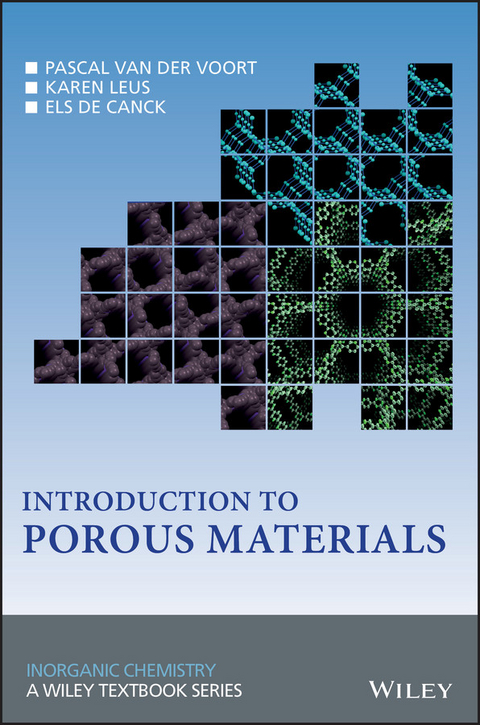
Introduction to Porous Materials (eBook)
John Wiley & Sons (Verlag)
978-1-119-42670-7 (ISBN)
The first comprehensive textbook on the timely and rapidly developing topic of inorganic porous materials
This is the first textbook to completely cover a broad range of inorganic porous materials. It introduces the reader to the development of functional porous inorganic materials, from the synthetic zeolites in the 50's, to today's hybrid materials such as metal-organic frameworks (MOFs), covalent organic frameworks (COFs) and related networks. It also provides the necessary background to understand how porous materials are organized, characterized, and applied in adsorption, catalysis, and many other domains. Additionally, the book explains characterization and application from the materials scientist viewpoint, giving the reader a practical approach on the characterization and application of the respective materials.
Introduction to Inorganic Porous Materials begins by describing the basic concepts of porosity and the different types of pores, surfaces, and amorphous versus crystalline materials, before introducing readers to nature's porous materials. It then goes on to cover everything from adsorption and catalysis to amorphous materials such as silica to inorganic carbons and Periodic Mesoporous Organosilicas (PMOs). It discusses the synthesis and applications of MOFs and the broad family of COFs. It concludes with a look at future prospects and emerging trends in the field.
- The only complete book of its kind to cover the wide variety of inorganic and hybrid porous materials
- A comprehensive reference and outstanding tool for any course on inorganic porous materials, heterogeneous catalysis, and adsorption
- Gives students and investigators the opportunity to learn about porous materials, how to characterize them, and understand how they can be applied in different fields
Introduction to Inorganic Porous Materials is an excellent book for students and professionals of inorganic chemistry and materials science with an interest in porous materials, functional inorganic materials, heterogeneous catalysis and adsorption, and solid state characterization techniques.
PASCAL VAN DER VOORT Center for Ordered Materials, Organometallics & Catalysis, Department of Chemistry, Ghent University, Belgium
KAREN LEUS Center for Ordered Materials, Organometallics & Catalysis, Department of Chemistry, Ghent University, Belgium
ELS DE CANCK Recticel NV Insulation, Belgium
PASCAL VAN DER VOORT Center for Ordered Materials, Organometallics & Catalysis, Department of Chemistry, Ghent University, Belgium KAREN LEUS Center for Ordered Materials, Organometallics & Catalysis, Department of Chemistry, Ghent University, Belgium ELS DE CANCK Recticel NV Insulation, Belgium
Preface
1) Nature's porous materials: from beautiful to practical
2) Theory of adsorption and catalysis; surface area and porosity
3) Zeolites and zeotypes
4) Silica, a simple oxide - a case study for FTIR spectroscopy
5) Ordered mesoporous silica
6) "INORGANIC" CARBONS
7) The era of the hybrids - Part 1: Periodic Mesoporous Organosilicas or PMOs
8) Era of the hybrids- part 2: metal organic frameworks Beyond the hybrids - covalent organic frameworks
"... an excellent book, one that is long overdue, one that should be in all inorganic materials' laboratories and one that should be a must read for any new PhD student starting research on materials.... These chapters are just packed with data and ideas. Read them and you will be keen to put on your lab coat and start to make these materials and apply them to your own work."
--Peter Myers, Chromatographia, December 2019
1
Nature's Porous Materials: From Beautiful to Practical
Porous materials are materials that contain voids, channels, holes, or basically pores. This type of material has always attracted a lot of attention as the presence of pores means that the material possesses an internal surface area of interest for all type of applications (see Chapter 2). Nowadays, many porous materials are made in the laboratory and can even be produced on a large industrial scale (see Chapters 3 and 4). However, many porous materials are naturally occurring and were first produced in “Nature's laboratory” without any human influence. In fact, mankind has often based the preparation procedures of synthetically porous materials on processes that occur in nature.
Nature has found a way to produce beautiful and practical porous materials and they can be very diverse: tissue or bones in the human body and animals, rocks, fruit, and so on. A general overview with some examples is presented in Figure 1.1. Besides that, mankind has found its own way to introduce porosity in many materials as some examples clearly demonstrate (Figure 1.2). Ceramics, bricks, and clothing are a few items that were developed very early.
Figure 1.1 Examples of naturally occurring porous materials: lemons, snowflakes, sea sponges, coral reef, egg shells, butterfly wings (European peacock butterfly), soil, and sandstones.
Source: All photographs are public domain.
Figure 1.2 Synthetic porous materials, all made by mankind: Concrete road, paper, fabric of clothes, chalk, ceramics, cake, bread, pottery, bricks, and artificial sponges for cleaning.
Source: All photographs are public domain.
This chapter describes a few carefully selected naturally occurring porous materials. It aims to give the reader a taste of what is available in nature. These materials are also the foundation for development of synthetic porous materials that are more elaborately described in Chapters 3–9 of this book. Silicas and zeolites are also materials that were originally found in nature before a synthetic procedure was discovered to produce them. They will not be covered in this chapter, as they are described in depth in Chapters 3 and 4.
1.1 Living Porosity
1.1.1 Butterflies
Porous materials can be found in animal and human bodies. The bones and lungs of humans are famous examples of ingenious porous structures. In particular, the bones of a human skeleton are very robust, despite their high porosity, as they must support and protect our body and vital organs, respectively. Animals can also create porous structures of very diverse and beautiful shapes. For example, sponges are multicellular organisms that have an entire body containing pores. The wings of butterflies are not only colorful and useful to fly, but they are also porous (Figure 1.3). The cuticle on the scales of these butterflies' wings is composed of nano‐ and microscale, transparent, chitin‐and‐air layered structures. Rather than absorb and reflect certain light wavelengths as pigments and dyes do, these multiscale structures cause light that hits the surface of the wing to diffract and interfere. Cross ribs that protrude from the sides of ridges on the wing scale diffract incoming light waves, causing the waves to spread as they travel through spaces between the structures. The diffracted light waves then interfere with each other so that certain color wavelengths cancel out (destructive interference) while others are intensified and reflected (constructive interference). The varying heights of the wing scale ridges appear to affect the interference such that the reflected colors are uniform when viewed from a wide range of angles.
Figure 1.3 (a) Optical image of M. menelaus; (b,c) Scanning Electron Microscope (SEM) image of the nanostructure of the wing under different magnification. (d) Optical image of P. u. telegonus; (e) SEM image of the nanostructure of the blue region; the insert in (e) is the high magnification of SEM image; (f) SEM image of the nanostructure of the fiber region; and, the insert in (f) is the high magnification of SEM image. (g) Optical image of O. c. lydius; (h,i) the SEM image of the nanostructure of the wing according to different magnification.
Source: Reproduced with permission. Taken from Ref. [1], open access: https://creativecommons.org/licenses/by/4.0/.
1.1.2 Algae
Single‐celled diatoms can also produce porous structures, however, on a very different scale. Diatoms are microalgae that can be abundantly found in, for example, oceans all around the world. They are part of the phytoplankton family and contribute a staggering 20% of total oxygen produced on our planet every year. They are very unique and useful small creatures and, moreover, they produce a porous cell wall or protective shell called a frustule [2]. The frustule consists of two overlapping structures with identical shapes but slightly different in size. They are called the thecae or valve, and a girdle band or expansion joint holds the two thecae together.
The frustule is entirely made from silica, with a very well‐defined structure and unique for every diatom species. It is estimated that approximately 200 000 separate species exist with very different frustules [3]. The dimensions of the frustules can be very different depending on the species. Pore sizes range from 3 nm up to a few hundred nm [4].
A few examples of different species are presented in Figures 1.4-1.6. These figures clearly show the different morphologies, but also diverse types of porosity. These frustules do not only have beautiful porous structures, they can also be used practically.
Figure 1.4 SEM images of purified diatom frustules of Coscinodiscus sp. (a), Melosira sp. (b) and Navicula sp. (c). Scale bar = 5 μm.
Source: Reproduced with permission of John Wiley & Sons, Ltd. Taken from Ref. [4c]
Figure 1.5 SEM images of diatom frustules after 1% HF treatment: (a) and (b) Melosira after 2 and 3 h, respectively; (c) and (d) Navicula after 1 and 2 h, respectively.
Source: Reproduced with permission of Springer Nature. Taken from Ref. [4c].
Figure 1.6 Electron micrographs of the pore structures of different diatom species: (a) Lauderia borealis; (b) Odontella sinensis; (c) Thalassiosira weissflogii; (d) Coscinodiscus granii; (e) Navicula salinarum; (f) Nitzschia sigma; (g) Stauroneis constricta. Scale bar = 5 μm (a) and 0.1 μm (b–g).
Source: Reproduced with permission of the RSC. Taken from Ref. [4b].
These algae can be produced on a large industrial scale as they possess a very fast growth rate and only need a limited amount of space. Moreover, they use carbon for photosynthesis, which also makes them very interesting. It is believed that diatoms for these reasons are a very promising alternative biomass resource to produce biofuels. Additionally, they present a new source of porous silica with very defined pore sizes and distinct morphologies. The silica source can be further used as support for all kinds of applications (Chapter 5).
As an example, here we show how we extracted the silica from algae and used it as a photocatalyst for air purification [5]. Diatom frustules were extracted from a sample containing a cultivation of Thalassiosira pseudonana in its salt water medium. After an initial washing procedure to remove the majority of the salts, an acid treatment was used to remove any remaining carbonates and partially digest the organic matter. After washing away the acid, calcination in air at 550 °C was used to completely free the frustules of organic components. The resulting pure silica sheets are shown in Figure 1.7.
Figure 1.7 Silica extracted as diatom frustules from the algae species Thalassiosira pseudonana.
Source: Reproduced with permission of Elsevier. Taken from Ref. [5].
It can be clearly seen that these silica sheets contain very uniform pores. We then deposited titania nanoparticles onto these frustule sheets. The results are shown in Figure 1.8.
Figure 1.8 TEM images of the optimized titanium functionalized frustules, showing an overview of the nanoparticles (a) and a detail of the nanoparticles contained inside the pores.
Source: Reproduced with permission of Elsevier. Taken from Ref. [5] with permission.
It is remarkable how all the titania nanoparticles are situated in the pores of the silica nanosheets. These materials were shown to be very active photocatalysts for ambient air purification, outperforming the current commercial benchmarks.
1.1.3 Bamboo
Another example of an organic source that has a high silica content are bamboo leaves. An amount of 1 g of bamboo leaves contains 0.03 g of silica. A careful extraction is again key to extract the beautiful and fluffy silica flakes as presented in Figure 1.9.
Figure 1.9 Extraction of silica out of bamboo.
As we zoom in closer on the silica...
| Erscheint lt. Verlag | 11.6.2019 |
|---|---|
| Reihe/Serie | Inorganic Chemistry: A Textbook Series |
| Inorganic Chemistry: A Textbook Series | Inorganic Chemistry: A Textbook Series |
| Sprache | englisch |
| Themenwelt | Naturwissenschaften ► Chemie ► Anorganische Chemie |
| Technik ► Maschinenbau | |
| Schlagworte | Adsorption • Anorganische Chemie • bioinorganic material • carbon • catalysis • Center for Ordered Materials, Organometallics and Catalysis • chemical engineering • Chemie • Chemistry • COFs • COMOC • Covalent Organic Frameworks • guide to inorganic porous materials • guide to porous materials • Heterogene Katalyse • Heterogeneous catalysis • Inorganic Chemistry • Inorganic compounds • inorganic porous materials • inorganic porous materials handbook • Introduction to Inorganic Porous Materials</p> • <p>porous materials • Materials Science • Materialwissenschaften • metal organic framework • Metal organic frameworks • MOFs • ordered materials • Organometallics • organometallics and catalysis • Pmos • Poröse Materialien • Poröser Stoff • Porosity • porous inorganic materials • Porous Materials • Silica • silicas • synthetic zeolites • Zeolites |
| ISBN-10 | 1-119-42670-7 / 1119426707 |
| ISBN-13 | 978-1-119-42670-7 / 9781119426707 |
| Informationen gemäß Produktsicherheitsverordnung (GPSR) | |
| Haben Sie eine Frage zum Produkt? |
 EPUB (Adobe DRM)
Kopierschutz: Adobe-DRM
Adobe-DRM ist ein Kopierschutz, der das eBook vor Mißbrauch schützen soll. Dabei wird das eBook bereits beim Download auf Ihre persönliche Adobe-ID autorisiert. Lesen können Sie das eBook dann nur auf den Geräten, welche ebenfalls auf Ihre Adobe-ID registriert sind.
Details zum Adobe-DRM
Dateiformat: EPUB (Electronic Publication)
EPUB ist ein offener Standard für eBooks und eignet sich besonders zur Darstellung von Belletristik und Sachbüchern. Der Fließtext wird dynamisch an die Display- und Schriftgröße angepasst. Auch für mobile Lesegeräte ist EPUB daher gut geeignet.
Systemvoraussetzungen:
PC/Mac: Mit einem PC oder Mac können Sie dieses eBook lesen. Sie benötigen eine
eReader: Dieses eBook kann mit (fast) allen eBook-Readern gelesen werden. Mit dem amazon-Kindle ist es aber nicht kompatibel.
Smartphone/Tablet: Egal ob Apple oder Android, dieses eBook können Sie lesen. Sie benötigen eine
Geräteliste und zusätzliche Hinweise
Buying eBooks from abroad
For tax law reasons we can sell eBooks just within Germany and Switzerland. Regrettably we cannot fulfill eBook-orders from other countries.
aus dem Bereich