


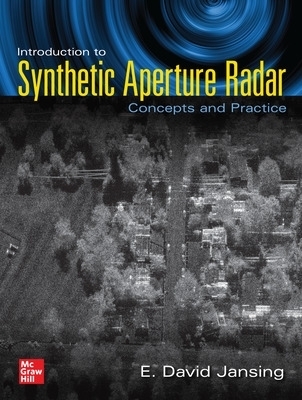
Introduction to Synthetic Aperture Radar: Concepts and Practice
Seiten
2021
McGraw-Hill Education (Verlag)
978-1-260-45896-1 (ISBN)
McGraw-Hill Education (Verlag)
978-1-260-45896-1 (ISBN)
Publisher's Note: Products purchased from Third Party sellers are not guaranteed by the publisher for quality, authenticity, or access to any online entitlements included with the product.
Explore the principles and applications of synthetic aperture radar
This comprehensive guide offers a solid grounding in synthetic aperture radar (SAR) fundamentals and techniques. Written by a remote sensing and signal processing expert, Introduction to Synthetic Aperture Radar: Concepts and Practice clearly explains data collection, image formation, error correction, and image quality. You will get concise descriptions of commonly used image formation algorithms, including the Range-Doppler Algorithm (RDA) and the Polar Formatting Algorithm (PFA). Continuous wave LFM systems, interferometry, polarimetry, and moving objects are discussed in detail.
Coverage includes:
Origins of synthetic aperture radar
Ranging and imaging
Image formation and image processing tools
Linear frequency-modulated chirp
Image formation algorithms for quadrature demodulated data
Image formation algorithms for dechirped data
Autofocus
Image quality and speckle reduction
Linear frequency-modulated continuous wave systems
Remote sensing
Interferometry
Moving objects in SAR
Explore the principles and applications of synthetic aperture radar
This comprehensive guide offers a solid grounding in synthetic aperture radar (SAR) fundamentals and techniques. Written by a remote sensing and signal processing expert, Introduction to Synthetic Aperture Radar: Concepts and Practice clearly explains data collection, image formation, error correction, and image quality. You will get concise descriptions of commonly used image formation algorithms, including the Range-Doppler Algorithm (RDA) and the Polar Formatting Algorithm (PFA). Continuous wave LFM systems, interferometry, polarimetry, and moving objects are discussed in detail.
Coverage includes:
Origins of synthetic aperture radar
Ranging and imaging
Image formation and image processing tools
Linear frequency-modulated chirp
Image formation algorithms for quadrature demodulated data
Image formation algorithms for dechirped data
Autofocus
Image quality and speckle reduction
Linear frequency-modulated continuous wave systems
Remote sensing
Interferometry
Moving objects in SAR
E. David Jansing Ph.D., is a Chief Engineer at Johns Hopkins University Applied Physics Laboratory, as well as a Lecturer at Johns Hopkins University Whiting School Engineering for Professionals Program. He has more than 20 years of experience in remote sensing, signal and image processing, data analysis, interpretation, modeling, and optimization.
| Erscheinungsdatum | 16.04.2021 |
|---|---|
| Zusatzinfo | 150 Illustrations |
| Verlagsort | OH |
| Sprache | englisch |
| Maße | 196 x 244 mm |
| Gewicht | 581 g |
| Themenwelt | Technik ► Elektrotechnik / Energietechnik |
| ISBN-10 | 1-260-45896-2 / 1260458962 |
| ISBN-13 | 978-1-260-45896-1 / 9781260458961 |
| Zustand | Neuware |
| Informationen gemäß Produktsicherheitsverordnung (GPSR) | |
| Haben Sie eine Frage zum Produkt? |
Mehr entdecken
aus dem Bereich



aus dem Bereich
Grundlagen, Systemtechnik und Analysen ausgeführter Beispiele …
Buch | Softcover (2025)
Springer Vieweg (Verlag)
CHF 55,95
Wegweiser für Elektrofachkräfte
Buch | Hardcover (2024)
VDE VERLAG
CHF 67,20


